
March 8 will arrive soon. Everyone, from the president of the country to panchayat functionaries in tiny villages, will perform her/his official duty of celebrating International Women’s Day. No one will remember that even though the United Nations had decided to celebrate this event from 1975, it was Vladimir Lenin who had declared March 8 to be celebrated as International Women’s Day in 1922 in honour of the women’s struggle during the Russian revolution. The role played by the communist party of the United States of America in wining voting rights for women in that country has become hazy in public memory as well.
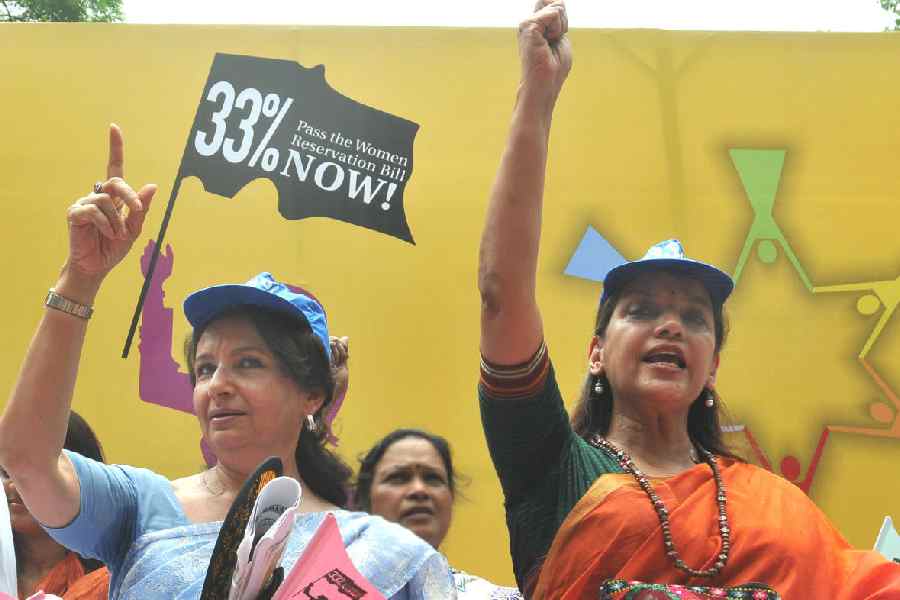
I have two deeply personal connections with this day. One, the UN’s declaration of International Women’s Day in 1975 happened to be the day of my wedding. Two, my illustrious friend, Mahasweta Devi, often spoke of the 1920s’ women’s rights struggle as a source of her strength. Though I had read her works before, I first met her in 1997, soon after the Women’s Reservation Bill based on the joint parliamentary committee chaired by Geeta Mukherjee was introduced as a constitutional amendment bill. It lapsed as the Lok Sabha was dissolved soon. When it was reintroduced, Mahasweta Devi, given her astute political instinct, said to me, “Ganesh, I do not think these politicians will make it happen even after I am a hundred years old.” Reintroduced in 1996, 1998, 1999, and 2008, the Lok Sabha did not pass it even in 2010, although the Rajya Sabha did. The bill was asking for just one-third reservation for women representatives in a country where nearly 48.5% of the population is women.
The Women’s Reservation Bill was finally passed in 2023. But not everything with it was straight. The reservation did not come into effect immediately with the 106th Constitutional Amendment in 2023. Had it been the case, the Lok Sabha would have seen about 180 women MPs. Likewise, there would be many more women legislators in state assemblies. The passage of the bill came with a rider: it was to come into effect only after a fresh census. Not that the country did not know the ratio of the women’s population to the total population even in 2023. The unstated reason was that none of the male MPs — irrespective of their party affiliation — was willing to give up on their long-cultivated constituencies. And all of them knew that it had been decided in 2002 that a fresh delimitation process to increase the number of MPs would begin after the first census after 2026. Thus, in 2023, the National Democratic Alliance government, which wanted to claim the credit for being ‘women friendly’, was aware that the benefit of women’s reservation could be delayed beyond the Lok Sabha elections of 2024.
Indeed, the NDA government and the Rashtriya Swayamsevak Sangh cannot be easily described as ‘pro-women’ in their ideological stance. The idea of ‘nation’ proposed by the founders of the RSS and its associate, the Hindu Mahasabha, actively advocated the revival of patriarchy, often looking at women as child-bearing machines. For them, colonial modernity as well as the medieval era are blots on Indian history while ancient society is a model worthy of emulation. That sums up the regime’s attitude towards women, their dignity, social equality and rights.
Initially, the census was to have taken place in 2021. It did not due to the Covid pandemic. But after the epidemic subsided, while nearly 150 countries around the world completed their census, India did not. A Kumbha Mela with participation of countless devotees and many election rallies with tens and thousands of participants could take place, but not the census. Had the census taken place, the delimitation process towards offering reserved constituencies to women would have become mandatory, if not for the 2024 Lok Sabha elections then at least for the assembly elections in the following years. That could have possibly triggered resentment among male electoral representatives and caused disaffection towards the party in power.
The date of the census process has now been declared. With the reference date of March 1, 2027, its population data are scheduled to be published by late 2027. The delimitation process, too, will follow suit. Politicians, irrespective of party affiliation, have their eyes set on the delimitation process. The question in their mind is this: how many more seats would be added to the Lok Sabha and to the state assemblies?
It is not so difficult to make an estimate. In the present Lok Sabha, approximately 15% of MPs are women, 85% being men. If the interests of all of the male MPs are to be protected, increasing the present strength to 128% of its present strength will offer an 85-to-40 male-female ratio in terms of seats. In other words, if the present House of 543 has an addition of another 140-145 seats, the regime will be able to protect the interests of all male MPs and also claim credit for the ‘historic empowerment’ of women. Theoretically, a Lok Sabha of 700 MPs does not sound difficult to form on the basis of this back-of-the- envelope estimation. But there are serious risks hidden under the surface.
While the number of MPs in the Lok Sabha and, likewise, the number of MLAs in state assemblies will and must increase, the geographical area of the country and of the states remains the same, requiring the redrawing of boundaries of every constituency. Census data, on the basis of which delimitation is to be carried out, will show district and sub-division populations along with their religious, ethnic, linguistic and socio-economic identities. The two key members of the Delimitation Commission will be the chief election commissioner of India and a retired Supreme Court judge. If the Delimitation Commission does not have sufficient objectivity, it can succumb to pressures of an ideologically-driven party. Such pressure can then result in a massive, macro-level data-doctoring of the census as well as further marginalisation of minority populations while carving out constituencies for women. It is hoped that these possibilities will not take place.
In India’s past, women have suffered the oppressions of gender and varna. The Constitution opened up, for the first time in the subcontinent’s long history, the possibility of bringing about equality. Women’s reservation in Parliament and assemblies is a substantial step forward in the direction of equality. Yet, if women across party lines do not get together and compel the SIR-Census-Delimitation spectrum unfolding before us to be transparent, accurate and objective, it will be a great opportunity lost. At the same time, civil society, intellectuals, the academic community and the media have to firmly stand by India’s women. If such determination is not displayed, out of fear or apprehension of intimidation, India will suffer an irreparable loss.
This March 8, I pray and hope f or a New India in which women will find their rightful, dignified place at last.
G.N. Devy is the author of Citizen Under Siege and a Cultural Activist