|
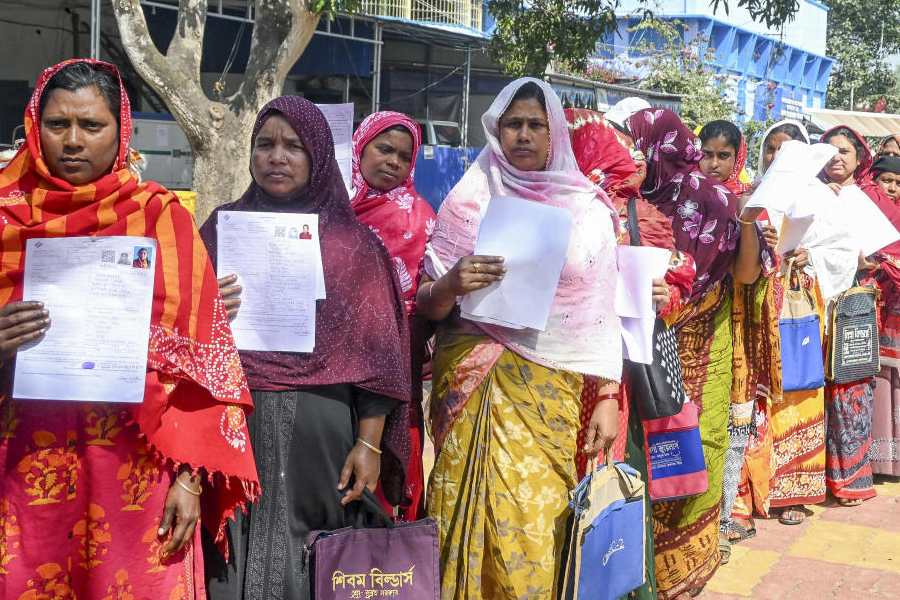
| File picture of women voters outside a polling booth in Berhampur |
Female voters have cast their votes in more numbers than their male counterparts — for the first time in the history of the general and assembly elections in Odisha.
According to the reports of the chief electoral officer, Odisha, the male voting percentage is 72.53, while there have been 74.63 per cent female electors. Besides, 56 of 1,185 other registered electors exercised their franchise. The over all voting percentage recorded in Odisha is 73.78 per cent.
Of around 1.51 lakh registered male voters in the state, a little over 1.09 lakh cast their votes. There were around 1.39 lakh female electors, of them a little more than 1.04 lakh exercised their franchise.
“Efforts by the Election Commission and the chief electoral officer, Odisha, to encourage more voter participation yielded good results. This is good that women have taken part in a large number, and we will try to increase the voter turnout in the future,” said nodal officer for election Naba Nayak.
Past election records showed that female electors had never outnumbered their male counterparts in any of the Lok Sabha or Assembly elections in the state till 2014. In 2009, the gap between the male and female voting percentage came very close to 1 per cent. Of 65.30 per cent voting in 2009 election, 65.70 per cent was male turnout, while 64.90 was female polling percentage.
In 1995, there was also a better women participation with the gap between male and female poll percentage being around 1.5 per cent. Besides this, in almost all the Assembly and general elections, the female voter turnout was less by more than 5 per cent than the male participation.
An official said that of the 147 Assembly constituencies where election was held this year in two phases, 36 segments had witnesses this new trend of women outnumbering men.
Many tribal-dominated areas saw female electors taking lead in casting votes. In southern districts such as Koraput, Gajapati and Rayagada women were ahead of men. In Mayurbhanja and Nabarangpur, two tribal-dominated districts, where the overall voter turnout was the highest in the state, saw female participation better than their male counterparts.
Bhubaneswar that witnessed the lowest voter turnout in the state saw better female polling percentage. In its three Assembly constituencies, females have outnumbered males in central and north, while in Ekamra, women lagged behind by a mere 0.3 per cent.
But in almost all the coastal districts, the males had better outing when the election was held in the second phase on April 17.
An election expert said that while rural and mostly tribal areas usually witnessed high women participation as the candidates played huge role in it, Bhubaneswar, however, was a revelation this time.
“Massive campaigning encouraged women in Bhubaneswar,” said Sutapa Rout, a woman voter in the city.