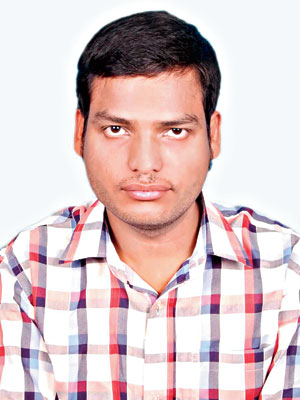
Overcoming obstacles have made them stand out in the crowd. Counted among achievers, they have fought adversities ranging from physical disability to abject poverty. Anwesha Ambaly of The Telegraph profiles these bunch of youngsters who are idols unto themselves and have set examples for others to follow

Manoj Kumar Sahoo
Barely a couple of months back, Syed Tanveer Nasreen, professor of history at Bengal’s Burdwan University, had the opportunity to interview 29-year-old Manoj Kumar Sahoo. Speaking to The Telegraph, Nasreen said she would remember the meeting with the young lad all her life and for good reason.
Son of a locksmith, Manoj is a postgraduate in history from Utkal University and has recently been selected in the Odisha Staff Selection Board Examination.
“It was a very fascinating experience. The amount of struggle that he has been through is remarkable. He was fluent in English and more importantly displayed a sound knowledge of his subject,” said the professor.
Manoj grew up in Salia Sahi slum in Bhubaneswar and gave tuitions to children in the area to support his studies. Asked how history has enriched him, Manoj said it has taught him to withstand the humiliations he had to suffer in life.
“Apart from monetary problems, we have also faced a number of social setbacks. People used to look down upon us,” he said. But, Manoj and his younger brothers have set examples for others. While one of them is a software engineer, the other is a constable with the Central Industrial Security Force.
The three siblings have a common aim - to buy their parents a better home in Bhubaneswar. “They have struggled a lot all their life to educate us. We have been struggling for the last twenty years. Now, that we have started earning, we want to gift my mother a house,” said Manoj.
His ultimate dream is to get a PhD degree. “Now I am pursing a company secretary course. Once I finish it, I will start applying to universities in the state from next year for PhD enrolment,” Manoj said.

Madan Meher
A PhD research scholar from JNU, this native of Dhama in Sambalpur spent his childhood mending shoes along with his father. Later, he worked as a daily wage labourer to support his college education.
Immediately after he left Odisha to do his PhD, his father and two of his siblings died. He had no other option but to quit his study and return to his village to look after his mother. On the same day, he got to know that he qualified for the NET examination and got a junior research fellowship.
“I got a moral boost as well as a financial backing. My mother also supported me a lot so I decided to go ahead,” said the 32-year-old scholar.
After completing his master’s degree from Sambalpur University, he prepared hard for JNU.
For a village boy who had never dreamt of stepping out of the state, pursuing higher studies on an international topic was a big deal. “My topic of study was the partnership of Nato and European Union in Afghanistan and I have enjoyed the subject thoroughly,” he added.
People used to see his family as a “disgrace”, lamented Meher. “ I was mocked at by everyone for being the son of a cobbler. My brothers and I were always humiliated. But, I never lost hope,” said Meher.
He has presented papers at 14 national and international conferences and has also written two books. He joined Atabira College as a lecturer on October 5 last year.
“My first duty would be that once I get my first salary, I would hire two teachers to teach poor students who fail to pursue their studies due to financial constraints,” said Meher.

Manjulata Panda
She is a differently-abled girl from a village in Sambalpur and recently become the first visually-impaired woman from Utkal Univesity to complete her PhD in political science.
Panda is an inspiration for all those differently-abed people who continue to strive hard, even to complete their basic education. Her research was on the employment status of visually-impaired persons in public and private-sector organisations in Odisha. This is an original work of research that provides a practical set of recommendations to include disabled people in state and national level organisations.
Acute shortage of study materials and lack of availability of data were the few hurdles that she faced during her course of research.
“A number of government departments and organisations did not want to cooperate with me. Also, getting a research guide was very difficult as many felt dealing with a differently-abled girl would be worthless. The process of writing literature review was equally hectic as I had to travel to libraries in other states to gather information and file a number of RTI petitions,” said Panda.
“My father worked in a re-rolling mill that was shut down without any notice. He did not receive his salary for more than eight years and died of kidney failure in 2014. My mother is a homemaker and brother is also visually-impaired. So, running the family was a very tough challenge for all of us,” she said.
Asked about her future plans, Panda, who aspires to become a teacher, said: “I also want to work for the state’s visually-impaired community for whom getting a degree from a government college is often very difficult,” she said.

Muna Murmu
Almost 12 years ago, Muna Murmu was like any other village urchin while his family was struggling hard to make ends meet. Today, he is a national-level rugby player representing the Indian team in various international tournaments.
Murmu, who is now doing postgraduate in political science in KIIT University, was lucky enough to get a seat at
the tribal school, KISS, and was admitted in Class V.
“I used to study under a tree in my village. One day, my father met a KISS official who told him about the school in Bhubaneswar. That meeting came as the major turning point of my life,” said Murmu.
The 23-year-old rugby player said: “When I look back, I remember the times when I was really upset with my father for sending me away from the family. Gradually, I realised that was the best decision he took for me.”
His father depends on farming at Chudanga village in Khurda district. “We have been living in abject poverty. I have two sisters and it is very difficult to run the family,” he said.
He was a good athlete and while a rugby team was being selected KISS, his teachers forced him to take part.
“The selectors were looking for young guys who could run fast. I just gave a try and my life has changed since then. Now, rugby has become my lifeline,” said Murmu.
He wants to continue his career as a rugby player, but laments that the players here are not paid any match fees unlike in other sports. “We are given allowances. The National Rugby Board is planning a league and if that starts, it will help the players,” said Murmu.
A member of the national rugby team in the U-20 Asian Rugby Championship held in Laos, Murmu had represented KISS and visited France in 2009.

Ratikanta Mohanty
A 32-year-old from Kendrapada, Ratikanta Mohanty wanted to do something for the people of his area after graduation. Taking a leap of faith, Mohanty quit his job in an electronic firm and started his project to provide employment to youngsters from rural hamlets of Odisha.
Overcoming a series of impediments, the entrepreneur started khadi manufacturing unit ‘Grameen’ on the outskirts of Bhubaneswar last year and has employed 10 young professionals.
What took his fancy in handloom products was when Narendra Modi urged people to buy at least one khadi item on Gandhi Jayanti.
“That was when I developed an interest in this. I did a lot of research and met several officials from the khadi board in Odisha.
I got a lot of encouragement from them and started the unit,” the entrepreneur said. His aim was to promote original khadi products and make them available at a reasonable price.
“Youngsters these days still love to wear khadi handloom products. I did a lot of survey but the lack of innovative designs and affordable apparels have limited the khadi market in the state. Many also sell cotton products in the name of khadi,” Mohanty said.
Mohanty said that getting the initial amount to start the business was an uphill task.
“A number of youngsters earlier had taken money from banks, but never utilised the sanctioned amount for the right purpose. So, I had to prepare a foolproof plan and project design after consulting a number of experts in the field,” he said.
He was finally given the amount under Pradhan Mantri Gramodaya Yojana (PMGY).
“Now, I procure fabric from various khadi boards and prepare designs keeping in keeping with recent trends. Production has started two months ago and it will be available in the market soon,” he said. With expansion of business, he plans to hire more young people.

Suchismita Das
A young girl living in a slum in Bhubaneswar, Suchismita Das dreamt of becoming a famous dancer. For her parents surviving on a very limited amount every month, sending their daughter to a dance school was a far cry.
But, the 25-year-old girl was one with strong determination and willpower. “Initially, I learnt dance steps by watching television. I copied the steps and practiced at home,” said Das.
Her father had a private job, but he quit it in 2001 to start a grocery shop. She started doing odd jobs with her mother to earn some money.
“We had to go through a lot of financial problems. We had to struggle hard to have a stable income for our family. I felt my dancing career would never see the light of the day,” she said.
A chance meeting with social activist Ratnakar Mohanty, who is the co-ordinator of a school in her area, changed her life.
“I really liked her interest in dancing. I felt she had a lot of potential and the confidence to shine through with a a bit of support,” said Ratnakar.
With his support, Suchismita enrolled herself in a dance school. While her interest was in contemporary dance forms, she also took training in Odissi.
Ratnakar, whom the young dancer considers her mentor, gave him a chance to choreograph a few songs during the annual ceremony of his school.
“My efforts were praised by all. That gave me the zeal to start an initiative of my own and I started giving dance lessons to underprivileged children in her area,” said Suchismita, who is popularly known as Soni in her locality.
Her idea has taken the shape of a dance school - Little Star Dance Group - with 15 regular students. “Initially, people were reluctant to send them here. They also did not pay me anything for the dance lessons I imparted. Seeing the improvement in their children, more and more parents started sending their kids,” said Soni, a graduate from a college in Nakhara, Cuttack.
Apart from fulfilling her dreams of becoming a choreographer, she also wants to groom the kids of various slum in Bhubaneswar.