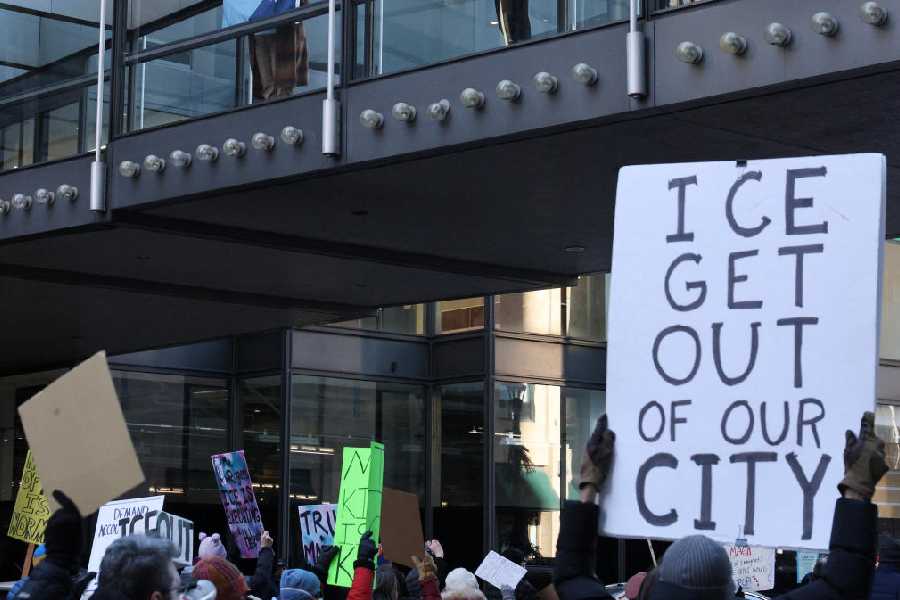
A Netherlands-based website that began as a cheeky online response to a warning from the US homeland security secretary has grown into a sprawling, volunteer-driven project identifying US immigration agents involved in enforcement crackdowns, drawing millions of views.
The site, known as ICE List, operates from Europe, The Guardian reported.
“What we’re doing is a reaction to a problematic regime,” said Dominick Skinner, the Netherlands-based Irish national behind the website ICE List, describing its aim of stripping anonymity from armed federal agents deployed across US cities.
The origins of ICE List trace back to June, when Kristi Noem, the US homeland security secretary, warned that Americans who identified ICE agents could face arrest. Skinner said the remark prompted an immediate response.
“I reposted that and said, ‘well, we’re not in the US, so send them to us,’” said Skinner, 31. “By the evening I had private investigators messaging me, and by the next week we had a framework of how to work.”
Since then, the project has expanded.
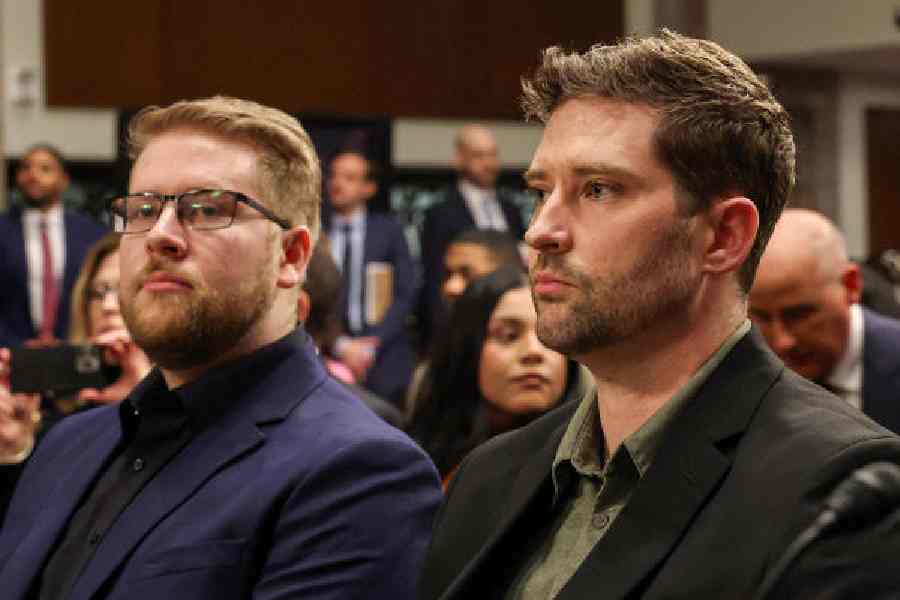
The website now functions as a crowdsourced wiki, supported by around 500 volunteers who sift through tips submitted by the public.
Skinner said that as tensions around ICE operations have intensified, another 300 people have expressed interest in joining the effort.
ICE List publishes the names, job titles and, in some cases, photographs of ICE agents and others involved in the Trump administration’s hardline immigration policies.
The listings exclude home addresses and phone numbers, Skinner said, a boundary he argues is central to the project’s legitimacy.
The initiative has pushed Skinner and his six-member team into the centre of a polarised debate over law enforcement anonymity.
In recent months, armed federal officers have increasingly worn masks and sunglasses during operations and have often lacked visible name tags. In some cases, it has been unclear which agency officers belonged to.
The issue reached Capitol Hill in late January, when Democratic leader Chuck Schumer said Democrats would block legislation funding the Department of Homeland Security (DHS) and several other agencies unless demands were met.
These included requiring ICE agents to remove masks, use body cameras and carry proper identification.
The DHS has defended the practice, saying masks are necessary to protect agents who, it claims, are facing a dramatic surge in violence, though it has not provided evidence to support that assertion.
Speaking to The Guardian, Skinner questioned those claims. “I always say that ICE aren’t actually fearful of their safety,” he said. “What they’re fearful of is not being invited to baseball games or not being invited to the pub with their friends. Community exclusion – that’s what they’re fearful of.”
According to Skinner, tips identifying agents come from a wide range of sources.
Some involve large-scale leaks containing thousands of names. Others are smaller, including neighbours reporting individuals, or hotel and bar staff passing along information seen on identification cards.
A small fraction of identifications have involved the use of artificial intelligence and facial recognition tools, he said.
Once received, the information is verified using publicly available sources. “Over 90 per cent of the people we have, we’ve identified through information they themselves have made public,” Skinner said, pointing to professional networking platforms such as LinkedIn. “All we do is amplify already publicly available information.”
To date, more than 1,500 individuals have been listed on the site. Five entries have been removed, either because of inaccuracies or because the individuals had left the agency.
Skinner rejected claims by Noem that identifying ICE agents is criminal, insisting the project serves the public interest. He said its goal was not to incite violence but to encourage social accountability.
With opinion polls showing that a majority of Americans disapprove of ICE’s handling of its mandate, Skinner said he was inspired by events in 1920s Chicago, where public identification of Ku Klux Klan members led to widespread social boycotts.
“There were no attacks on members of the KKK, it was a boycott of them in public life,” he said. “And then slowly the KKK disappeared from Chicago. That’s kind of what we’re trying to do here, to just allow the public to know which of their neighbours are involved in this.”