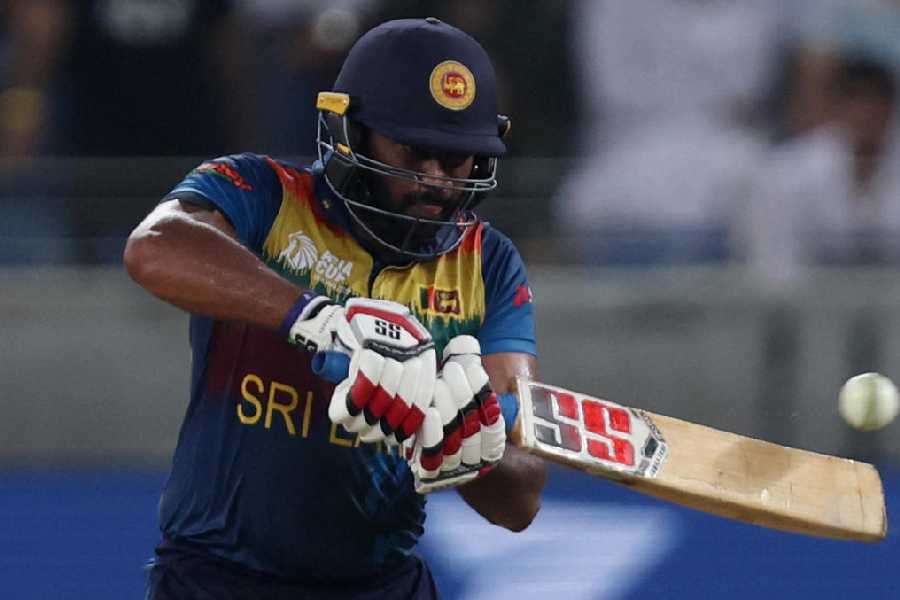
Sri Lanka batter Bhanuka Rajapaksa has alleged that Indian players use “special bats” that generate unusually high power and confer an unfair advantage.
The remarks were made after Sri Lanka’s 20-run win over Ireland in Colombo during the ICC Men’s T20 World Cup 2026.
Rajapaksa suggested that the power produced by some Indian batters cannot be explained by skill alone, hinting at equipment that goes beyond what is commercially available.
ICC rules are clear on paper.
Bats must be made only of wood and must comply with strict limits on size, thickness and materials. Any hidden or power-enhancing substance inside a bat would violate regulations and is subject to detection during routine inspections at international matches.
Officials regularly check bats to ensure they meet these standards.
“Indian players have bats that are far superior to the best bats we get. It feels as though a layer of rubber has been applied. I can’t imagine how that’s possible. These bats can’t even be bought by others — all players know this,” NewsWire quoted Bhanuka Rajapaksa as saying in an interview.
The cricketer claims that “Indian players are using bats that generate more power”, the publication added.
The assertion that “others can’t buy these bats” is partly accurate, though not necessarily in the way the allegation implies.
Professional cricketers often use “player edition” bats that are customised and not sold in retail stores. These bats are made to individual specifications, meaning an Abhishek Sharma bat, for instance, is designed exclusively for him.
Each bat is shaped, weighted and balanced to suit a player’s swing, strength and timing.
Top Indian batters have well-documented preferences. Virat Kohli and Rohit Sharma are known to favour a duckbill profile that improves pick-up and control.
According to CIEL Sports, Rohit’s bat has a ‘mid-to-low swell design’, while Kohli’s bat features a high, thick spine that “tapers off quickly into a flatter toe”.
Branding can further complicate perceptions.
Although logos such as SG, SS, MRF or CEAT appear on the blade, the sponsoring company may not manufacture the bat itself.
ICC rules allow registered sponsors to place their logos on bats they market, even if production is handled by specialist makers like SG, SS, BDM or BAS.
This explains why the exact models used by stars such as Kohli or Rohit Sharma are rarely available to ordinary buyers.
Once obtained, whether purchased or gifted, equipment such as bats, gloves, helmets and pads belongs to the player and doubles as personal advertising space.
India has faced similar accusations before.
During the ICC World Cup 2023, former Pakistan cricketer Hasan Raza alleged that India were receiving different balls that offered more swing and seam.
Wasim Akram dismissed the claim with humour, saying, “I want to have the same thing these guys are having, sounds like fun. You are not only embarrassing yourself but us too.”
Misbah-ul-Haq and Shoaib Malik also rejected the charge. “Instead of learning from them, we think negatively that something is fishy,” Shoaib Malik said.