
Ramakrishna Paramahansa, who seldom left Dakhshineshwar, and visited Kashi and Mathura just once in his lifetime, was reluctant to visit Puri that was much nearer to his place.
He believed that his mortal frame would not bear the overwhelming presence of Lord Jagannath, and like Chaitanya, he would never return from Puri.
Nevertheless, millions of Hindus have been visiting Jagannath in Puri for centuries, and visualise him through the metaphor of "blue mountain," or "blue whale of the eastern sea".
I had no memory of going to the Puri temple in my mother's arms as a childy. My first sight of a gigantic Jagannath was on the silver screen of Capital cinema in Cuttack in 1950, when Odia blockbuster "Shri Jagannath" was screened.

My father, then a fledgling playwright, had done the script. I still have his scrapbook with notes and dialogues. The filming was done for a large screen audience in epic style, with horses and stunt men. I still remember my father recounting several stories of the film's making. Famous Odia actor Samuel Sahu alias Babi had played Galmadhab, who was the king's emissary. It was required of the character to fall from a horse's back when the hooves stumble on the crown of shri mandir, which was virtually buried under the sands of time.
Babi volunteered to do the stunt on his own. Technicians from Calcutta had pulled it through. The railways had made special provisions for big wagons to bring the shooting equipment to locations.
As we grew up, I joined a summer camp in Puri as a senior school boy and stayed in Patherpuri hostel on the sea shore, which was once the abode of Rabindranath Tagore for his sojourn during his journey to Odisha for management of his zamindari spread over the Bengal Presidency.
It was a summer of great fun and frolic and our days were spent in the sea bathing, drinking lassi near Lakshmi cinema and visiting the temple almost every evening for its many layered spectacles of endless pilgrims.
It was the start of the rollicking sixties. Although the epiphany of change was in the air, like the music, the hippies were yet arrived in large numbers, nor was the Iscon. The stone temple was still staccato white, plain and not curved. It was buried under thick layers of lime. The peeling of the plasters had not started and the temple had not emerged with its intricate full-body stonework, as now, like a surreal giant beauty from its chrysalis.
Since then, Puri has always been my occasional get away, but once I return to Cuttack, crossing the distance of 50 odd miles and the Trinity of Jagannath remain hanging in our house in a docile frame, taken from the annual calendar of the Cuttack Students' Store.
When the behemoth rides a chariot every July on the grand road of Puri in the congregation of a million people, I had to remain content with the toy chariots drawn in our Sahi in Budhithakurani and listen to the radio broadcasters. It took years for K.P. Singhdeo, my good friend from the Ravenshaw College days, to become the minister for information and broadcasting and start direct telecast from Puri.
Earlier the visuals would find place in next day's newspapers. Along with reports of chariots, the snail's pace, commotion and delayed rituals. I would note all the disincentives like the scorching sun, the downpours and yet yearn for a real glimpse for myself on some well-ordered day.
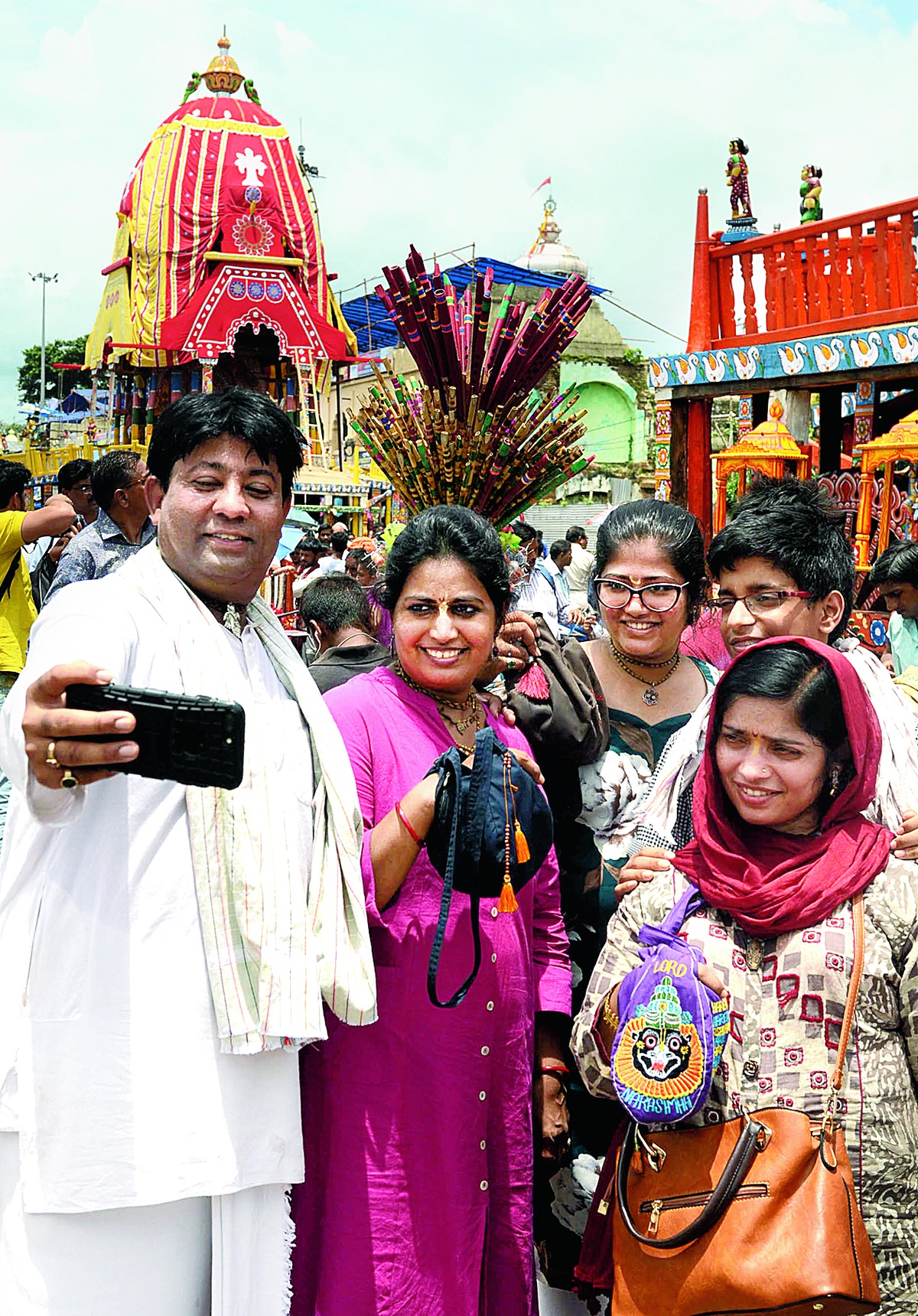
Visiting Puri on Rathayatra day has not been considered any less than a life-time odyssey for the common man since the Britishers coined the word juggernaut. The word stood for the killer chariot before which it was believed that the Hindu devotees willingly throw themselves to attain salvation.
So ratha yatra in our young minds was not disassociated with some secret tremor of apprehension of various ordeals, beginning from TB injections at health camps rassment for parking, and of course the inevitable fear of getting lost forever in the mammoth crowd.
On a bright July afternoon in Vani Vihar, the university campus in Bhubaneswar, where I was a postgraduate student in the late sixties, Dr Krishna Prasad Mishra, our reader in philosophy, offered me a ride on his scooter to Puri for rath yatra. Out of temptation, I hopped on to his scooter and both of us soon found ourselves on the edge of the Grand Road, packed with countless human heads without any interval. They were shining like miles of blackberries, dense and thick.
K.P. was a tall and handsome person with a straight spine, true in all senses of the term. He held a hand of mine firmly and asked me not to walk but swim in the cadence of human waves. Sometimes unique experiences are expressed only through cliches.
I really swam in the "human ocean" and was in the middle of the broad Grand Road without once touching my feet on the ground. The afternoon sun was still warm and high, and to the thrill of my life, I could see the three colourful chariots at considerable distance amidst endless human ants, just as if on the cover page of the National Geographic.
In Puri, the other god, and as mighty, is the sea, eternally throbbing with white foam. One cannot really separate both the gods. When KP took me to the seashore in the evening as the inseparable part of our homage to Puri, he told me an interesting story, which I still remember even after half a century.
Several years back, when K.P. was an eligible bachelor, he came to see a girl in Puri and all that was needed was his consent for the betrothal. A believer in cosmic signs, K.P. stood on the sands of the sea shore alone after coming out of the girl's place and beckoned the waves to touch him 21 times within a time he stipulated for himself. He was looking for the magic approval of providence. It happened, the waves washed his feet, and he went back to say yes to the girl the same evening.
K.P. had left the civil service to join the university. He was in Canada for his higher studies. As a short story writer, he had already carved a niche for himself in Odia literature. His maiden novel 'Singhakati' had fuelled the dreams of my adolescence. He is of course no more. In my memory he will persist ever as the god sent vanguard who took me to the first car festival of my life.
After a glance of the National Geographic that sweltering July afternoon, my thirst for Puri rath yatra was largely quenched, but the mystic distance remained. So I was greatly amused when while working in the home department in the 1980s, I was made a part of the coordination committee for the car festival for several years.
Once, on the day of Shri Gundicha, we were caught in a beastly traffic jam at the entry point and could not find a straight access to the Grand Road.
My police escort made me virtually run through a warren of mean streets and took me from the back to the right hand corner of the temple. From the noise of the drums and cymbals, we could know that the Pahandi has started. We jumped the police cordon and also scaled a half wall on the corner in great haste.
When I was on the top of the wall, the policeman pushed me, urging me to jump, and lo and behold, I fell almost on the chest of the Lord bedecked with flowers and fineries. The images were at the temple gate. The scandalised pandas quickly pushed me away as an intrusion. I straightened myself and the Pahandi passed by me in its enchanting swing.
In that split second, when I was face to face with Jagannath, and looked into his large round eyes, without anything in between us, I met my Maker. I stood aside while the idols climbed the stairs to the chariot. I was overwhelmed by the transcendent moment, and smell of camphor and sandalwood throughout the day.
While shooting the film Biswaprakash in Puri, the temple had steel scaffolding for removal of lime plaster. The young protagonist of the film, a Brahmin boy from Puri, would feel restless and choked looking at the scaffolded temple, as if the white pigeon of soul is mutely caged. The film in its own style has documented this image makeover.
The Puri temple, tall and towering, made of undifferentiated stone, looks lonely at night. In that shadowless loneliness, one feels an inchoate presence. The car festival on the other hand, with its teeming millions is the wide divine smile of Jagannath full of colour and gaiety, which is seldom extinguished.
The writer is former vice-chancellor of Ravenshaw University