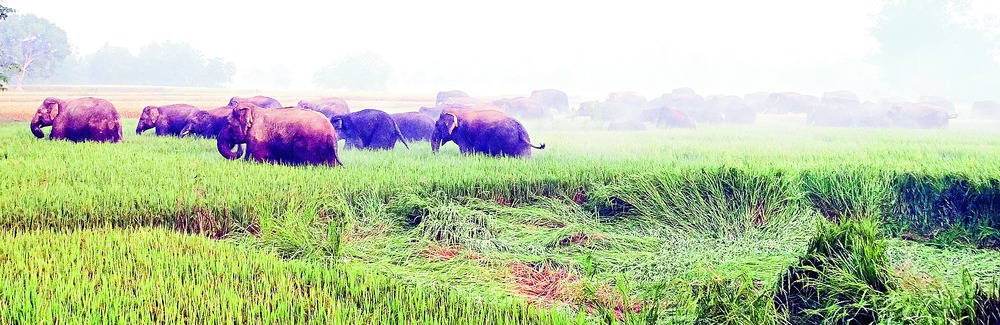

Baripada, Aug. 13: An expert team from Bangalore has undertaken a study in the Mayurbhanj elephant reserve area to check man-elephant conflicts.
The area includes the Kuldhia forest of Balasore and the Hathagarh forest of Keonjhar.
A Bangalore-based private body, Asian Nature Conservation Foundation, is conducting the study at the behest of the state government. The team, headed by R. Sukumar, is analysing various aspects related to elephants in other reserve forests, said a forest official.
Regional chief conservator of forests H.K. Bisht said: “Since the past two years the team has been working to assess the carrying capacity of the forest to ascertain the vegetation of the area.”
“The team is trying to find out if resident elephants are migrating due to change in habitat or habit,” he said.
Ajit Satpathy, the deputy director of the Similipal Tiger Reserve, said: “Experts suggest that if the habitat is not disturbed and the vegetation is maintained with respect to the population, elephants will not trespass on human settlements.”
“If any of these two aspects are affected, the animals will stray into the human settlements and will behave aggressively. If all these aspects are taken care of, man-elephant conflicts can be avoided,” he said.
Man-elephant conflicts are seen frequently in Mayurbhanj. The animals enter the state either through Badamphad or Suliapada. They cause damages to crops, houses and human life. In 2014, about 10 people died in the region due to jumbo attacks.
A member of the foundation said: “The main reason behind jumbo migration was depletion of their habitats, inadequate food, non-forest activities and industrialisation.”
He said resident elephants in Mayurbhanj had no dearth of food and water here, so they did not migrate.
About 150 elephants of the Jharkhand reserve forests have entered Mayurbhanj through Rairangpur and Karanjia in search of food.
“The Mayurbhanj elephant reserve is one of the best in India. The number of jumbos here is around 550, and there are possibilities of growth in their population,” said the foundation member.
He further said people irritated the animals when they searched for food and water. Jumbos attack humans only when they become angry. He said that they had already received reports of about 60 human causalities this year.