
You are in the film industry for more than five decades. You must have been observing the changes in the industry, the differences between your era and present times.
When I came to the Odia film industry, it was not a lucrative career. I had a flare for acting since my childhood days. After coming in contact with director of international repute Mrinal Sen, I felt I should be a part of this profession. However, after I completed my studies, I joined a private company. In 1975, I decided to get into the film industry. Despite opposition from my family, I resigned from the company job and started creating a space for myself in the film industry.
Are not you worried that ill-gotten money has entered the film industry? There are instances of people from real estate and sham deposit companies investing in the film industry to make quick money. People are now raising their voices against filmmakers and artists…
Ill-gotten money has come to all the industries. Film industry is no exception.
But does not the film industry have a responsibility of giving moral messages to the common man?
Like other industries, the film industry also has a responsibility. Bad money has affected the image of the film industry.
Do you think that it is wrong for the producers to invest money of sham deposit collection companies in films?
This money, instead of helping the cause of the film industry, has ruined it. Every industry, including film industry, has to be economic viable. When there is profit, the film can be a viable project. After ill-gotten money entered the industry, producers unnecessarily hiked the cost of production by offering huge money to actors — sometimes to the tune of Rs 20 lakhs per picture. This made the job of regular producers difficult. These people who had become producers with their ill-gotten money had no love for films. They had no regards for a writer, no respect for subject, no reverence for a good screenplay. Their films lack originality because they borrow films from other industries (languages) and often copy the entire contents. The originality of film-making, story ideas and smell of the soil — all are lost.
Should the producers and actors who have brought bad name to the industry be punished?
Who am I or you to decide who will be punished? The audience will take a call on this issue. The audience and the law will punish them.
What would you say about Rajya Sabha MP Anubhav Mohanty and others promoting the Oscar Group in a film produced by the company? In a way, they influenced the common man to deposit money in the sham company. Do you think that whatever dialogue that the director gives should be delivered by the actors?
I have not seen that film. But if what you are telling me is true, I think it should not be done. There are certain things that cannot be put in our mouth as it is going to the masses. In earlier times, film actors were called stars and superstars. Their behaviour and lifestyle were accepted and imitated by people. If a producer says go and kill a particular community, will you do it? Should we be party to giving bad messages? By doing this, we become guilty of setting a wrong example. We should not do it.
The actors always say that the script demands such scenes or dialogues…
Scripts never demand what is not acceptable to the society. If the story revolves around a particular company that helps the poor man, and if the story develops around that, delivering such a dialogue can be debated. I think that here the script did not demand this.
There is a growing demand that film stars be interrogated for taking undue favours from Ponzi firms…
I think the investigators will go by the terms of reference, by the law of land and not by public perception or public demand. If the crime branch has prima-facie evidence to show that the actors are involved in these nefarious activities of the producers which are detrimental to poor investors, they should be interrogated. If they are punished, I will not be unhappy.
How much money one requires to make a film nowadays?
After ill-gotten money entered the industry, the cost of the film production has crossed Rs 1 crore. This has made the job of a professional producer more difficult. Besides, one needs another Rs 30 lakh for promotion and publicity of the film. Now, TV channels are making films and they are making it economically viable. They can promote their film through their channels and also earn revenue through it. For a regular producer now, making a film is a tough challenge. They neither have a channel nor do they have enough money to give the movie good publicity.
We have heard about casting couch. Does it exist in Odia film industry?
Compared to film industries elsewhere, the phenomenon of casting couch in Odia film industry is negligible. Some girls are complaining. They might be correct. However, the complaints that come are much less compared to others.
Has technology affected acting skills?
Technology always enhances acting skills. In my era, cameras used to be five feet away from actors that made capturing expressions and emotions difficult. These days, cameras are so close to you. Technology makes a film sleek. It never takes away the talent of an actor.
Do you think that the Odia movie industry will bounce back?
Definitely, it will. The Hindi film industry had passed through a similar phase in the 90s. People were bored seeing same kind of films. After multiplexes came up, we have now a targeted audience. Their demands are something different. To cater to their demands, good number of qualitative films are coming up. These films have become instant hits and doing good business. Bengal, the mother of all film industries, also passed through the same phase. But the film Chokher Bali opened up the eyes of good producers. If you give the people a film with an original idea in a perfect atmosphere, it will certainly click.
You have worked with many leading actresses. Who among them you consider the best?
I have worked with almost all of them — Jharana Das, Gita, Maheswata and Aparajita. But most of my films were with Maheswata. I have seen her growing. I always liked being cast opposite her. We had a better understanding and our chemistry was much appreciated.
Over the years you have built a romantic image. Have you ever fallen in love?
Not really. It was not necessary. I fell in love with the film industry and with my future. I am very selfish in this respect. If you are talking of physical love, my wife has given a lot of love and inspiration, After this, I cannot think of anyone who can give me more than that.
You started your political career with the BJP. Later you switched over to the NCP and now you are with the BJD. It seems that you have no fixed ideology…
I love an anti-Congress platform. I had joined BJP in 1995 when it was nowhere in the state. I had thought that this particular platform would work. I had worked hard and we came to power. But some people in BJP played foul with me. Like Abhimanyu, I was trapped in their chakrabyuha. But I have survived their machinations.
But you had to resign on charges of corruption…
Give a dog a bad name and hang it. That is what they did with me. I hope I am free from all corruption charges.
Don’t you regret joining politics?
Never. I acquired lot of knowledge from politics. Earlier, I used to understand people through films. Active politics has given me the opportunity to know people from close quarters. It has given me the scope to learn about their aspirations, anger, joys and sorrows.
As you are in a political party, you must have some ambitions…
My ambition is to be considered an asset. I do not believe in power or privilege or money for that matter.
But the BJD has never considered you an asset. Had it considered you so, they would have given you a ticket to become an MLA…
Becoming an MLA is not everything in politics. They have made me the general secretary of the party.
But they have made a good number of people their general secretaries. Considering your position in the society, they should at least have considered you for the slot of an MLA…
They have made only 10 general secretaries. To be an MLA is not the ultimate achievement. I am in a position to become a kingmaker but not the king.
But why did the party deny you a ticket?
I have never asked them this question.
The party could have sent you to the Rajya Sabha as you are a stalwart from the film industry as well as a senior member of the party.
That’s another thing. Do you want to say that they should have sent me to the Rajya Sabha so that I could avail pension?
No. By going to the Rajya Sabha, you could have contributed to the cause of the state by raising many issues pertaining to the state…
I know what 250 members of the Upper House are doing for the cause of the country. All of you know about the contributions of Sachin Tendulkars and Hema Malinis. I leave it to you to analyse and let me know.
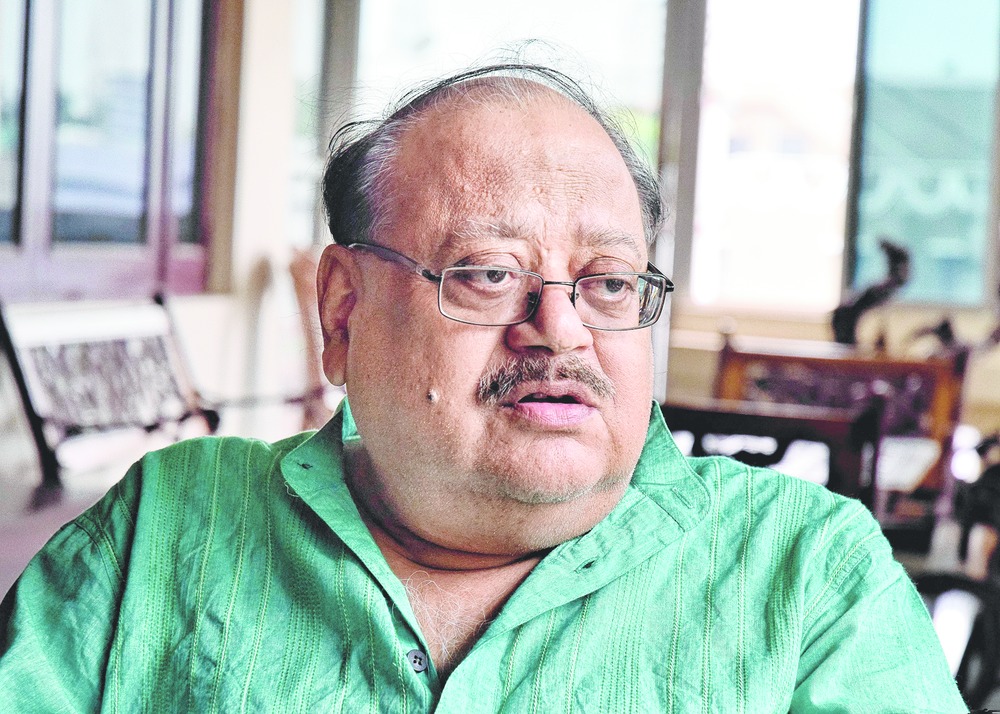
VERSATILE GENIUS
• Nanda, 70, ventured into the celluloid industry in the early 70s
• He acted and dominated the industry as the lead actor for close to two decades
• A multifaceted personality, Nanda is also a well-known director, screenwriter, lyricist and playback singer
• In 1995, he joined politics and in 2000 became an MLA from Begunia as a BJP candidate
• He became a minister in the Naveen Patnaik government in 2000
• Later, he joined Sharad Pawar’s Nationalist Congress Party (NCP) and was elected an MLA in 2009. He headed the NCP’s state unit for a brief period
• Rejoined the BJD following the its merger with the NCP’s state unit
WHAT WOULD YOU HAVE BEEN, HAD YOU NOT BEEN AN ACTOR?
After my master’s in political science, a degree in law and business management, I worked for two companies. I would have continued with that job