The move to ban social media access for children under 16 is gathering momentum in countries across the globe, including India where ministers in several states have said they are studying a law that recently came into effect in Australia.
Andhra Pradesh, Goa and other states are currently the most active, with ministerial panels reviewing how such a ban might work.
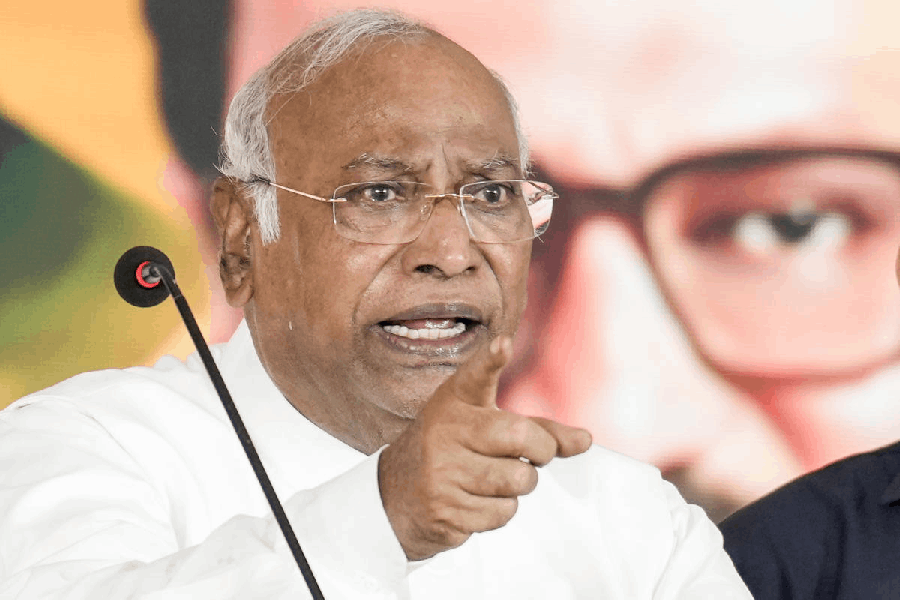
Goa information technology minister Rohan Khaunte on February 16 said his government was examining the possibility of restricting social media use for children below 16 years in the coastal state, citing rising concerns over digital addiction, cyberbullying and online safety risks.
The state plans to constitute a task force comprising representatives from academia, parent-teacher associations, industry and government to study the issue and recommend a policy framework, he added.
Referring to global precedents such as Australia's move to ban social media access for children under 16, Khaunte said the issue requires serious deliberation in India and must be approached in a structured and consultative manner.
"Our objective is not to rush into a decision but to examine how we can protect children below 16 from the risks of social media while promoting constructive and educational use of digital tools," Khaunte asserted.
The issue has also drawn judicial scrutiny, with the Madras High Court urging India’s federal government in December to consider Australia-style restrictions, highlighting how concerns about children’s online safety are driving regulatory debates well beyond legislatures.
Andhra Pradesh is also studying international models. The conversation is no longer rhetorical; it is administrative.
The state's IT minister Nara Lokesh last week said on X that children were "slipping into relentless usage" of social media, affecting their attention spans and education.
"We will ensure social media becomes a safer space and reduce its damaging impact, especially for women and children," he added.
Lavu Sri Krishna Devarayalu, MP from Andhra Pradesh’s ruling party, the TDP, has introduced a private member's bill targeting social media use by children under 16.
The IT minister of Maharashtra has ordered a task force be assembled to recommend methods for addressing the harms of social media to children.
In a related development, the Himachal Pradesh government will soon impose a complete ban on mobile devices used by students in all government and private schools across the state. The ban is expected to come into effect from March 1.
Earlier this year, the Economic Survey raised age-based restrictions on social media use as an issue for discussion.
"Policies on age-based access limits may be considered, as younger users are more vulnerable to compulsive use and harmful content," stated the survey, seen as a policy nudge.
This debate gained renewed urgency after three children in Ghaziabad reportedly died by suicide last week. Investigators are looking into whether an online Korean drama played any role.

India is the world's second-largest smartphone market after China, with around 660 million smartphone users and more than 950 million internet users.
The country has over 1.16 billion mobile connections, making it a major growth market for platforms like Instagram and YouTube. TikTok has been banned in India since 2020.
About one-fourth of India's population is in the 0–14 age group, meaning hundreds of millions of potential underage users.
Here’s how other countries are approaching the issue.
Australia
In December last year, Australia became the world's first country to ban social media for children under 16, blocking them from platforms including TikTok, YouTube, Instagram and Facebook.
Companies that fail to comply could face penalties of up to A$49.5 million ($34.9 million).
Britain
England is considering an Australia-style ban on social media and tighter AI chatbots safety rules for children under 16 as early as this year, technology minister Liz Kendall has said.
China
China's cyberspace regulator has put in place a so-called "minor mode" programme that requires device-level restrictions and app-specific rules to restrict screen time depending on age.
Denmark
Denmark said in November it would ban social media for children under 15, while parents could provide access to certain platforms to kids down to the age of 13.
France
France's National Assembly in January approved legislation to ban children under 15 from social media. The bill needs to pass through the Senate before a final vote in the lower House.
Germany
Minors aged 13 to 16 are allowed to use social media only if their parents provide consent. But child protection advocates say controls are insufficient.
Greece
Greece is "very close" to announcing a social media ban for children under 15, a senior government source told Reuters on February 3.
Italy
Children under the age of 14 need parental consent to sign up for social media accounts, while no consent is required above that age.
Malaysia
Malaysia said in November it would ban social media for users under the age of 16 starting from 2026.
Norway
The Norwegian government in October 2024 proposed raising the age at which children can consent to the terms required to use social media to 15 from 13, although parents would still be permitted to sign off on their behalf if they are under the age limit.
The government has also begun work on legislation to set an absolute minimum age limit of 15 for social media use.
Slovenia
Slovenia is drafting a law that would prohibit children under 15 from accessing social media, Deputy Prime Minister Matej Arcon said February 6.
Spain
Spain will ban access to social media for minors under 16 and platforms will be required to implement age verification systems, Prime Minister Pedro Sanchez said early in February.
It was unclear if the proposed ban would require approval by the country's highly fragmented lower House.
United States
The Children's Online Privacy Protection Act prevents companies in the US from collecting personal data from children under 13 without parental consent. Several states have passed laws requiring parental consent for minors to access social media, but they have faced court challenges on free-speech grounds.
EU
The European Parliament in November agreed on a resolution which is not legally binding calling for a minimum age of 16 on social media.
It urged a harmonised EU digital age limit of 13 for social media access and an age limit of 13 for video-sharing services and "AI companions".
What tech industry says
Social media platforms including TikTok, Facebook and Snapchat say people need to be at least 13 to sign up.
Child protection advocates say the controls are insufficient, and official data in several European countries shows huge numbers of children under 13 have social media accounts.