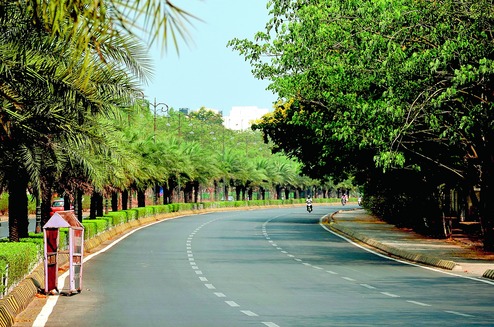

Bhubaneswar, April 26: The state capital is on the fast track to urbanisation and the pace has picked up ever since it was selected for the Centre's Smart City Mission. However, the authorities are cautious that steps towards urbanisation do not end up disturbing the ecological balance.
The awareness has increased as the push has led to an increased impact on the environment with the city's ecological footprint bearing the brunt more than before.
Ecological footprint measures the ecological assets that a given population requires to produce natural resources it consumes (including plant-based food and fibre products, livestock and fish products, timber and other forest products, space for urban infrastructure) and to absorb its waste, especially carbon emissions.
In keeping with the demand of reducing ecological footprint and to ensure sustainable development, the Bhubaneswar Municipal Corporation and other allied agencies have decided to implement a renewable energy programme under the Smart City Mission.
The programme will be taken up on a pilot basis along the Bhubaneswar Town Centre District on Janpath and will later be expanded to other parts. The administration has decided to set up a 10-megawatt solar power plant at Saheed Nagar for it.
"We have decided to generate at least 10 per cent energy needs from solar. There will be a solar power plant in the proposed lake-neutral smart city project from where we will simultaneously generate and supply power," said mayor Ananta Narayan Jena.
The Odisha Renewable Energy Development Authority (Oreda) will help the civic body augment the plan. The administration also plans to power street lights with solar. Besides, it has plans for solar rooftops, waste and water recycling, sewage treatment and integrated water management.
Jena said the civic body, alongside Oreda officials, would conduct camps to sensitise people about installing solar photovoltaic cells in their households. "We need citizen participation for successful implementation of the programme. Our focus will be on commercial buildings, apartments and other such structures," Jena said.
Besides, the administration will also use renewable energy measures for water supply with photovoltaic power plants powering the pumping stations. "We have conducted a survey to save energy during water supply. An agency is doing the job. Once it submits the findings, we will begin implementation," said an urban development official.
For street lights, the administration has decided to consider three approaches. These include standalone solar street lights, small solar photovoltaic cell to provide power to a group of street lights or large solar power plants with net metering facility to meet the entire power requirement of street lights.
"We have decided on the initial stage for implementing the renewable energy programme in the city. We will conduct a feasibility survey and come up with a detail project report. We may hire an expert agency to execute the project," said an Oreda official.
Environmentalists have welcomed the move and urged for its fast implementation.
"It is time for any city that is undergoing such rapid urbanisation to take up sustainable measures of development. Nature should be conserved. This could help put up a fight against global warming," said environmentalist Alok Mohanty.