|
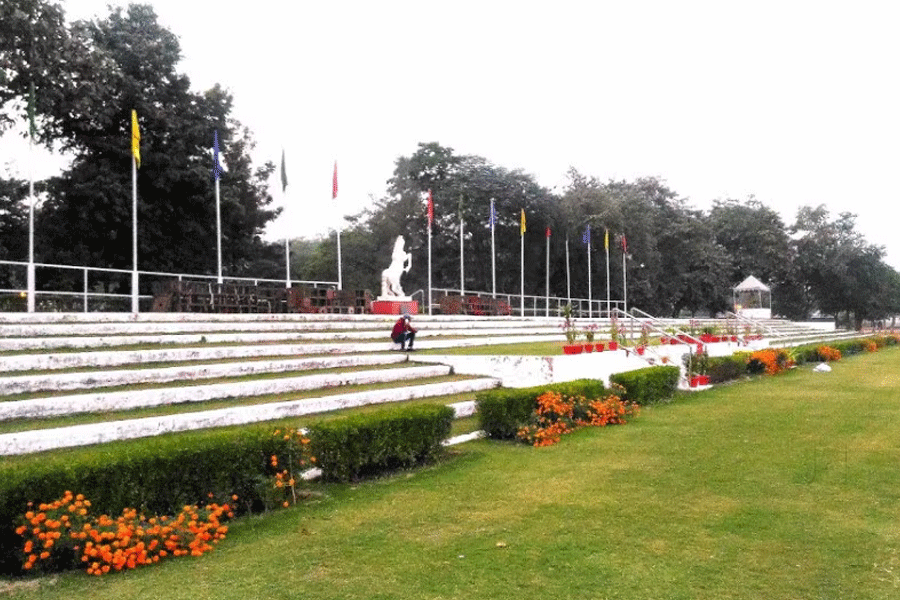
| The cemetery and (right) the False Point lighthouse in Paradip. Telegraph picture |
Paradip, March 8: The False Point lighthouse, that bears the signature of the British Raj, is poised for a makeover. The directorate of lighthouses and lightships has drawn up a blueprint to give the heritage site a facelift by developing it into an eco-tourism project.
“The tourist spot would have a guesthouse, an amusement park, besides regenerated cover of mangroves. Besides, the 200-year-old cemetery, where Britons who worked for the East India Company lie buried, would also be renovated,” said Jayanta Chatterji, who is in-charge of the lighthouse.
Ships of the East India Company approaching Calcutta Port used to mistake the mouth of Mahanadi for Hooghly river. Therefore, the point near the mouth of Mahanadi came to be known as False Point. The False Point lighthouse had come up in 1838 to guide the distracted British vessels and ships, said Chatterji, the lighthouse in-charge.
A high-level committee from the directorate of lighthouses and lightships had made an on-the-spot assessment of the False Point, which houses one of the country’s oldest lighthouses. The scenic spot, located along the Bay of Bengal coast, was found as a viable place for eco-tourism project.
A central team from the Union tourism ministry recently inspected the spot and gave its nod to the proposal for eco-tourism project, said lighthouse officials.
Special emphasis will be given to renovate the British cemetery that is wallowing in neglect. The purpose of the project is to attract tourists from Great Britain and other European countries.
 |
“There was a massive residential complex near the lighthouse which housed British navigators and crews. The Englishmen who died there used to be buried at the nearby cemetery. The tomb of captain H.A. Harris, who was drowned on May 9, 1877, is one of the most illustrious tombs in the cemetery.
The scenic beauty of the lighthouse and the cemetery along the coast of the Bay of Bengal and the numerous ships that used to anchor here prominently figured in the autobiographical Memoirs of a Bengal Civilian, authored by John Beames, the then Cuttack collector,” said Bijoy Kumar Rath, former administrator of the state archaeology department.