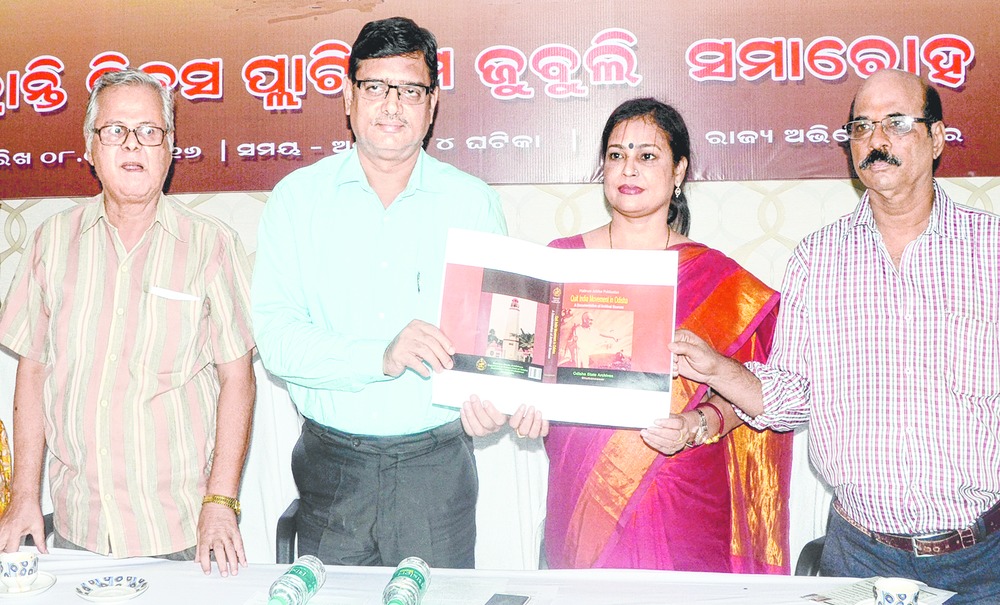

Bhubaneswar, Aug. 8: The state culture department will release a new book to commemorate the role of Odias in the civil disobedience movement tomorrow on the 75th anniversary of the Bharat Chhodo Andolan (Quit India Movement).
In Quit India Movement in Odisha: A Documentation of Archival Sources, which will be released at the Odisha State Archives, the department has captured the role of Odisha during the freedom struggle.
"People of Odisha played an active role in the success of the Quit India Movement. Around 70 Odias died in police firing during the fight against the British. The state had witnessed mass public uprisings across districts, including tribal-dominated Koraput and Bhadrak," said superintendent in charge of the archives Bhagyalipi Malla.
The book is a compilation of 55 archival records pertaining to the movement, including police reports submitted to the British government, inquiry accounts of the revenue commissioner into the Eram fighting, list of persons dead and injured in the rioting at Papadahandi and the inquiry report on allegations of lawlessness and disorder at Chandbali in 1942 among others.
The department has also organised a state-level seminar at the archives, where historians will talk about the nature and activities of the movement and its leaders in various districts of the state.
The archives will also organise an exhibition of photographs of the records, popular leaders who took part in the movement and martyrs' tombs that were erected during the period across the state. Old photographs of the Quit India Movement have also been recreated on canvas for the exhibition.
"We have also compiled the songs written during the movement into an audio CD for future reference," said Malla.
Mahatma Gandhi's charkhas and other items that are now kept at the Swaraj Ashram in Cuttack will also be exhibited.
Culture secretary Manoranjan Panigrahi said: "The book provides an insight into various aspects of the Quit India Movement in Odisha, including events that led to massive police firings in Koraput, Nabarangpur and at Eram. This will be helpful for future generations and for research scholars."
According to archival records, it was at Mathili police station in Koraput district that tribal villagers under the leadership of Laxman Naik, a member of the Bhoomia tribe, tried to take over the British rule. "They were mercilessly beaten up, and during the scuffle, a forest guard was killed in police firing. The movement had a huge impact on the psyche of people in Odisha," said Panigrahi.
Among the noted clashes that have been included in the book, the one at Eram, which has become popular as Rakta Tirtha, takes place of pride. British police opened fire on a huge gathering of freedom fighters, killing 29, including Pari Bewa regarded as the state's only woman martyr.
The archives is focusing on digitising rare records of various landmark events related to the state's recent history at present.
It recently released books on Nabakalebar and the Odisha famine of 1866. The books have also been digitised and put up on its website. The National Informatics Centre has been entrusted with the job of restoring the website.