
Bhubaneswar, April 1: The scenic beauty of remote villages in Ganjam came alive in the artwork of Nilansubala Sasmal and Veejayant Dash that was displayed at the Lalit Kala Akademi here.
The artists put forth their visual observations of the social life of the villagers in Ganjam through various media at the exhibition named "What we carried back," which concluded yesterday.
From patriarchal force restricting women within the house to wastage of excess crop due to lack of awareness about market demand, the exhibition touched upon various relevant themes. "We had been in Ganjam for a community art project since early 2012. The project ended last year. We noticed the dominance of rituals and customs there. We also observed that the political processes fail most villagers in that district," said Dash.
Symbolism, rural elements, bright colours and intriguing concepts mesmerised the visitors.
Sasmal said the artworks were what the artists had carried back to the city from Ganjam. "The works are a collaboration of objects, concepts, images and ideas from the villages. All of these have been used to create a set of narratives," said Sasmal.
Both the artists were shocked to see that women in these villages were forced to stay indoors. In one of their works, they painted a boundary inside which images of women were presented to depict their lifestyle. Ropes were used on the canvas to express their plight.
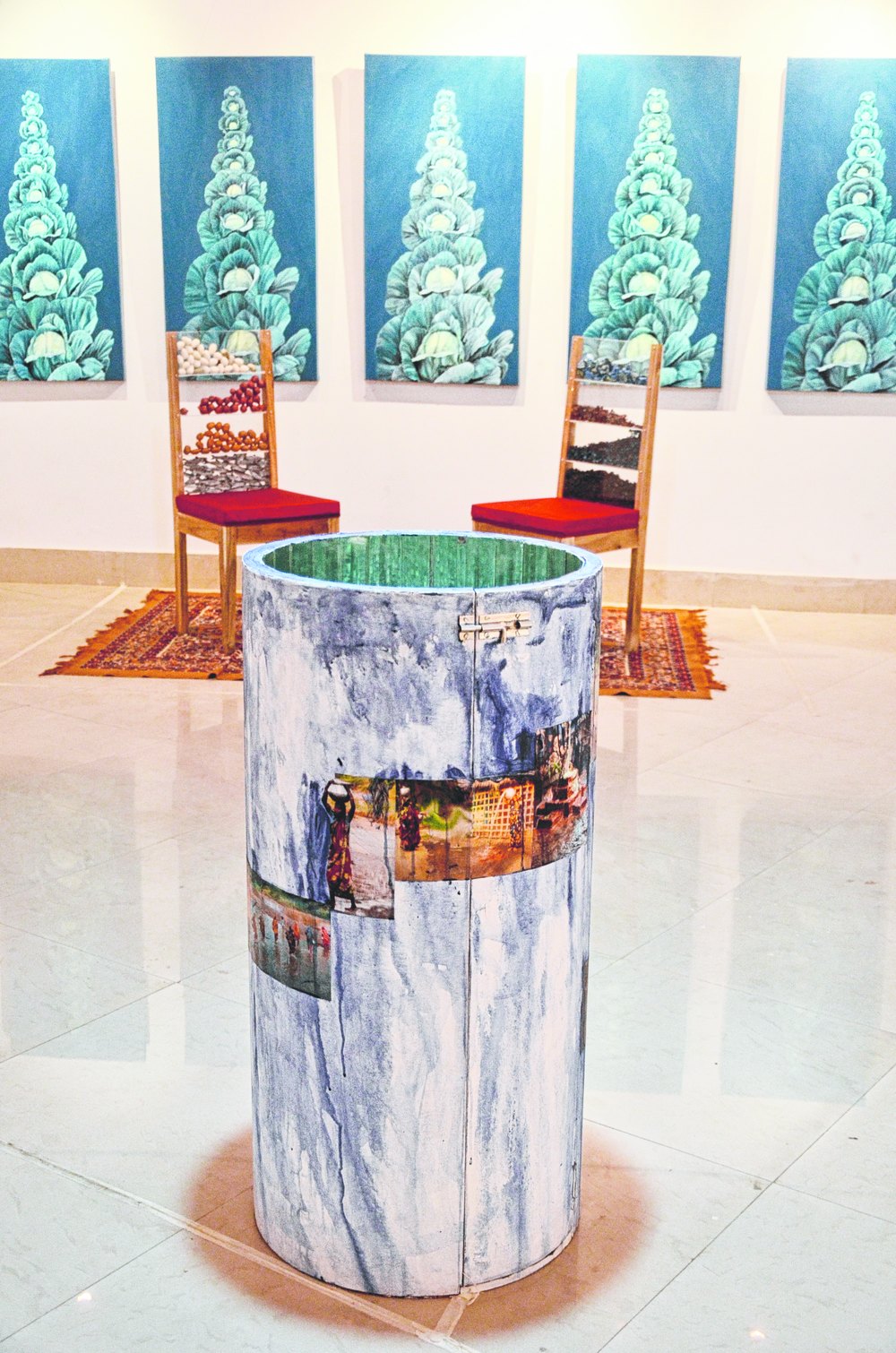
In another work, a number of paintings of cabbages were installed in a series.
The artists had found that cabbages were produced in high quantity in the villages and the produce would be wasted.
In front of these installations, two chairs were placed with different vegetables placed in layers. This reflected the irony of the vegetable production scenario.
A series of pots filled with grass were also displayed. Each of the pots had pictures of women inside the surface to show the relation between women and the Earth. The duo also used audio-visual media to express their concept.
"The works are very interesting. The artists have used creative ways to convey strong social messages," said Parthasarathi Sahoo, an art enthusiast.