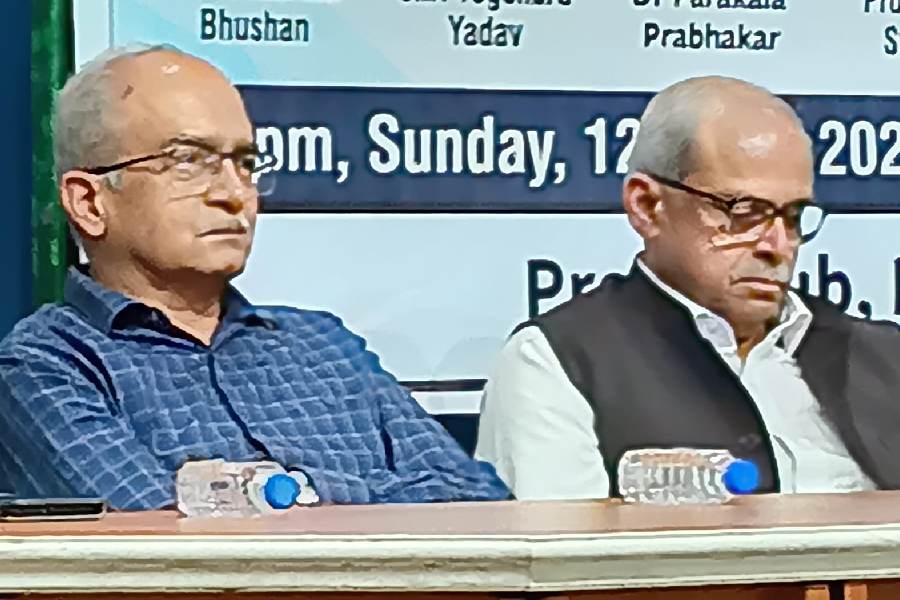
The process of erasure of a section of the population that started with the deletion of names in the voters list may not stop at it, feel public interest lawyer Prashant Bhushan and social activist Yogendra Yadav.
“The BJP talks about a Hindu Rashtra, where non-Hindus will not have voting rights. They cannot change the Constitution. They tried through the National Register of Citizens. That exercise did not go their way. Now they have used the SIR to target Muslims. Once the voting right is snatched other rights will also be taken away,” said Bhushan addressing a press conference in Kolkata, which Yadav and economist Parakala Prabhakar also addressed.
Taking Bhushan’s argument forward Yadav said, “Tomorrow, they may say there are a large number of fake Aadhaar cards in Bengal. Those who were removed from the voters list will be the first to have their Aadhaar cards marked deleted.”
A day before the Supreme Court resumes its hearing on the petitions filed against the special intensive revision of electoral rolls that has deprived nearly 91 lakh voters from exercising their right to vote in Bengal, three of the strongest voices against the Narendra Modi government spoke about the dangers posed by the mass disenfranchisement of voters.
Prabhakar said the India of tomorrow would be divided into Indians with voting rights and those disenfranchised.
“Who wins or loses the elections is an immediate transactional implication. There is another possibility. India in the wake of SIR will create two classes of Indians – those with voting rights and those disenfranchised. The over-all impact of SIR in the long-term will be a direct assault on universal adult franchise,” said Prabhakar.
The UAF guarantees every citizen above the age of 18 irrespective of their social status, wealth, gender, race, religion or caste, the right to vote and forms the basis of India’s electoral democracy.
Yadav said the adjudication process, which left out over 2.7 million voters from the electoral rolls was a move targeting one particular community: Muslims.
“The draft rolls did not see targeted deletions. But the deletion of these 27 lakh voters after the adjudication process was targeted. In Bhabanipur, Muslims constitute about 22 percent of the population and 52 per cent of the community were in the adjudication list. If this is not targeted deletion, then what is?” asked Yadav.
Yadav cited the examples of four voters from the Ballygunge constituency – two Muslim women and two Muslim men – whose names were deleted after the adjudication process.
“Both the women were told the age difference between them and their grandfather was less than 40 years. One of them even produced her birth certificate but got rejected. If not a birth certificate what else can one attach as evidence?” Yadav questioned.
Negating the Election Commission and the BJP’s claims on “infiltrators” in Bengal’s voters rolls, Yadav produced data from the poll panel to poke holes in their argument.
“The adult population of Bengal on the day the chief election commissioner announced the special intensive revision of the electoral rolls was 7.67 crore. The number of voters in the previous electoral rolls in Bengal was 7.66 crore. Ideally the number of voters should be equal to the adult population of a state. Bengal’s electoral rolls had 99.67 per cent of the adult population. I have not seen such a close match in any other state. Bengal’s voters list was the ideal,” said Yadav.
Yadav said that in other states where SIR has concluded, the number of voters has increased from the draft rolls stage to the final rolls; Bengal is the only exception.
“In Uttar Pradesh, the draft roll had 12.56 crore voters and the final rolls has 13.5 crore voters. Gujarat, Madhya Pradesh, Rajasthan, Kerala and Tamil Nadu have all seen a rise in the number of voters. Something unusual has happened in Bengal,” he said, adding that the reason behind the unusual happenings is the BJP’s desperation to win Bengal.
Yadav claimed 41 per cent of the applications for new voters made between July and August 2025 were rejected, and the percentage of unmapped voters in Bengal (4.5 per cent) was higher than those in BJP-ruled states like Chhattisgarh (3.6 per cent), Rajasthan and Madhya Pradesh (1.6 per cent each).
Yadav said the percentage of voters deleted in the draft rolls in Bengal (around 7.7 per cent) was higher than the corresponding figures in Rajasthan (7.6 per cent) and Madhya Pradesh (7.3 per cent).
He said the judicial officers appointed by the direction of the apex court had to decide on 25 cases per hour.
“Whether 25 Indian citizens can remain voters or not was decided in less than an hour,” he said.
All the three expressed their disappointment with the Supreme Court which is hearing a bunch of petitions on the SIR issue.
“The Supreme Court is still allowing this exercise to continue which is illegal,” said Bhushan.
Yadav added: “The Supreme Court did not intervene when it should have. The SC’s job is to intervene in situations like this. Even at the risk of contempt of court, I will say the SC has failed to live up to the expectation of the people in this case.”
Prabhakar said Monday’s hearing is a golden opportunity before the judiciary to protect the cardinal principles of our Constitution.