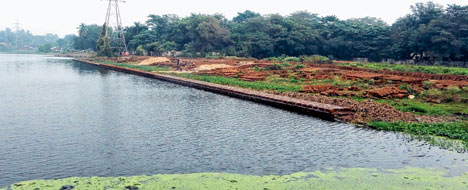


Cuttack: The Centre-funded Integrated Barabati Fort Development Project remains stuck in a limbo even after eight years of its inception. Even the restoration of the moat wall is far from complete.
The Centre had sanctioned Rs 17-crore under the Urban Infrastructure Development Scheme for Small and Medium Towns for the project aimed at developing the fort area into a major tourist attraction.
Chief minister Naveen Patnaik laid the foundation stone of the project on August 31, 2010, and was scheduled for completion by March 31, 2012.
The Archaeological Survey of India (ASI), which is the custodian of the fort, was assigned the job to renovate and restore the wall of the moat that surrounds the 104-acre fort.
The ASI started restoration of the moat wall in May 2015. A deadline of two years was set to complete the work. In the first phase, renovation and conservation was taken up in the moat on the western side of the fort area. But the work is still far from complete.
As part of the project, the Cuttack Municipal Corporation was to introduce boating facilities in the moat and also convert adjoining vacant land into mini-parks. The plan included installation of a water fountain.
Municipal commissioner Bikash Ranjan Mohapatra admitted that the progress of the work had been "slow".
"We have passed on Rs 1.5 crore of central fund to the ASI for restoration of the moat wall. We will soon hold a meeting with the ASI officials to expedite the work," Mohapatra said.
The superintending archaeologist of ASI's Bhubaneswar circle was not available for comments.
However, an ASI official on condition of anonymity said: "It's a huge project. Though a deadline of two years was set for completion of the first phase, progress has been slow because of several complexities involved".
"The restoration of the moat is being done only after excavating stone mixed soil and slush to expose the existing walls and dismantle the damaged portion" the ASI official said.
"This is turning out to be a difficult job with the moat full of water," he said.
The 2.5-km moat surrounding the fort was built during the Ganga dynasty in 12th century to protect it against attack from invaders.
The ASI had undertaken excavation and conservation work at the fort since 1989.
The restoration was taken up as the authorities were worried about the protection of the moat and structures linked to it.