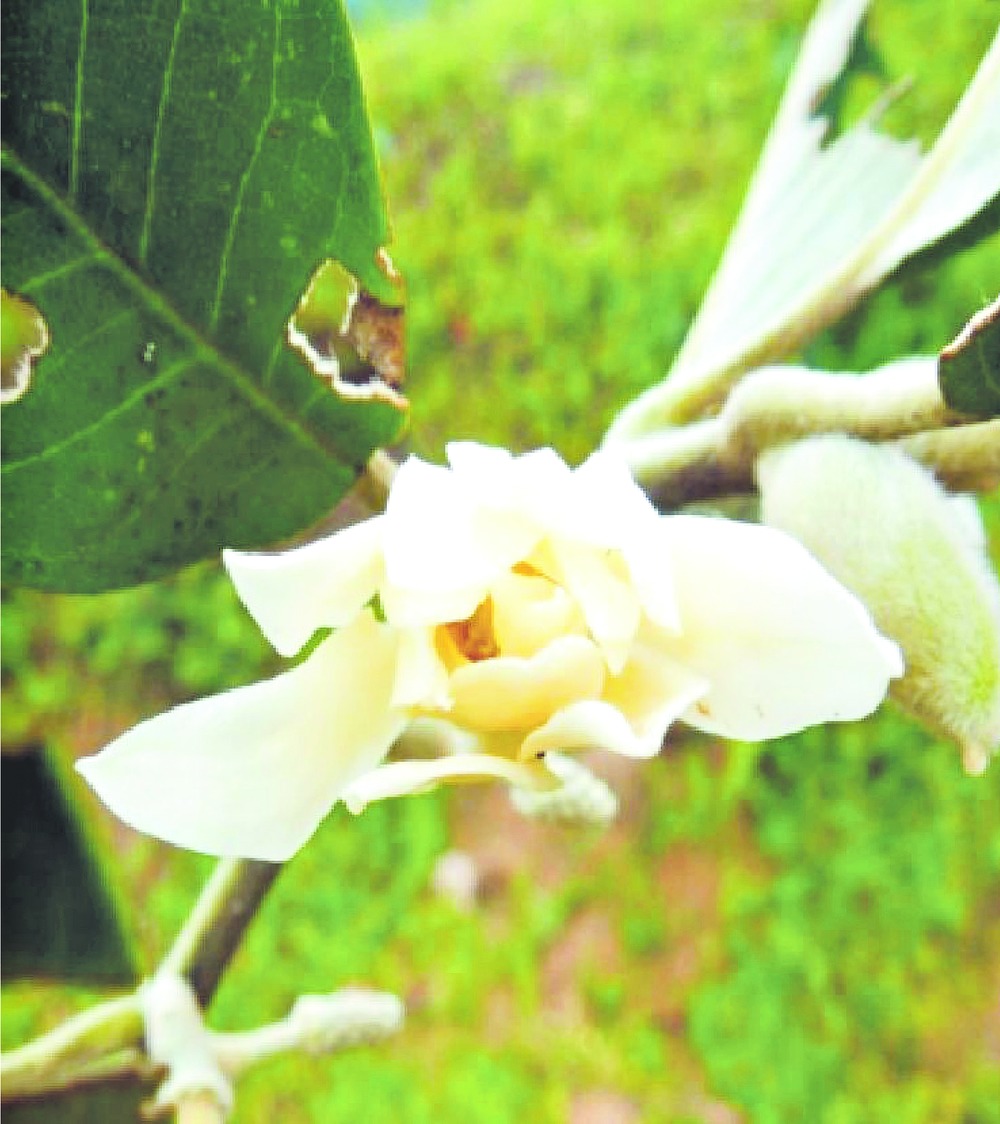

Guwahati, Jan. 27: Scientists at North Eastern Hill University, Shillong, have spotted a rare species of tree - Magnolia lanuginosa - in West Khasi Hills after nearly a century.
Magnolia lanuginosa is a medium-sized tree that grows in subtropical broadleaf forests. The tree, which is under the threat of extinction, is not very commonly found in Meghalaya. It is chiefly found along forest slopes at 1,500-2,400 metres above sea level in West Bengal, Sikkim, Arunachal Pradesh, Nagaland, Manipur, Nepal, Bhutan, Myanmar, Tibet and southwestern China.
The first and only sighting was in 1915 at Kynshi by U.N. Kanjilal and was reported in Flora of Assam, where it was stated to be a "less commonly found species, classified as "data deficient" by the International Union for Conservation of Nature's (IUCN) Red List of Threatened Species as there is neither any information on the existing subpopulations nor are the threats and uses known.
The spotting of the species has been reported in the latest issue of Journal of Threatened Taxa by eight Nehu scientists.
The species was found while carrying out floristic studies at Mawnai sacred grove, the least disturbed site in West Khasi Hills. The identity of the species was confirmed by comparing it with the specimens housed in the herbarium at the Botanical Survey of India.
Extensive field surveys were carried out at different parts of West Khasi Hills between January 2013 and 2015 to locate the species with the help of the information available at the herbarium and the local people. Apart from Mawnai sacred grove, the tree has been found in Mawnai village forest, Kynshi village forest and Rngisawlia village reserve forest. It was observed that the species also grows alongside pines.
Magnolia lanuginosa has an average height of 15 metres but there were some that had attained a height of 25 metres. Flowering buds are initiated in late July and it attains peak flowering in August. Fruiting starts from August and the fruit matures during September-October.
Apart from the sacred grove, the low seedling and sapling density of the species at all the sites could be because of its association with pine. Pine or pine-mixed forests are exposed to fire every year, leading to high mortality of the saplings.
"The study reveals that the population of the species is low and there is an urgent need for conservation to save it from extinction in the state. The forest patches where the species occurs need to be protected and the local people encouraged to grow the species in their home gardens, which will reduce the pressure on the species in the wild," the paper stated.