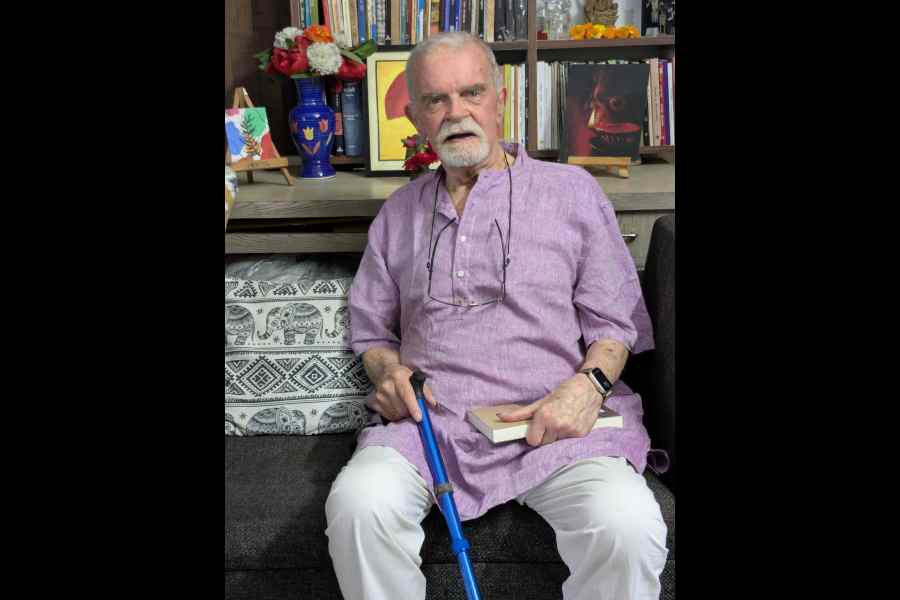
An informal meeting was underway at the house of linguist Tarun Kumar Ghatak in south Calcutta. Two dozen people — students and professors of Bengali literature alongside some folk and classical singers — had gathered. The younger lot was holding garlands, uttoriyos, shawls...
The cynosure of the evening was John William Hood, famed in these parts for his English translation of Niharranjan Ray’s Bangalir Itihas. Hood’s book is titled History of the Bengali People.
Hood, 81, lives in Australia. He had decided to major in Bengali literature from the University of Melbourne in the 1960s. The pull of the language keeps drawing him to Calcutta time and again. Apart from the language, he loves its literature and Bengali films.
That day he was dressed in pajama-panjabi. He began, “I am more comfortable in written and literary Bengali. Since I don’t have the habit of speaking it regularly in Australia, forgive me if I speak in English.” A local train whistled in the background.
Hood’s earliest memory of Calcutta is from 1966. He recounted, “I had camped at the majestic Great Eastern Hotel that charged a princely ₹28 per night. A bottle of beer used to cost ₹5.” The late 1960s were a period of Naxal violence, but Hood did not seem to remember an atmosphere crackling with tension. He said, “I’d feel more secure travelling in public transport in Calcutta late in the evening than in Melbourne.”
Hood spoke about his own life and his early dalliances with the Bengali language. He had chosen Indian studies at the University of Melbourne for his postgraduate degree. The department was headed by two Bengalis — Sibnarayan Ray and Atindra Mojumder. Sibnarayan was a thinker-educationist and Mojumder a poet and expert in ancient Bengali literature. Mojumder encouraged Hood to master Bengali. He also suggested that Hood pursue a PhD on historian Niharranjan Ray’s magnum opus.
“I first met Niharbabu at his home near Golpark with a letter of introduction from Mojumder,” said Hood. It took him seven years to complete the doctoral thesis and translate the classic.
The book was well-received in North America and Europe and has had several reprints. Hood said, “What surprised me was that it sold most in Calcutta and Bengal. I wonder why Bengalis would buy my book when they have access to the original one.”
He admitted that he discovered Tagore late in life. Said Hood, “The Australian education system used to be Eurocentric. Asia didn’t figure much and Africa was on another planet.”
Hood also did a thorough research of the films of Satyajit Ray. He acquainted himself with the works of other directors of Bengali films too.
He told his audience how he finds Ray most affable, and Mrinal Sen lacking in a sense of humour. After having watched most of their films, he wrote two books — Chasing the Truth: The Films of Mrinal Sen and Beyond the World of Apu: The Films of Satyajit Ray.
Later, he got to know filmmaker Buddhadeb Dasgupta and translated his poetry. It was Dasgupta who introduced him to Prafulla Roy’s writings; many of his films were based on Roy’s stories. Said Hood, “I am a fan of his work on Partition, relations between ordinary people and the life of the rural underclass. His writings are profound.”
The last few years, Hood has been translating Roy’s Keyapatar Nouko, which is “longer than Tolstoy’s War and Peace, but slimmer than Seth’s A Suitable Boy”. The second part of the book titled Paper Boats was published recently.