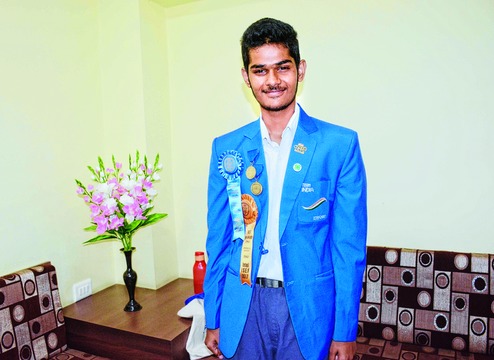

#I-am-an-asteroid. Jamshedpur boy Prashaant Ranganathan may soon earn the right to flaunt that as his Twitter or Facebook status.
The Class XII student of Carmel Junior College, Sonari, has won the Intel International Science and Engineering Fair (ISEF), 2017, contest in environment engineering category, which entitles him to a special MIT honour of a minor planet being named after him, besides a cash prize of USD 8,000.
The honour is conferred by MIT's Lincoln Laboratory, which partners with Society for Science & the Public, a US-based nonprofit to promote science education through its Ceres Connection programme.
The programme names minor planets such as asteroids in honour of students in fifth through twelfth grades and their teachers. The selection is done through three contests - the Discovery Channel Young Scientist Challenge; Intel Science Talent Search (STS) and Intel ISEF, the 2017 edition of which took place in Los Angeles from May 20.
Prashaant's project - Biodegradation of chlorpyrifos using native bacteria - showed how farmers can break down harmful pesticides to save crops and human lives in turn. He was among 20 Indian high school students and more than 1,700 from across the globe who took part in the week-long contest.
"In my category, there were 98 contestants. I won and have been told that a minor planet will be named after me. The MIT Lincoln Laboratory has been naming planets after honorees in the field of science for welfare of mankind. It is a time-taking process. As of now, I have been told that the asteroid that will be named after me is somewhere between Mars and Jupiter," Prashaant, who is back in the city, told this newspaper on Monday.
Fewer than 15,000 people share the honour of having a minor planet named after them. The process follows a well-defined sequence of events. After a minor planet receives a permanent designation or number, the discoverer of the minor planet has 10 years to propose a name for it. Once the name is proposed, the 13-member International Committee for Small Body Nomenclature must judge and approve the same.
For his Intel ISEF feat, Prashaant has won the opportunity to attend the Science Congress in London in August. But, the Carmel student, who was earlier this year chosen for the two-week Yale Young Global Scholars programme at Yale University in Connecticut, US, isn't sure if he can attend both.
Prashaant was among thousands of applicants from 150 countries for the prestigious Yale programme, which includes a USD 5,000 scholarship and a chance to stay and work at one of Yale's historic residential colleges.
"I am confused because the dates clash. Both the Science Congress and Yale programme are between July 27 and August 9. Let's see. I will decide after my terminal examinations, which begin from June 26," he said, adding that his cash prize would be spent on his education. "I want to appear for SAT and seek admission in one of the Ivy League colleges.
In 2015, Prashaant was among the top 20 innovators in Google Science Fair. He won a science contest organised by IIT-Guwahati in 2016 and has been the all-India champion in IRIS (Initiative for Research and Innovation inScience) by Intel Corporation.
Prashaant is an avid researcher and has been working on four projects simultaneously. He is planning to apply for a patent for a project that demonstrates how iron oxide enhances chlorophyll and speeds up photosynthesis in plants.