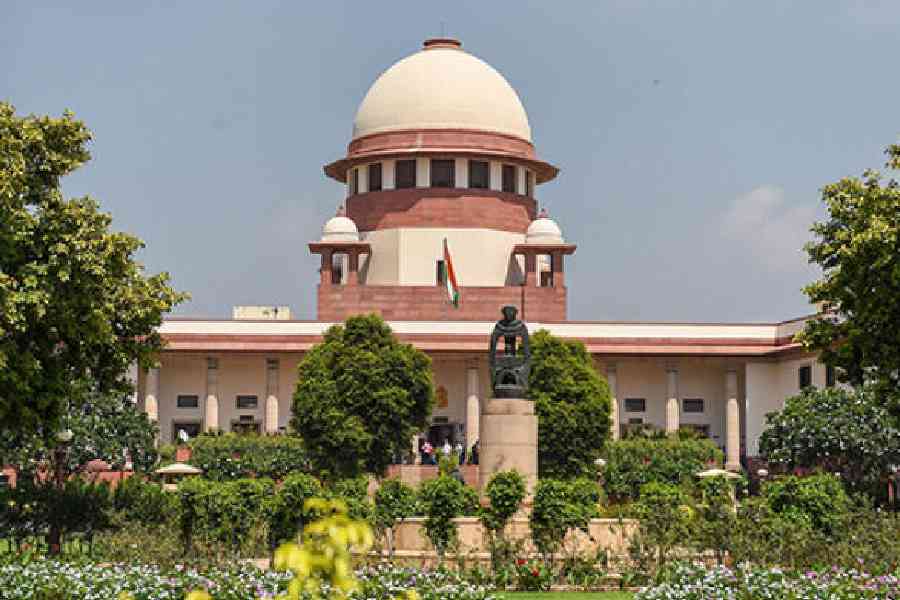
The Supreme Court on Wednesday declined to quash the Union home ministry’s January 28 circular on singing all six stanzas of Vande Mataram at official events and schools, but held that the directive was not “mandatory” and carried “no penal consequences”.
“Show us the notice sent to you compelling you to play the national song. You run a school, we don’t know whether it is recognised or not also,” a bench headed by Chief Justice of India Surya Kant told senior advocate Sanjay Hegde, appearing for petitioner Muhammed Sayeed Noori.
Solicitor-general Tushar Mehta, who was present in the court in connection with another case, rose to ask: “Do we need an advisory to respect the national song?”
The bench, which also included Justices Joymalya Bagchi and Vipul M. Pancholi, told Hegde that Clause 5 of the circular used the expression “may” and not “shall”.
The usage of the expression “may” and not “shall” means it was not mandatory and involved no penal action for disobedience.
“There is as much freedom to sing and as much freedom to not sing. That is why it does not fall foul of the Bijoe Emmanuel (judgment),” Justice Bagchi observed.
In the Bijoe judgment, the top court had held that singing the national anthem was not mandatory, though a duty was cast on all individuals to stand up when it was played.
“You have vague apprehensions, which do not have any nexus with the circular,” the bench told the petitioner on Wednesday.
Hegde expressed apprehension that an individual who chooses not to sing Vande Mataram because of their religious beliefs might be subjected to “discrimination” or harassment.
“What we have in this country is equal respect for every religion. If by any means, even under the garb of enforcing an advisory, people can be compelled to sing along, those of us citizens, irrespective of religion... everyone then feels compelled to participate in a social demonstration of loyalty,” Hegde argued.
Mehta referred to Article 51A of the Constitution that cast a fundamental duty on every citizen to respect the national anthem.
Hegde countered the argument, saying Article 51 applied to the national anthem and not the national song. The senior counsel submitted that the government circular was issued in disregard of the national anthem because it had directed that Vande Mantram be sung first.
“It will dilute the national anthem as Vande Mataram has to be sung first,” Hegde argued.
The CJI said there was no reason for the court to entertain the petition at this stage.
“We will hear all these issues when there are penal consequences (for disobeying the circular) or (singing Vande Mataram) is made mandatory. This notification is an advisory. There are no penal consequences,” the bench said, refusing to entertain the petition.