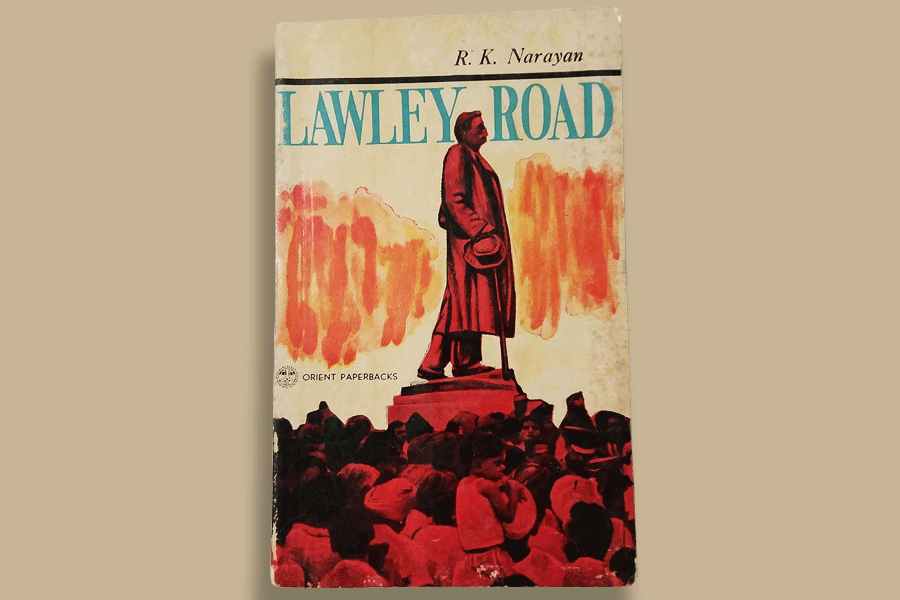
A short story written by R.K. Narayan in 1956 has regained relevance in 21st century India where Kerala has become Keralam, West Bengal wants to be Bongo and Delhi wants to become Indraprastha. Or so the decision-makers say.
In Lawley Road, which was part of the book Lawley Road and Other Stories and an episode of the Doordarshan serial called Malgudi Days that is much-loved by Indians of a certain vintage, the arrival of Independence brings new vigour to the municipality, which wants to rename roads, parks and places.
What follows is strangely timeless, specially now. Here are some relevant excerpts (in italics), juxtaposed against current events.
Authority decides to do ‘something great’
The Talkative Man (the narrator) said:
For years people were not aware of the existence of a Municipality in Malgudi. The town was none the worse for it. Diseases, if they started, ran their course and disappeared, for even diseases must end someday. Dust and rubbish were blown away by the wind out of sight; drains ebbed and flowed and generally looked after themselves.
The Municipality kept itself in the background, and remained so till the country got its independence on the fifteenth of August 1947.
Our Municipal Council caught the inspiration. They swept the streets, cleaned the drains and hoisted flags all over the place. Their hearts warmed up when a procession with flags and music passed through their streets.
The satisfaction the Chairman now felt was, however, short-lived.
In about a week, when the bunting was torn off, he became quite dispirited.
I was forced to ask, ‘What is wrong, Mr Chairman?’ ‘I feel we have not done enough,’ he replied. ‘Enough of what?’ I asked. ‘Nothing to mark off the great event.’ He sat brooding and then announced, ‘Come what may, I am going to do something great!’
Cut to the present, and the lines about diseases running their course, dust, rubbish and drains looking after themselves remain relevant for large swathes of India.
And the sense of ‘not doing enough’ still evidently plagues politicians across India.
So Allahabad becomes Prayagraj. Mughal Sarai becomes Pandit Deen Dayal Upadhyay.
What’s in a name
In Lawley Road, here’s how the chairman tried to do ‘enough’.
He called up an Extraordinary Meeting of the Council, and harangued them, and at once they decided to nationalise the names of all the streets and parks, in honour of the birth of independence.
They made a start with the park at the Market Square. It used to be called the Coronation Park—whose coronation God alone knew; it might have been the coronation of Victoria or of Asoka. No one bothered about it. Now the old board was uprooted and lay on the lawn, and a brand-new sign stood in its place declaring it henceforth to be Hamara Hindustan Park.
Mahatma Gandhi Road was the most sought-after name. Eight different ward councillors were after it. There were six others who wanted to call the roads in front of their houses Nehru Road or Netaji Subash Bose Road.
Well, sir, even in the most democratic or patriotic town it is not feasible to have two roads bearing the same name. The result was seen within a fortnight. The town became unrecognisable with new names……
Calcutta’s iconic Park Street is now Mother Teresa Sarani, Bishop Lefroy Road is now Satyajit Roy Dharani [because he lived there, but no one knows why dharani, which in Bengali means the ground or the earth]. There are Calcutta metro stations named after poet Nazrul Islam and revolutionary Khudiram Bose, despite the areas having no connection with them.
There are at least two Mahatma Gandhi Roads in Kolkata.
A total of 377 km of roads in India are named after Mahatma Gandhi, according to various estimates. They cover 58 major cities.
Then there are about 20 stadiums named after the Nehru-Gandhi family.
There’s only one stadium named after Prime Minister Narendra Modi. That’s in Ahmedabad. The two bowling ends of the stadiums are named Adani and Reliance.
What did the renaming frenzy lead to in Narayan’s short story?
Well, sir, even in the most democratic or patriotic town it is not feasible to have two roads bearing the same name. The result was seen within a fortnight. The town became unrecognizable with new names……
Of course, it created a lot of hardship—letters went where they were not wanted, people were not able to say where they lived or direct others there. The town became a wilderness with all its landmarks gone.
Removal of colonial baggage
In the short story, the Chairman is gratified with his work, but not for long. He becomes restless again and looks for fresh fields of action.
He decides to go for the colonial masters. The municipal council does not seek to erase Mughal influence (the story is set in South India, where Mughal expansion was limited) but instead aims to eliminate colonial remnants:
At the corner of Lawley Extension and Market there used to be a statue…
The Chairman suddenly remembered that it was the statue of Sir Frederick Lawley. The Extension had been named after him. Now it was changed to Gandhi Nagar, and it seemed impossible to keep Lawley’s statue there any longer. The Council unanimously resolved to remove it.
The statue towered twenty feet above them and seemed to arise from a pedestal of molten lead. In their imagination they had thought that a vigorous resolution would be enough to topple down the statue of this satrap, but now they found that it stood with the firmness of a mountain. …..If it was going to mean blasting up that part of the town for the purpose, they would do it.
For they unearthed a lot of history about Sir Frederick Lawley. He was a combination of Attila, the Scourge of Europe, and Nadir Shah, with the craftiness of a Machiavelli.
He subjugated Indians with the sword and razed to the ground the villages from which he heard the slightest murmur of protest. He never countenanced Indians except when they approached him on their knees. People dropped their normal occupations and loitered around the statue, wondering how they could have tolerated it for so many years.
But contractors demand high sums for the task and the Chairman offers it free to the Narrator if he removes it at his own expense. The Narrator calculates potential profit from selling the metal or even selling the statue to the British Museum.
He borrows money, hires labourers, and after days of failed effort, uses dynamite (with permission from the district magistrate) to bring it down.
Transporting the massive statue to his house causes chaos in the town. It is lodged partly inside his small home. But after he publicises the event (the Narrator is a reporter), historical societies protest the removal, creating fresh complications and exposing the irony of public sentiment.
In 21st century India, we have Lutyens’ (the architect of New Delhi) bust removed, South Block changed to Seva Teerth, Rajpath changed to Kartavya Path, and even the Parliament complex renovated and renamed Central Vista complex.
All Indianised, at cost to the exchequer (read you and me).
And yes, the prime minister’s residence (earlier 7 Race Course Road) was changed to 7 Lok Kalyan Marg. Lok Kalyan means people’s welfare.
Clearly, India’s leaders continue to be plagued by the guilt of not doing enough for the people.
Historical revisionism
Lawley Road, the story, is tragicomic. The twist of the tale is in its tail:
We had all been misled about Sir F. This Frederick Lawley (of the statue) was a military governor who had settled down here after the Mutiny. He cleared the jungles and almost built the town of Malgudi.
He established here the first cooperative society for the whole of India, and the first canal system by which thousands of acres of land were irrigated from the Sarayu, which had been dissipating itself till then.
He established this, he established that, and he died in the great Sarayu floods while attempting to save the lives of villagers living on its banks. He was the first Englishman to advise the British Parliament to involve more and more Indians in all Indian affairs. In one of his despatches he was said to have declared, ‘Britain must quit India someday for her own good.’
The Chairman said, ‘The government has ordered us to reinstate the statue.’
The narrator refuses to give up the statue of Sir Frederick Lawley, claiming it is his property. But the public demands the statue back and protests erupt outside his house. They accuse the narrator of trying to profit from it, especially after he puts up a “Statue for Sale” notice.
The municipality threatens legal action under the Ancient Monuments Act. The conflict drags on for months until the government intervenes, questioning the municipality’s conduct.
Finally, the Narrator and the Chairman reach an understanding:.
I called on the Chairman and said, ‘You will have to do something grand now. Why not acquire my house as a National Trust?’ ‘Why should I?’ he asked. ‘Because,’ I said, ‘Sir F. is there. You will never be able to cart him to his old place. It’ll be a waste of public money. Why not put him up where he is now? He has stayed in the other place too long. I’m prepared to give you my house for a reasonable price.’ …
It appealed to him. We arrived at a figure. He was very happy when he saw in the papers a few days later:
‘The Chairman of Malgudi Municipality has been able to buy back as a present for the nation the statue of Sir Frederick Lawley. He proposed to install it in a newly acquired property which is shortly to be converted into a park. The Municipal Council have resolved that Kabir Lane shall be changed to Lawley Road.’
The bottom line? In contemporary India, fact can really compete with fiction. Meanwhile, the drains still look after themselves, diseases still run their course.