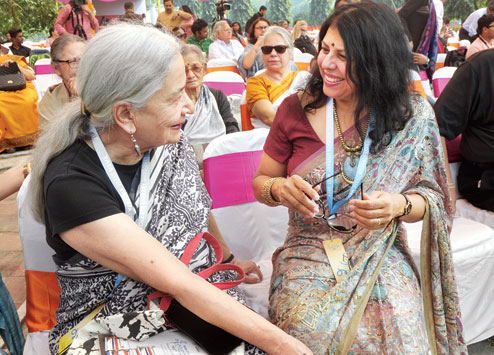

Chitra Banerjee Divakaruni — the author of bestselling titles like The Palace of Illusions and The Mistress of Spices — has a new work, Before We Visit the Goddess (Simon & Schuster, Rs 499). A novel told in stories, it traces three generations of women as they battle their particular demons. Multiple narrators present different perspectives as the scenes meander between time zones and timelines. t2 caught up with the Presidency girl now based in Houston at the Tata Steel Kolkata Literary Meet, held in association with The Telegraph, to discuss women, identity and Calcutta.
You moved to America at the age of 19. How much of the narrative in Before We Visit the Goddess is personal?
The concerns are very personal. I started writing this book after my mother passed away, so a lot of the concerns about heritage and the importance of women being successful came out of conversations that my mother and I had.
Is there a character you identify with in particular?
When I’m writing a character, I really have to get into their mental make-up. Otherwise if I’m just portraying them from the outside, they won’t come alive. Perhaps the one whose story touched me the most was Sabitri. She was of my mother’s generation and in her I saw a lot of the struggles of my own mother, who really wanted an education but who also had to drop out of college. She went back much later but she never really did as much as she wanted.
Do questions of identity haunt you often? Do you think growing up in a different country invariably brings up these questions?
I’m not haunted by it all the time. Every once in a while it comes out. I’ve lived in the US for over 30 years and now I’m quite comfortable with a hyphenated identity. I’m American in some ways and Indian in some ways. For instance, when I come here, I feel very much at home and I fit right in. But in my earlier years I felt the tug much more, the alienation and homesickness. But at a certain point, you accept that this is home and make the necessary adjustments. Nowadays the Indian-American community is much larger, so really we have a real sense of society over there with people who share our concerns. Houston, in fact, has the only Durga Bari in the US. There is also an India House where Indian national holidays like Republic Day and Independence Day are celebrated.

Do you think the community is at risk now that Donald Trump is in power?
I’m concerned. I’m going to watch very carefully. I don’t believe in damning someone before they’ve done anything. I do believe we should follow the proper channels of protest. I am going to be watching very carefully what happens to women’s rights under Trump and how minorities are treated. These are my two areas of concern. We should do what we can to create a stronger America.
You said you fit right in when you come back, but in your eyes has Calcutta changed a lot?
It’s so different! It’s grown so much. Transportation is so much better with flyovers and the Metro. When I left the city, they had just started work on the Metro lines and everything was dug up. I listen to people and feel there is more entrepreneurship, albeit not as much as in other cities.
What do you remember of your childhood in Calcutta?
I went to Loreto House and Presidency College but I used to spend my summer holidays at my maternal grandfather’s house in a little village near Burdwan. He really opened me up to a lot of stories. He was very encouraging. He always told me, ‘Go for what you want, you’re smart enough to do it.’ Both he and my mother gave me a lot of confidence and support, but they never thought I’d become a writer. At that time I wasn’t thinking of writing at all. I always wanted to be a teacher. I was studying literature to be a teacher.
You have 16 books to your name. Which one would you pick as your favourite?
I think right now it’s Before We Visit the Goddess, because craft-wise this is my most artistic work. I worked really hard on the structure, the characters, how to reveal things at different times. Subject and character-wise, my favourite would be The Palace of Illusions. Draupadi was a great character to write; she is so multi-faceted.
You teach creative writing at the University of Houston. Would you say that impacts your writing?
We’re always discussing how to make writing better. I look at student works and how they’re improving. We talk about all kinds of writing and it’s so much fun to explore books together. I do think it’s useful to go through a course like that. It’s very hard to know what’s working or not when you’re writing. My own writers’ group has been very helpful to me. I trust their judgement. They read my work first before I give it to my agent. It’s important for writers to get some feedback.
Would you ever consider making a man a protagonist in your novel?
Not right now. I want to put women in the centre of their stories and make them the tellers of their own lives, although I’m really fond of some of the male characters in Before We Visit the Goddess. Here every generation has their own successes — Sabitri has her sweet shop, which allows her creativity to flourish, Bela has her blog and Tara has her family, and in the end she reconnects with her grandmother. Although Tara has a problem that stems from her life... she feels her parents have been taken away and she has been robbed of a family life. She feels abandoned, especially by her father, who she was very close to, but she had a lot of loyalty towards her mother also. There was so much emptiness in her life.
Do you have a rigorous writing schedule?
When I’m at home, I try to write every day that I’m not going in to teach. So about three to four hours, thrice a week. I work on my novels or short pieces commissioned by magazines. I do my writing in the morning but I’m a night person. I like working and reading at night. My mind is calmer then. I put two things on my blog — writing tips and cooking experiments. My sons love eating Indian food, so I have simplified versions of my mother’s recipes. I also put recipes that appear in my books on the blog, so from Before We Visit the Goddess there is Chocolate Sandesh!
Is there a restaurant you really liked in Calcutta?
Recently I went to 6 Ballygunge Place. I loved the typical Bengali food there.