 |
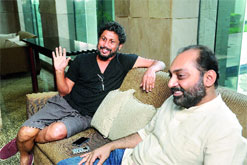
| Shoojit Sircar and Anindya Chattopadhyay at Hyatt Regency. Anindya’s film Open Tee Bioscope, which is produced by Shoojit, releases on January 16, 2015. Picture: Pabitra Das |
A north Calcutta para, its quaint lanes and bylanes, four friends, a story about growing up, and a football match. A host of small, intimate moments from first puff to first crush make Chandrabindoo singer Anindya Chattopadhyay’s debut directorial venture Open Tee Bioscope, which its star producer Shoojit Sircar says will be “a realistic, witty, laugh riot”.
Open Tee Bioscope hits screens on January 16, 2015. A t2 chat with the producer and the director.
Why did you decide to release Open Tee Bioscope in January ’15?
Anindya: Our film is a coming-of-age tale and Saraswati Puja, Valentine’s Day play a crucial role. So it’s the appropriate time for the release of the film.
Shoojit: It’s a story about growing up, and everyone will relate to it. It’s about adolescents falling in love for the first time, watching an adult film for the first time… so the milestone dates are very important, from Durga Puja to Kali Puja to New Year’s to Valentine’s Day.
Anindya: Everyone goes through the same experiences, everyone falls in love, then comes out of it and falls in love again.
Shoojit: It’s a slice-of-life story set in a north Calcutta para. This film has the feel of Nukkad.
How much of the film is autobiographical?
Anindya: It’s not an autobiographical film. I’ve grown up in north Calcutta, near Beadon Street. So I know the lanes really well. For example, there was one lane called Ek Cigarette Gali, which got its name because you could finish a cigarette as you walked from one end of the lane to the other. Or when I was growing up I would see a group of teenagers moving from door to door, ringing the doorbells and then running away. Or someone would call someone else Chucho, leaving him totally unglued for the rest of the day! A person who was hard of hearing would get his daily dose of news from someone who would shout out every line from a newspaper. The para is a character in the film and a kind of odbhut moja happens in that para.
And are the bits about falling in love inspired from real life?!
Anindya: Once again I reiterate the film’s not autobiographical, but then people did fall in love… and in most cases the para would have more guys than girls, so the guys would often fall for one girl and there would be chaos (smiles)!
How did you first meet Shoojit?
Anindya: I had gone to sing Bola baron (Aparajita Tumi, directed by Aniruddha Roy Chowdhury and co-produced by Shoojit) at Shantanu Moitra’s studio in Bombay in 2012, and met Shoojitda there.
Shoojit: Of course I had heard Chandrabindoo’s songs by then.
Anindya: Remember you were thinking of doing a music video for one of our songs?
Shoojit: And once Aparajita Tumi got over, Anindya told me about his stories and said that he wants to make a film and when I heard this story I got really excited.
Anindya: It was a long story, more like a novel called Ekdin Baapi. It was about a daylong football tournament.
Shoojit, did the story remind you of any particular film?
Shoojit: Lots of Mexican and Iranian films. And I could see the potential in his story. We worked through 2013 on the drafts of the script and started shooting in November.
Did you ever think of getting someone else to direct it?
Shoojit: Anindya had shown a desire to direct a film and we were very clear about that. I was eager to produce my second Bengali film after Aparajita Tumi and Anindya was ready to direct Open Tee Bioscope. I know what is required to do a film, so I was the facilitator and I wanted Anindya to comfortably direct it.
Anindya: Ami jokhoni bipode porechhi, I’ve turned to Shoojitda (smiles).
Shoojit: Everyone participated and we had a lot of fun on the sets. It was a tough shoot but it was like a picnic. We enjoyed every moment. You’ll see the same vibe on screen. There’s so much exuberance in the film.
Anindya, why did you turn to direction?
Anindya: I had a desire to direct a film for a long time. I worked as an in-house director for Tara channel, and then I assisted Rituparno Ghosh in Titli. I wanted to see and learn. But then it’s different when you direct your own film. Shoojitda told me to go off a few things like my singing, my writing, and for a prolonged period I lived in my house in north Calcutta separately.
Shoojit: We had discussed two or three stories and then I told him that this (Ekdin Baapi) should be his first film. It’s really important for a director to have a vision. My suggestion to Anindya was to make a film he would be proud of.
Anindya: There’s an interesting story involving Rituda (Rituparno Ghosh). Shoojitda told Rituda that he was doing a film on north Calcutta. Rituda knew that I wanted to do a film on north Calcutta. Then Rituda told Shoojitda that if he was planning on doing a film on north Cal, then he should give my script a listen. Then Shoojitda told him with a smile that he was producing that film only! Rituda called me… he was so excited.
How did you choreograph the football scenes?
Shoojit: We shot in a real para with real players near Entally on a hockey ground. It is quite difficult to shoot football scenes. Shob theke tension ota niye chhilo. And we didn’t have too many days. But we had a lot of fun shooting it since both of us like football. We even played during training.
You don’t have star in your film...
Shoojit: Story, music and Anindya are the stars (smiles).
Anindya: And Shoojitda…
Shoojit: It’s tough to do a film without a star. But then we didn’t have a star in Vicky Donor. Everyone was new, the idea was taboo. So that film is a huge learning and a big example. Yes, stars help to create a buzz and get you an audience but beyond Monday nobody is a star. The story becomes the star.
You’ll get the flavour of old Bengali films, like a Hrishikesh Mukherjee film, you’ll get the charm, the innocence, the wit, the freshness, and one will get to relate to the characters and situations.
Were you present on the sets during the shoot?
Shoojit: We planned extensively, but I went on the sets only for a few days. I left it to Anindya and how he wanted to capture it. I was there on the first few days and then on the days of the football match just to help him out since there were so many people around.
How would you define your role as a producer?
Shoojit: See I’m not here as a regular producer whose main criteria revolves around the economics… to notch up the numbers. Economics is an important part ’cause I’ve to keep on making films, but for me the passion is very important. I don’t expect that I’ll earn a huge amount of money from one film and that I’ll go back home and sit back and enjoy. I see where I’m breaking even, and once that happens I move on. For me, the creative process is important. I enjoy the process. The director gets his vision, that’s my kick.
Who has scored the music?
Shoojit: Upal (of Chandrabindoo) is the music director, and Shantanu (Moitra) is the guest music director.
Anindya: Upal can work really well with youngsters. And since our film revolves around adolescents, we thought the music should also have a kind of innocence.
Have you sung in the film?
Anindya: No… there are seven songs in the film, and you’ll find glimpses of purono Chandrabindoo.