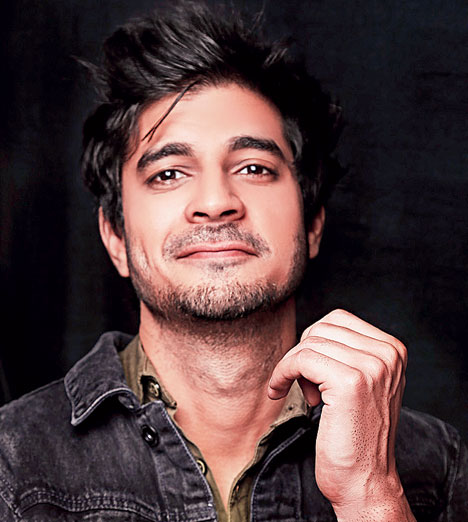

He burst into the scene as the smooth-talking antagonist in Rani Mukerji’s 2014 film Mardaani. Since then, Tahir Raj Bhasin has taken it slow. However, Nandita Das’s Manto, a biopic of celebrated writer Saadat Haasan Manto with Nawazuddin Siddiqui in the title role, could shift his career to top gear. Back from the Cannes Film Festival where the film was screened to big praise, Tahir talks about his Shyam in Manto and the way forward.
Walking the red carpet at Cannes must have been a high…
We are very excited about the international buzz the film is creating. For someone like me, who is in the initial stages of my career, to take a film to such a big platform and represent my country on the world stage was huge. Very few people know the importance of the Un Certain Regard category at Cannes… it’s one of the most prestigious. The film was shown to an international jury and a European audience. It was a very proud feeling.
Was any particular feedback a little more special?
After the screening, I looked back and saw Benicio del Toro, who was the president of the jury, giving the film a standing ovation. He’s an actor I have admired in films like Snatch and Sicario. For him to give the film a standing ovation was a big moment.
The overriding feedback was that despite the film being based in India and set in the 1940s and the language being Hindi and Urdu, the story remains relevant. That’s because Manto believed in creative freedom and freedom of speech and that’s a theme that resonates across borders today.
What was your Cannes diary like?
We were so involved in our teaser launch that we didn’t really get the time to watch other films. But it was a good time for me to bond with Nandita and Nawaz and while we were there, we were talking about how exactly one year ago we were shooting in a remote village in Gujarat and sometimes we would just get a cup of tea and a couple of biscuits in the whole day. And just one year later, we were at Cannes with the same film, having croissants and coffee (laughs). It was such an incredible turnaround.

What can you tell us about your character Shyam?
When I was first told about Shyam, I had to speak to my grandparents’ generation to know who he was. He was a film star from the late ’40s and early ’50s. In a very short time, he became a big star and had five back-to-back successes. Any film historian will tell you that if Shyam had not died in a horse riding accident at 31, he would have taken on the might of Ashok Kumar and Rajesh Khanna.
Shyam was Manto’s confidante and an inspiration for a number of his stories. I was excited about playing this boisterous and charming star in a film with a retro-vintage feel. Also, I was happy to be working with Nawaz.
We did a lot of research, including going through old photographs and diary entries. Manto had written a fascinating chapter called Krishna’s Flute in a book called Stars From Another Sky, which has a detailed description of what Shyam was like. Manto had written that Shyam reminded him of a character from a Russian novel. He loved life and loved everything that was beautiful, be it art, music or the girls he dated.
What was Shyam’s influence on Manto like?
In the film, there are definitely grey shades to Shyam. Shyam and Manto find themselves in the middle of a clampdown on artistic freedom coupled with a lot of religious turmoil and that affected their dynamics. Shyam was a man who lived in the moment. He was carefree and had a boisterous laugh and he wasn’t as intense as Manto.

Nawaz had told t2 that to play Manto he had switched off from technology and listened to music and read books from Manto’s time. What was your prep like?
I did watch a lot of Hollywood films from the ’30s, ’40s and ’50s. The actors of that time had certain mannerisms and gestures that I had to inculcate. The fear was that if we put on costumes from the ’40s but walked and talked like we do in 2018, it would look completely fake. I had to cut down on my modern mannerisms.
How important was it to be part of a film like this so early in your career?
Cannes has happened now and it’s become a big film, but when I made the decision to do it, none of this had happened. The theme of an artiste rebelling against the clampdown on creative freedom was just so appealing. It’s very rare that an actor, through his work, gets to make a statement about the times we are living in. If in 2050, someone watches Manto made in 2018, they will be able to say, ‘Okay, this is what these actors were trying to say about the times they were in’.
We expected a flood of films after Mardaani. Why hasn’t that happened?
One of my mottos is quality over quantity. Three films in three years is not really such a bad number! (Laughs) In Bombay, no matter how much you try to control things and make your choices, the circumstances control you. I feel very lucky to have had diverse opportunities, whether it’s a crime drama like Mardaani or an action film like Force 2 and now a biopic like Manto.

After Mardaani and Force 2, did you find yourself being approached only with roles of the smooth-talking villain?
I call him an anti-hero (laughs). When you look a particular way but act against type, it only enhances your acting skills and that’s what happened in both Mardaani and Force 2. The work I have done is a result of the choices I have made and there has been a variety to choose from, thank god for that.
When we had spoken last, you had said that there is more to your life than movies. What do you like doing when not making films?
The actor in me loves watching films. The last thing I watched and loved was the Netflix documentary Wild Wild Country. Everything I do in life is related to my job in some way or the other because an actor is all about his experiences. Travelling is a huge thing for me… it gives me new perspective and fresh ideas. After Cannes, I spent a week backpacking alone through Italy. Loved it!