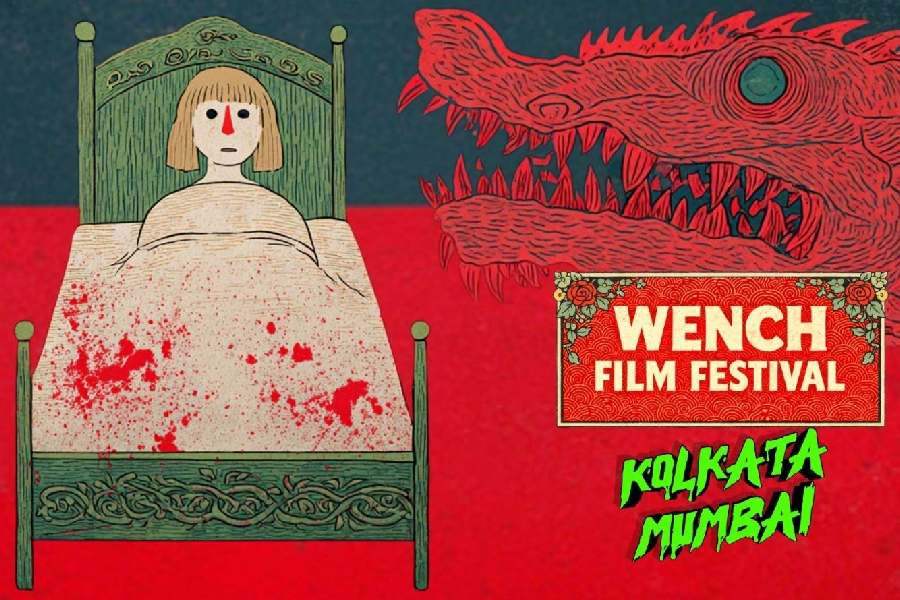
The Wench Film Festival, dedicated to horror, sci-fi and fantasy movies, will return with its sixth edition in Kolkata and Mumbai later this month, featuring 54 films, including 33 directed by women, the organisers announced on Thursday.
The festival will be held in two legs — from February 19 to 22 at the Satyajit Ray Film and Television Institute (SRFTI) in Kolkata, followed by screenings from February 26 to March 1 at the National Film Development Corporation of India (NFDC) in Mumbai.
According to a press release, the upcoming edition marks Wench’s first collaboration with both institutions.
This year’s festival will open with the India premiere of Ritesh Gupta’s The Red Mask, followed by a post-screening Q&A with the director. The closing film will be Fantasia winner Mother of Flies by Adams Family.
The official selection will be screened across three categories — Blood Thirsty (films over 60 minutes), Dwarves (10 to 40 minutes) and Elves (less than 10 minutes).
Festival founder Sapna Moti Bhavnani’s latest short film Landfills of Desire, which had its world premiere at Fantastic Fest 2025, will have its Asia premiere at the festival. The film was shot on Dal Lake in Kashmir and features the Kashmiri folkloric figure Rantas as its elusive protagonist.
The 2026 edition’s visual and conceptual theme is the hospital, inspired by a member of the Wench team who experienced a particularly difficult year, followed by a serious leg injury and prolonged hospitalisation.
“The theme centres on the body reaching its limits. The hospital is not framed as a place of healing or resolution, but as a space where interruption becomes unavoidable where the body asserts itself after prolonged strain. This theme is dedicated to women who consistently stretch themselves across work, care, and creative labour, often without pause, until the body demands attention,” the organisers said.
The festival will also continue its collaboration with global genre platform Fantasia and partner with Bloodstream to introduce a distribution initiative aimed at extending the life of select films beyond the festival circuit.
Under the partnership, selected titles will be considered for curated distribution opportunities, addressing what the organisers described as a key gap in India’s independent cinema ecosystem.
Wench will further continue its associations with the Embassy of France in India, the Institut Francais and the Alliance Francaise, supporting cultural exchange and access to contemporary French cinema through curated programming and artist-led conversations.
“Wench was built slowly, without a safety net. For a long time, it existed because of conviction rather than validation. Having institutions like NFDC come on board for the first time, alongside the support of SRFTI and our continuing collaborations with the French cultural bodies, feels like a quiet acknowledgment of years spent building something that didn’t have a template or guarantees,” Bhavnani said.