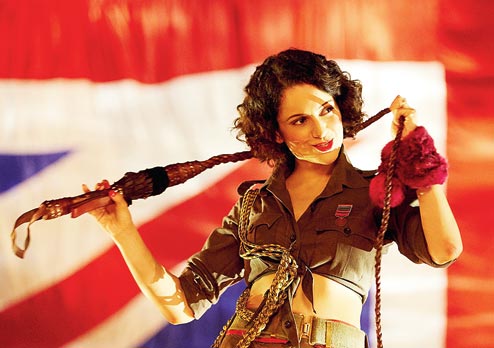

Kangana Ranaut knows how to make headlines. On a promotional spree for the Vishal Bhardwaj-directed Friday film Rangoon, the actress has been making waves for the last few weeks. “But it’s not that I go out of my way to make headlines. I just say what I believe in,” Kangana said with a laugh when t2 recently met her.
Dressed in all black, Kangana oozed confidence with her blonde curls and blood red lips. Her look is in sharp contrast to the delicate paisley and pastel-hued interiors of the vanity van that the stunner has designed for herself. But that’s who Kangana is — a bundle of contradictions.
From working with Saif Ali Khan and Shahid Kapoor in Rangoon to the ugly spat with former beau Hrithik Roshan last year, and love, Kangana chatted about everything and then some...
From your previous interviews, it seems like Julia of Rangoon is a fairly dark character...
Not really. She is a very real character. Writers and directors don’t always flesh out female characters in most of our films. That’s why they come across as superficial and one-dimensional. Women in our films are either limited to sexy, bubbly or the girl-next-door. That’s not how Vishal Sir’s women on screen are. The women in his films are very well written. Julia is a complete woman. She is a lover, an ambitious woman. She is a fighter. She is searching for meaning to her life.
In an interview, you talked about Julia whipping herself!
(Laughs) It’s so funny that you mention that. I just got a text from Vishal Sir. I am going to see the final edit of the film. So Vishal Sir messaged to tell me that that particular scene has been edited out. It was my favourite scene from the film! There was some technical problem. It is the director’s prerogative to edit a film the way he wants to, but of course, I wish he could have used it. For an actor to do that scene was something else. I hope at some point they release that scene. I had to tap into another level of guilt and shame to do that scene. (Shrugs) Vishal Sir knew I’d be really upset with that being edited out. I told him not to worry. I am sure I’ll do better work with him in the future.

Both Shahid and Saif have worked with Vishal in the past. What was it like for you to walk onto a set where your co-stars already have a rapport with the director?
Initially it was very difficult. Shahid had just done Haider with Vishal Sir. He was completely in sync with the whole crew, from the director to the assistants. It was intimidating. Saif and I were in the same boat because he had worked with Vishal Sir a long time ago (Omkara, 2006). But it’s just a matter of a week and then you get to know everyone.
Vishal is a director on the wish list of most actors. Was the experience of collaborating with him everything you had expected it to be?
Oh, absolutely! I think one of the reasons why I loved working with him was because this film was a love story with a woman as the central character. This film was called ‘Julia’ before. It was a very fulfilling experience. This was an opportunity to work with a great director on a great script. This combination doesn’t happen very often.
In the past we have spoken about how much you love to travel. This film took you to Arunachal Pradesh, a part of the country you had never been to before...
Arunachal is a beautiful state. If not for this film, I doubt if I would have ever gone to parts of the state that we did. Only army trucks go there! (Laughs) I remember this time when I had to go and change in this local’s house. It was a basic bamboo house on stilts. I saw their kitchen, their living quarters… it was so enriching to see for someone who loves to travel and experience different cultures. For me, this was the best part of our time in Arunachal. They live such organic and environmentally friendly lives. I felt like I was so close to nature.
You shot Rangoon at a time when you were caught in a very public and ugly battle with Hrithik Roshan…
Which is why I was so glad to be away in Arunachal. There was no network there, so I could actually get away. I needed my own space to deal with things.
It was clearly a tough time for you. Are you someone who compart-mentalises or do you pour your emotions into work?
I compartmentalise. Work should not be driven by negative fuel. Work, for me, is very pure and I don’t like tainting it with anything negative. As an actor, I see myself as an empty vessel or a blank sheet or a piece of white cloth. That is the only way I can adapt to the colour of the character. You can’t have your own emotions clashing with your character’s emotions. This is my process.

Did dealing with the scandal give you a fresher understanding of how the industry works?
Yes. I always felt that I was on my own and that I am an outsider. So, the outpouring of love and support took me by surprise. It was overwhelming. Everyone stood up for what they thought was right.
Do you feel vindicated today?
Honestly, it’s a matter that even if you feel vindicated, you have still lost. In instances like this, there are no winners. When love fails, no one wins. But I am not bitter. You fall in love again. Love prevails (smiles).
Is the legal case shut now?
Of course! There was no case to begin with. But I don’t want to talk too much about it. It was all really strange, but now it’s all in the past.
You have always said that you are the central character of Rangoon. You have been very categorical about the kind of work you want to do. Has that reduced the number of offers that come your way?
Not really. All kinds of offers still come my way. There are great female characters being written. I get a lot of books, short stories, real life instances… a lot of material. There is no dearth of good work. But I do get a lot of characters that are uncomfortable to refuse.
Like what?
Films with superstars where I am offered a side-y character. I always keep refusing those films. I have to explain every time that I want to only play central characters.
Does it make things awkward socially when you meet actors you have refused films with?
This is why I don’t have a great social life here. This is why I don’t like mixing work with friendship. If a friend offered me a film that I didn’t want to do, I would end up offending them. That could mean the end of that friendship. I want to work with actors who come on the set as actors and not stars. That is how I approach my work.
Quite a few of your contemporaries are looking towards Hollywood. Do you also have similar aspirations?
Not really. I believe that the West is looking towards Asia to expand their market. To do so, they are incorporating more Asian characters in their films. I am not keen on going there for work. I have had offers… I have scripts lying with me. But why would I want to leave my audience right now? Why would I want to benefit another industry? I would much rather work here.
Karishma Upadhyay
Is Kangana underutilised or overrated? Tell t2@abp.in