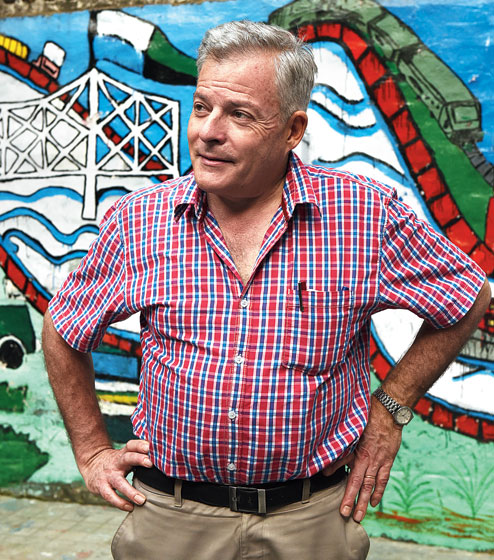

I grew up in London, went to a private school, one of the top schools. My father was a doctor in central London. His father was a doctor in central London. And I knew I was getting a really good education, so I would become a doctor in central London. Only problem was, I didn’t work hard enough in school. I joined sports and lots of activities and I got really, really bad grades. So, no chance of being a doctor. I was absolutely mortified. An uncle of mine said to me, have you thought of being a banker? That’s how I came to work with HSBC. And that’s how I came to be posted in Calcutta.
When I was growing up, waiting to become a doctor, did I ever imagine I would one day start a charity in Calcutta? Good Lord, no!
It all happened purely by chance. I was with HSBC in Hong Kong. And then one day the bank sent me to India, to be a branch manager at Shakespeare Sarani, Calcutta.
I arrived here as a 29-year-old enthusiastic lad who loved life. I was coming from Hong Kong, which is a very business-orientated city where everything looks so sharp, where you can travel around the whole place in a very short time, but the people are not friendly. And suddenly, I arrive in the middle of Calcutta, which was fantastically chaotic, but the people were absolutely brilliant!
The first day I arrived here, my burra babu, Mr Anthony, took me out for supper. It wasn’t till a few weeks later that I realised that he had given up his 50th wedding anniversary to just have me for supper, which was just amazing. And that’s the thing about Calcutta — the people.
‘DON’T BE STUPID! HE HASN’T GOT A HOME’
I used to drive myself to the bank. I would dump my Ambassador car next door, by the Calcutta Racket Club. One night I was going home at 10 and I was surrounded by women and children, all street people. They weren’t at all aggressive but they were very intense. They said you leave your car here, it’ll get stolen, you’ll report it to the police and we’ll get hassled. So we will look after it for you.
I thought they just wanted bakshish. But they never asked me for any money at all. I felt guilty being a rich banker and not giving them any money but we had such a nice relationship, I didn’t want to hand money out.
A few weeks later, one of the little boys, Baijwan, wasn’t there. I asked the children, they said he’s sick. And I said, ‘Has he gone home? Has he gone to the hospital…?’ They said, ‘Don’t be stupid! He hasn’t got a home and he can’t afford to go to hospital. He’s lying over there.’
I went and saw this child delirious with fever and I knew I could do something. I went into my bank, I looked up my customers and found a Dr Chatterjee. I rang him up and said, ‘You don’t know me, I’m your bank manager. I’ve got a sick child, can I bring him in?’ He was so happy I wasn’t talking about his overdraft, he said, ‘Bring him in!’
A few days later, Dr Chatterjee rang me up in a terrible steam. He said, ‘Mr Grandage, you know that boy you had brought to me? He turned up in my waiting room this evening and I was furious to see this child in rags, and so I had him sit in the waiting room until I had seen my last patient. At 10 ‘o’ clock, I stormed into the waiting room and said, what on earth do you want? And the little boy said, ‘I don’t want anything. I’m just feeling really good, so I came here to say thank you.’
Chatterjee said to me, ‘I’ve been practising medicine for 40-something years, with all the rich people in Calcutta, and nobody’s ever said thank you! You tell him, if he has any friends on the streets who need medicines, I’ll give them free treatment.’
Now, I very stupidly said to Baijwan, ‘If you’ve got any mates who are sick, bring them to me at the bank.’ I had 20 children a day pressing their faces against my air-conditioned glass! My staff thought I was eccentric, my customers thought about moving to Standard Chartered down the road….

‘WHAT ON EARTH ARE YOU DOING IN AFRICA?!’
We would take these children to Dr Chatterjee and get them better and then two or three weeks later they would come back to us with the same problems. I thought we are not getting anywhere. What we really need to do is to get the children off the streets.
As luck would have it, my chief clerk, Mr Anthony, was retiring from the bank after 52 years. I asked him what are you going to do? I said, you’re a good man. You have a fantastic wife… you see these children, why don’t you help me? Let’s take these children off the streets, we’ll build an extra storey on the roof of your house and let’s take them in.
He went back to talk to his wife, Gracy, and she said it’s a fantastic idea, so we built an extra storey. We had one room where they slept and where they were educated and one toilet and a kitchen. And that’s really where Future Hope began.
HSBC thought I was completely out of control, far too emotionally involved, so they picked me up from Calcutta and sent me back to Hong Kong. I felt very guilty to Mr Anthony and his wife and the children. So I would fly in every weekend from Hong Kong, via Bangkok, spend all Saturday and Sunday and then leave on a Biman Bangladesh flight from Calcutta to Dhaka, change to Dragonair, arrive in Hong Kong at 6.30 in the morning and go straight to work. I could never tell my boss!
Then there was this awful occasion when I was the only passenger in Dhaka so they didn’t bother to land the plane to pick me up. All the ground staff came and told me, ‘Sir, you are so lucky. We are going to put you up in the only five-star hotel in Bangladesh!’
I thought, Oh my God! I rang my boss the next day and I said I’m going to be a little late for work. He said no problem. How late? And I said I’ll be back on Wednesday. I am in Dhaka. And he said, ‘What on earth are you doing in Africa?!’
THE DUTCH GIRL...
By the time I had gone back to Hong Kong, it had gone up to the senior general manager level and I realised my days with HSBC were numbered.
I went to the chairman of the bank and asked if he could post me back to Calcutta so that I could set up the charity. He said he couldn’t do that because it would set a precedent…. So he asked me, what are you going to do? I said I am going to resign. And he said, I’m your first supporter.
From that time on, the chairman of HSBC has been a great supporter of Future Hope and myself.
So, I left the bank and came back to Calcutta. One of my customers, Pradip Mahapatra, gave me a little two-bedroom flat. We already had 10 children in Mr Anthony’s flat and then we started taking children in at my flat. Soon we had 35 children in that two-bedroom flat! We threw out all the furniture, we all slept on the floor for five years.
Then a young Dutch girl (Erica) came as a volunteer for three months and she stayed for 25 years. She’s now my wife and we’ve had three children.
The first, Sophie, she was born here. She is more Calcuttan than most Calcuttans I know! Lucy is the other daughter and Christopher is our son. They’ve all been brought up here and they’ve played with the children.

A HOME AND AN OPPORTUNITY
We really feel that the most important thing in Future Hope is not the education, it’s the basic family life that we can provide. So there are two most important things about Future Hope. The first is the home, and the second is opportunity.
We started off with one home, now we have seven homes around Calcutta — different age groups — where local house parents give children the normal love and care that you would have in a family. Every single child in this world needs a good, honest adult who will bring them up in a caring way.... A safe, loving home where they can be brought up by responsible, educated adults, who would give them the right inputs, and advise them when they were wanting help, tell them off when they were doing something naughty and give them huge amount of praise and love when they were going in the right direction.
The second thing is opportunity. Now, opportunity is education, is skills training, is sports, is all different sorts of activities. All of us in this world have talents. The most important thing is you don’t push somebody to be academic who is not academic. You can develop them in so many other ways. You can learn to cook, you can paint and draw....
We started Future Hope School in 1998. Earlier we used to put the girls into Apeejay or Loreto and the boys into St. Lawrence or St. James’… but logistically it was very difficult once the numbers increased.
We have 250 children, we do two boards — CBSE and NIOS, the National Institute of Open Schooling. The idea is to get every child at least up to Class X, though there are many who go up to Class XII and many to university. If they are bright and hard-working and ambitious, we encourage them all to go to university.
We are very proud of our Sagufa, who is studying law in Bangalore. From the bustees and streets to becoming a lawyer is a real achievement.
What we found from Day 1 was that street children find it very difficult to go to school, even their own friendly school. The reason is because their mums and dads are illiterate and often they’ve lost their parents... they have never had anybody who has taught them, there is no one reading at home or getting them to read… so when you take a child off the streets and you put them in a school situation, it’s not easy. They feel stupid, they feel inferior, they feel hopeless.

RUN THEM, RUN THEM...
One thing we found, purely by chance, is to use sports as a means to change children.
When we were living in my flat with 35 kids, we were going absolutely bananas. They needed to go out! So we’d take them out to the Maidan and we’d just run them and run them and run them. The first thing it did is it got all the aggressive energy out of them. Second, they started to get fit.
Then we came to something really, really important. On the streets, it’s everyone for themselves. The bigger youth get the best food and the little ones get less. In sports, they had to learn to work as a team. And that’s a very strong thing to do. One of the sports we did really well was rugby.
The other thing is the feeling of inferiority that every street child has. But we started to play among all the elite clubs and elite schools in the city and we started winning. We played against La Martiniere and we won, we played against St. James’ and we won, we played against CC&FC and we won. But the most important thing we ever did, back in 1996, was we got into the Calcutta Cup finals. And who were we up against? The Calcutta Police.
Now, the police were the worst enemies of the children on the streets. The police too found the children horrific in that space. So when we got to this match... they were huge men, but the children were small and fast and they ran circles around them and we won! We went off to Tangra to celebrate over a Chinese meal.
My phone rang. ‘My name is Dinesh Vajpai, I am the commissioner of police. Your boys beat my boys today.’ I said, I’m terribly sorry, Sir. ‘No, no, no! I want you to send your boys from tomorrow morning to coach my boys.’
So, for the next 15 years we were coaching the Calcutta Police. What that did was that Future Hope children learnt to respect the police and make them their friends. The police also saw that street children were not vermin but little people and from that day on we’ve had huge support from the police.

The other thing we found is when you teach a sport, after teaching on the playing field, if you go into a classroom and draw things on the blackboard, they automatically and enthusiastically understand. So they think it’s a good place, their confidence is up and they go straight into school. Right now we’re very proud that we have 43 or 45 youngsters in university around India. And more and more are getting into university.
We have also started a skill centre. Because, as the Prime Minister of India said, there’s only 9 per cent of all Indians who are skilled. And by the year 2025, I think, 500 million people will need to be skilled. So skills training is a wonderful means of teaching less academic people and getting them into jobs.
We’ve teamed up with George Telegraph, they’ve been skilling people for 96 years in 51 different skills. As part of their CSR activity, they’ve helped us set up a skill centre on the land we have in Barrackpore where we have a village, teaching so many things — mobile phone repair, computer hardware, secretarial skills, fashion designing….

OM PURI & LITTLE ANWAR
We’ve always wanted to expose the children to interesting people. The most recent visitor was Boris Johnson, the British foreign secretary.
Earlier, we’ve had Prince Andrew (second son of Queen Elizabeth II) visit us. And he was absolutely delightful. He came twice. He spent the whole day just talking to the kids.
One of the most amazing people we’ve had, who died recently, was Om Puri. He was here filming City of Joy back in 1991. I went into The Oberoi Grand to find them. I met (director) Ronald Joffe, and I said, ‘You’ve got to come and see Future Hope.’ And he said, ‘Why doesn’t Future Hope come and see us?’
We had about 29 children then and he said bring them all to tea at Oberoi Grand. They booked the whole coffee shop. One of our little boys, Anwar, sat next to Om Puri and was chatting away. He presumed it was Om Puri’s personal dining room. So he said to him, ‘Omda, now that we’ve come to tea with you in your house, why don’t you come down to ours?’ Om said, ‘Yes I will.’ And Om Puri said to me, ‘Pick me up in 10 minutes.’
He spent some two hours with the children in our flat, chatting away. I told him that Anwar had been a bit naughty, that he was running away all the time. And he said to Anwar, ‘Anwar, I DO NOT want you to run away again. I will ring up in six months and I will find out.’
Six months to the day, Om Puri rang up: ‘Can I speak to Anwar?’ And the boy never ran away again.
THE NEXT 30 YEARS...
The celebration for our first 30 years is entirely dedicated to doing something for the next 30 years, to do something even better with Future Hope. Five years ago, we bought 24 acres of land just out of Rajarhat, in a place called Kashinathpur. We want to build children’s homes for 180 children within a mango orchard, a school for initially 500 children, which we will increase to 700 children, and four sports pitches. Because play is a very, very important part of growing up. We have the plans ready, let me show you…. We want to start building in October and finish in 18 months’ time. Three years from now we should have a fully functional school.
We are very excited. We’ve been working on this for the last five years, to get the plans absolutely correct.
And now we have a fantastic CEO, Sujata Sen. People who start a charity, like myself, do so with huge energy, huge passion and complete chaos. The people who take those charities on and take them to the next level do so with a lot more structure. Sujata, having headed British Council India in nine different states with 500 or so staff, will do this 10 times better than I ever would have!