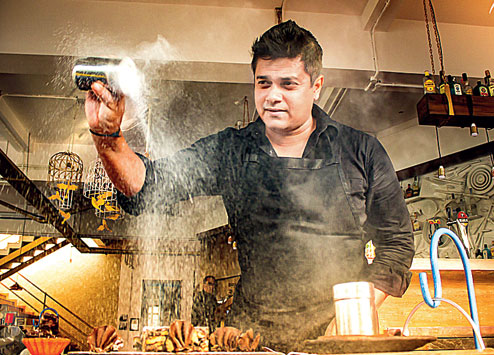

Poring over an article in t2onSunday written by one of my favourite Indian chefs, Sabyasachi Gorai or Chef Saby as he is popularly known, I became curious after reading about his inspiration behind opening restaurants like Lavaash and Mineoirty: his childhood spent in Asansol. I have often passed Asansol, either by car or train, but never taken any serious note of the place until this book came my way.

This is a place that had sparked off the coal mining history of India, way back in 1774. The Asansol-Raniganj-Durgapur belt, once described as the Ruhr area, has been singularly responsible for a sort of industrial revolution in Bengal, which resulted in a huge influx of mining communities from different places. My newfound interest about my state led me to the senior Gorai — chef Saby’s father.
Sakti Gorai, an anthropologist by training, had started working in this area in the Sixties as a senior town planner and had carried out meticulous research about the contemporary social, cultural and industrial structure of the region over a period spanning 1964 to 1993.
Thus, his book Glimpses of the Rurh of India (That Was) became my guide to the history of India’s first colliery belt.
From the tortuous Burdwan Fever or the “Sahib’s disease” that claimed many lives in the area once to the contribution of Prince Dwarakanath Tagore towards establishing organised mining in India through Carr Tagore & Co., the opening of the railway lines between Howrah and Raniganj to the great loss of life because of unfair ways of mining during World War I, the formation of National Coal Development Corporation to the introduction of the Coal Mines Act — Sakti Gorai’s book covers it all.
In Gorai’s words, small towns like Rupnarayanpur, Kulti, Ondal and Kalyaneswari and their people almost turn into characters actively participating in the narrative of a land that vaguely reminds one of Hardy’s landscape where man and nature live together in a fatalistic relationship.
Much coal has been raised from the Damodar basin since John Sumner and SG Heatly had applied for a licence to sell coal in Bengal in the late 18th century. The old Damodar has lost its turbulence and lost are those silhouettes of boats carrying coal on the waters of the Damodar. But to forget the indomitable will of the people of the Rurh to celebrate the good, bad and ugly of coal mining is to ignore our own story, the story of Bengal that was.
Sibendu Das
IN WHOSE FOOTSTEPS WOULD YOU FOLLOW?
Footsteps (Three Rivers Press, Rs 499) is an anthology of articles by various writers. Once published in The New York Times, the articles have been compiled as a book of travel essays. The anthology follows both the literal and literary footsteps of authors across the globe, winding through cities, states, islands and mountains that found a place in their imagination.

Reading Footsteps is not a passive, peaceful experience. It makes you jump up and follow the book around as it leads you on a whirlwind tour of the world, dodging just as quickly through minds as through streets and alleyways.
At the end of every three or four essays, I found myself exhausted, because every page was so infused with emotion: the writer’s, those of the author they were following, and the ones they invoked in me. A strange restlessness saturates every page of this book. It creates in the reader a desire to be far away from what one knows; to shed one’s skin and turn into something else.
In fact, if the essays could be said to have one thing in common, apart from the theme, it is this restlessness. From Byron’s flight to Geneva to Baldwin’s rush to France, from Rimbaud seeking the corners of the earth to Pamuk looking for his Istanbul under the skin of what it has become, the book seems to be continuously searching for something. As the writers seek signs of their favourite authors in the cities, the authors haunt the streets, searching for love, refuge, mystery, friendship, peace and meaning.
The most remarkable essay in the book is the one focusing on Kerouac’s sojourn to Mount Hozomeen in Northwestern US. Elevated partly by Kerouac’s densely evocative prose and partly by the writer’s (Ethan Todras-Whitehill) dedication to him, the essay transports the reader to the gigantic shadow of the mountain, looming over the brooding forests of pine and mist that wrap around it even now.
Another essay focuses on Yeats’s Innisfree, the island of buzzing bees and purple noons. The poem is a personal favourite and to find its inspirations, or at least the fractions of it that can be gleamed today, is no mean task, given that it doesn’t really exist outside the poet’s head.
The only complaint that one can make about this anthology is that on occasion, the essays can feel rather like journal entries or travel reports rather than a coherent weaving of facts with their deeper resonance. Otherwise, this is a book for the dreamer. Sometimes, we forget that the city we live in shapes us just as our feet shape it. Pick up this book if you need a reminder of that special kind of magic.
Rushati Mukherjee
MURDER, MAHABHARATA-STYLE

The Mahabharata Murders by Arnab Ray (Juggernaut, Rs 350) is a thriller featuring homicide detective Ruksana Ahmed. A serial killer who seems to be drawing inspiration from the Mahabharata is on the loose and Ruksana is trying to track him down with the help of her partner, Siddhanth Singh, and the politician Pavitra Chatterjee, who also goes by the name “Yudhistira”, owing to his extreme honesty. A photo of Pavitra is found at every crime scene, making him the killer’s endgame.
The book has a slightly stilted beginning, although it picks up pace near the very engaging middle. An abrupt plot twist means you will often hold your breath while turning the pages.
The complexities of Ruksana’s family background have been written movingly, in a female narrator’s voice. And the exploration of Ruksana’s sexuality is believable, liberating even.
But the third act is the book’s weak point, where the author creates new problems and solves them immediately. And the twist in the end is not convincing, because there have been absolutely no clues leading up to it. It almost feels like an afterthought. The only major clue seems like it was inserted during editing. The author also tries too hard to fit every single aspect of the story — physical and emotional — into the Mahabharata arc, to the extent that it stretches credulity.
Though it has its problems, The Mahabharata Murders is an engaging book that you might want to pick up for a quick, light read.
Rushati Mukherjee
A WELL-WRITTEN HISTORICAL THRILLER

In an author’s foreword to Ashoka: Satrap of Taxila (Westland Books, Rs 299), Ashok K. Banker writes, “If you’re looking for an engrossing, enjoyable, fictionalised account of what life in that era was probably like, based on the known archaeological facts and historical narratives, then read on”.
As he himself admits, very little is actually known about Ashoka, the subject of this book. Based on this, it seems that in Ashoka: Satrap of Taxila, the period is romanticised and Ashoka’s character — imbued with courage, moral virtue, and remarkable philanthropy — perhaps exaggerated. But the Mauryan empire was undoubtedly a great one, so this is understandable.
Otherwise this is an enjoyable read. The battle scenes are probably when the book is at its best. Although reality does need to be suspended at times, the depictions of these scenes are colourful and also rather graphic. The palace intrigue, including a raunchy sex scene, woven throughout the novel also adds to a growing sense of suspense and an increasingly racy narrative with a suitably menacing antagonist and heroic protagonist — Ashoka himself. The book ends with a well-crafted cliff-hanger to set up the sequel, Ashoka: Master of Magadha.
Elliot Keck
A ‘FAT’ HEROINE FINDS LOVE — AND HERSELF

Encounters of a Fat Bride by Samah (Penguin Random House India, Rs 175) is about Madhurima Pandey, a girl who weighs 93kg. Her parents can’t find a husband for her, although she doesn’t even want to get married. Hemmed in by social pressure, she is forced to say yes to her parents, until her self-esteem sinks so low that she can no longer separate herself from the rejections she has faced.
The book takes a critical look at the Indian marriage “market” and the romantic stereotypes promoted by Bollywood, showing how vicious these can be, for both girls and boys.
Madhu, who pines for male validation, begins to unlearn her damaging behaviour towards herself and others after landing up at a therapist’s chamber.
So when she does find love, it’s not because she needs anyone to make her feel better about herself but because she truly appreciates the man as a person.
There is no doubt that this was a story that we needed. It shows how Madhu’s weight causes her stress, and later, it shows her joining a dance class for self-improvement rather than an attempt to lose weight. This change of perspective in body image is an improvement on the way stories about fat people are usually told, especially in films.
As a reader, one wishes there was a story about a fat girl in which her being fat may be instrumental to her mental make-up but incidental to the story. This book is a step in the right direction, even if it isn’t quite there yet.
Rushati Mukherjee