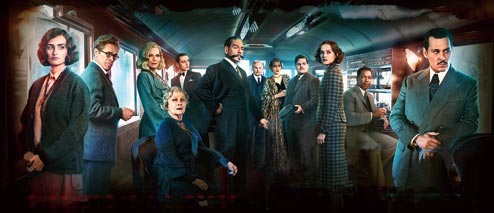


Kenneth Branagh — who plays the central role of super sleuth Hercule Poirot — directs the fourth adaptation of Agatha Christie’s 1934 crime thriller Murder on the Orient Express. The film that’s now running in the theatres boasts a star-studded cast — Judi Dench, Johnny Depp and Penelope Cruz to Willem Dafoe, Michelle Pfeiffer and Daisy Ridley. The plot? Poirot has to solve a murder aboard a train where almost everyone is a suspect. A chat with some cast members — led by Branagh…
It’s often said that being a director is like having your own train set to play with and in this case, you really did! The ‘Orient Express’ is very much a character in the film, isn’t it?
Kenneth Branagh (director and Hercule Poirot): Yes, because it can be exciting, glamorous, romantic, lethal…. It travels quickly and it is marooned at a dangerous place, so it becomes a claustrophobic confined environment in which people can be tested, nerves can be frayed and drama and conflict, which is the stuff of good storytelling, comes out.
When you’re limited to such a small environment, how does that make its way into your character?
Josh Gad (Hector MacQueen): It was surreal. I actually just had an opportunity to go on the real Orient Express, which was pretty amazing. The detail that the team brought to this production is unreal. It’s exquisite… it’s so spot-on. Everybody’s got a secret, everybody’s got their story right and everybody is what they appear to be, but there’s more to them. And when you’re confined in a space like that, it does something to you. It creates this sense of unease even if you have nothing to hide… that sense of, you know, are we on a train with a murderer?
Judi Dench (Princess Dragomiroff): What was extraordinary was that we were all together, it’s not like a film you do when you’re all in different bits. I remember once being in a film and going to the premiere and saying to an actor friend, ‘Hello, hello! What are you doing here?’ ‘I’m in it!’ he says. But in this case, we were all there all the time. And with all this footage going by, I wasn’t even aware that they were big screens. I thought that we were there, it was so believable! A lot of our job was done because, you know, the surroundings are done for you. Lucky us, lucky us.
Derek Jacobi (Edward Henry Masterman): We all established relationships with each other, not only as characters, but also as actors, as a company. One of the things about working with Ken on a film is that you get to laugh a lot. He creates on set an atmosphere where you are free to be yourself, to indulge yourself, to have fun — but what is important, mainly, is the work. When you think, he was playing the leading role, he was directing it, he was doing everything.
It’s a very dark story at its heart. Is that something you wanted to bring to the film?
Ken Branagh: It’s very much, and there’s the mystery, but then there’s rage and there’s loss, and there’s grief underneath it all and everybody has a story.
Did you watch Sidney Lumet’s 1974 film Murder on the Orient Express before shooting your film?
Ken Branagh: I did not and that was conscious. Our goal was to try and find a new approach. That’s why, I think, classic stories are worth retelling.
Penelope Cruz (Pilar Estravados): I had seen it when I was a teenager, but I didn’t remember anything. I am playing this character that Ingrid Bergman played so well, and there was no way that I could approach it trying to do what she did. And it was very clear for us that we were doing something new — all respect to the other film — but it was something new and very modern.
Ken, did you want your cast to read the book or did you prefer them to stick to the script?
Ken Branagh: They were free to do either, we took inspiration from everywhere.
Manuel Garcia-Rulfo (Biniamino Marquez): I did go to the book once I knew I was going to be in the film. I remember reading it a long time ago, but just for fun. I mostly listened to the script, to Kenneth….
Daisy Ridley (Mary Debenham): I read the script first, before I auditioned, and then I went back and read the book to see anything extra that I might need to know, although it was quite different. At the first session we had with Ken, we were talking about questions of moral and moral compass. There were these incredibly emotional days that I wasn’t actually expecting from a murder mystery, if that makes sense, and the questions of morality, to my mind, were shifting as we went on, which was interesting.
Sergei Polunin (Count Rudolph Andrenyi): I didn’t really refer to the book because my character was made up. I play a dancer and I am a dancer myself, so for me it was just digging into my own life, my own experiences.
The story is 80 years old. What themes will appeal to modern audiences?
Ken Branagh: I think we’ve had a chance, with the blessing of the Agatha Christie Company, to be inventive, a bit imaginative with how the story goes, in consultation with them in the spirit of Christie. It does ask quite a stark question about whether revenge, or an eye for an eye, is finally a satisfying way to avenge even the most terrible of crimes. Agatha Christie, and then (screenwriter) Michael Green, found something in the depths of these characters. I hope the heart of the piece comes out of the mystery.
With such a classic story, how do you decide where to make changes and where to make tweaks?
Ken Branagh: I’d have to kill you if I told you the details of all of it! One of the things we did early on was try to improvise a bit. We tried to find nuggets of character information that came from what Agatha Christie wrote, what Michael expanded on, but also what our actors were sort of drawn to.
Willem Dafoe (Gerhard Hardman): When you’re making a world and you’re part of this really strong ensemble, it’s all about finding your place. We were given lots of opportunities because we’re hanging out together all the time. As Judi said, it was quite complete, so I never felt stressed about finding the character, because we were living together and we were creating the world and very much guided by a witty and sharp screenplay, with a real edge.
Who in the cast would you want to bunk with on the Orient Express?
Lucy Boynton (Countess Helena Andrenyi): I’d have to choose Josh Gad just for the comedy.
Josh Gad: Not for my good looks?!
Olivia Coleman (Hildegarde Schmidt): Can I bunk with Judi? I’m right next to you, so you have to say ‘yes’. And Daisy, is that all right, can we have Daisy too?
Penelope Cruz: Well, I was going to say Judi too, but it’s okay, I’ll go with Daisy because we were sleeping together in the film. Don’t write the way I said it, okay! (Laughs)
Josh Gad: Daisy, I would have you in the train, so that I can just bug the hell out of you. And Judi, the first day I met you, do you remember what I said to you? I said Dame Judi Dench, more like damn Judi Dench!
Derek Jacobi: Well, I think that now he’s a gay icon, I’ve got to go with Josh too.
Sergei Polunin: I’ll go with Johnny Depp (who plays Mr Ratchett).
Ken, we need to talk about Poirot’s moustache. It is the best moustache... ever!
Ken Branagh: Agatha Christie describes it in the books as “immense” and so that’s what we decided to do. The moustache is a protection and it’s a provocation. He can hide behind it, but also when people ridicule it, or mock it, or sneer at it, or dismiss him, they underestimate him and therefore his job as a detective becomes simpler.
LURCHES WILDLY BETWEEN RESPECTFUL ADAPTATION AND CLUELESS REMAKE
In early 1934 Agatha Christie’s Murder on the Orient Express was published. Her third, and best, Hercule Poirot novel of the decade, it told the tight, claustrophobic tale of a primal connection between 12 seemingly disparate suspects and one profoundly sinister criminal on the eponymous snowbound train. It was received with rapturous reviews.
Since then the novel has been adapted into a stage play, a radio play, three television dramas (including the well-regarded David Suchet version in 2010) and one beloved Oscar-winning movie from 1974, featuring Albert Finney (as Poirot), Lauren Bacall and Sean Connery. It seems highly likely that at no point during this long and admirable adaptation history did anyone ever think: “You know what would make this even better? A special-effects avalanche, a chase scene, a fight scene, some dance-karate and a bonkers plan to set the climactic reveal in a tunnel!” And yet, as Poirot himself might have said: “Mesdames et messieurs, I give you Kenneth Branagh’s Murder on the Orient Express!”
To be fair to Branagh (here working as actor-director-producer and indecent-hogger-of-close-ups), that this is bland and occasionally awful is not entirely his fault. Being charged with rebooting the quaint pleasures of Poirot in the era of True Detective and Scandi noir is a poisoned chalice indeed.
Branagh begins with a newer, more troubled hero, who solves an initial crime in Jerusalem (the book begins in Aleppo, which might have made a bolder opening salvo), yet informs a local officer that his preternatural ability to see the imperfections around him makes living itself utterly “unbearable”. Ooooh. Dark Poirot. Nice. Very Batman. And, perhaps to prove the point, Branagh’s Poirot is also burdened with a preposterously shaped mega-moustache, as if two terrified grey squirrels had been surgically attached to his face.
Our bushy-faced hero soon finds himself in the dining car of the titular train and surrounded by an impressive array of star performers playing posh passengers and soon-to-be suspects. They include Daisy Ridley from Star Wars as the governess Mary Debenham, Michelle Pfeiffer as the garrulous Mrs Hubbard, Judi Dench as the stern Russian Princess Dragomiroff, Derek Jacobi as the manservant Edward Masterman, and Penelope Cruz as the missionary Pilar Estravados. All of the characters are, of course, intimately bound to the villain, Mr Ratchett, played by Johnny Depp with De Niro sneers and Noo Yawk delivery. So far, so Christie, so what?
And then, suddenly, because audiences are apparently morons, we get a giant computer-generated avalanche that almost sends the train hurtling off the side of the mountain, which has the unfortunate side-effect of making the subsequent murder seem slightly trivial by comparison.
The film then lurches wildly between respectful adaptation and clueless remake. It gives us a silly, superfluous chase sequence between Poirot and the secretary MacQueen (Josh Gad) under a makeshift mountainside scaffolding on which the distressed train is precariously balanced. There are fight scenes too, and a nutty moment when a count (Sergei Polunin) uses his ballet skills to beat up some photographers.
The rigid studio setting (filmed in Surrey) is painfully synthetic, and the computer-generated exteriors have all the artificial charm of The Polar Express. Branagh’s shooting style is bafflingly erratic and bounces between overhead shots, swooping crane shots, shots through glass, shots under the train and shots out of windows. It’s as if he’s suffering from visual diarrhoea, or he simply can’t stop himself from telling you, repeatedly, that this film is being directed by a man who is using a camera.
The other actors, too, are poorly served. They are rarely on screen together, as an ensemble, and must make do with scrappy, patchwork storytelling (bit of Pfeiffer here, bit of Jacobi there) and a grossly underwhelming climax in which they are arranged, inexplicably, against some trestle tables in the mouth of a mountain tunnel, as if posing for an Annie Leibovitz cover shoot.
Performances fall through the cracks. Cruz and Dench, in particular, have pointless, nugatory roles, while Branagh’s protagonist is unfairly lavished with a gratuitous side-story about pining for a lost love called Katherine. It is, frankly, a criminal waste of screen time, in a movie this mediocre, to cut repeatedly to Poirot in his room, in gauzy close-up, staring into a photo frame and cooing: “Oh, ma chere, Katherine! My love!” We don’t need this.
Christie knew what she was doing. Poirot’s love life is irrelevant. It adds nothing, and only reminds us that sometimes it’s possible, on a film set, to do too many things.
Kevin Maher
(The Times, London)