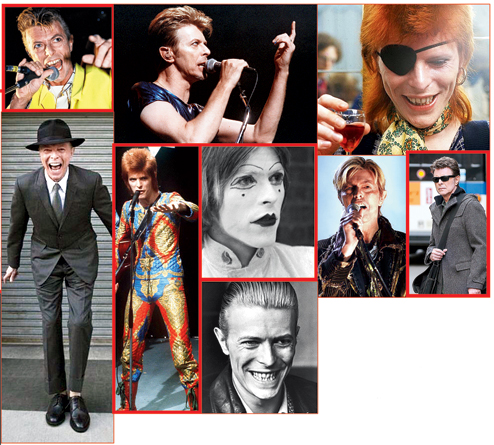

1. Ch-ch-changes
From the cosmic folk of Space Oddity, through the glam rock of Ziggy Stardust, to the electronic dance experimentation of Heroes and the synth-pop of Ashes to Ashes, his music changed the fabric of pop music. The refusal to repeat himself was an aesthetic that he had set out in one of his earliest songs, Changes, in which the 24-year-old Bowie had sung: “Turn and face the strange ch-ch- changes / Oh look out now you rock and rollers / Pretty soon now you’re gonna get older.”
2. Alter egos
He adopted a string of flamboyant alter egos including his most famous creation, Ziggy Stardust, named after a tailor’s shop and the Stardust Cowboy — and whom he described as “a cross between Nijinsky and Woolworths”. Bowie’s first appearance as Ziggy on Top Of The Pops (1972), dressed as an androgynous alien with orange hair and outrageous make-up was the defining moment in the emergence of glam rock as a teenage fashion.
More sinister was the persona he adopted three years later when, taking a line from the title song of his Station To Station album, he became the Thin White Duke: a character who had a dangerous fascination with Nazism. He described Adolf Hitler as “one of the first rock stars”.
3. Screen versatility
The look and character of the Thin White Duke had, in part, been borrowed from his first major film role, playing an alien in Nicolas Roeg’s The Man Who Fell to Earth. The diversity of his musical persona was matched by the versatility that he showed in his parallel screen career: prominent roles included playing a prisoner-of-war in Merry Christmas Mr Lawrence; a goblin king in Labyrinth; Pontius Pilate in The Last Temptation of Christ; an FBI agent in Twin Peaks: Fire Walk with Me; and Andy Warhol in Julian Schnabel’s biopic of Jean-Michel Basquiat.
4. He wrote his problems out
Themes of alienation were prominent in his songwriting, which he admitted was his form of therapy. “Most of my family have been to an analyst,” he said. “My parents went, my brothers and sisters went and my aunts and uncles and cousins. They ended up in a much worse state. I thought I’d write my problems out.”
5. Gender bender
In 1970, he married the 20-year-old Angie Barnett, who claimed that, on their wedding day, they had enjoyed a three-in-a-bed romp; she gave birth a year later to Bowie’s son, whom they named Zowie (now known as the film director Duncan Jones). He had by then already posed dressed as a woman on the cover of his album The Man Who Sold The World, and in 1972 he used a Melody Maker interview to announce that he was gay. He clouded the issue in later years by first confirming that he was bisexual and then issuing a quasi-denial in which he said he had always been “a closet heterosexual”.
Yet, according to Angie in her salacious 1993 memoir Backstage Passes: Life On The Wild Side With David Bowie, she and her husband operated a wildly promiscuous open marriage and swung both ways as “the best-known bisexual couple ever”. She reported that they had both enjoyed affairs with the singer Dana Gillespie and that she had once found Bowie in bed with Mick Jagger. They divorced in 1980 and he married — more happily — the Somali-American model Iman Abdulmajid in 1992. Their daughter, Alexandria “Lexi” Zahra Jones, was born in 2000.
6. ‘Been on Earth before’
He was born David Robert Jones on January 8, 1947 in Brixton, south London. The midwife present at his birth claimed to be a clairvoyant and allegedly observed: “This child has been on Earth before.”
7. The bowie knife
When he went solo in 1966, he changed his name — after the American frontiersman James “Jim” Bowie, who died at the Battle of Alamo (1836) and gave his name to the popular bowie knife.
8. Early influences
He failed his 11-plus and went to Bromley Technical High School, where he fell in love with the early rock ’n’ roll records of Little Richard and Elvis Presley. He had added first guitar and piano to his repertoire, and then saxophone, after his half-brother had introduced him to the jazz records of John Coltrane.
9. Mr Space
His first hit came in the summer of 1969 with Space Oddity, which was released to coincide with the first Apollo Moon landing. Soon arrived the album Hunky Dory, with songs such as Life On Mars and Changes. Then came Ziggy Stardust — and nothing was ever the same again.
10. First US #1
After moving to America (in the early 1970s), there came another change of direction as he melodramatically announced that rock music was dead and embraced black dance music on Young Americans. The album included Fame, co-written with John Lennon; it gave Bowie his first US No 1.
11. Near the infamous wall
To help kick a drug habit that by 1976 had grown “astronomic”, he left America to take up residence in tax-friendly Switzerland. Working with Brian Eno and recording in Berlin in a studio next to the infamous wall, he came up with a trilogy of dark, densely synthesised albums in Low, Heroes and Lodger. Ever the shapeshifter, he also collaborated with Bing Crosby on The Little Drummer Boy.
12. The silent era
He grew increasingly private. He refused to give interviews or promote his records and abandoned the concert stage; his last tour took place in 2003 and his final performance came in 2006.
13. ‘A wider receiver’
His ambition, he once said, was to make pop music a “wider receiver” that could “incorporate ideas from other arts”. His success in this aim was evident in 2013, when the V&A museum in London curated an exhibition dedicated to his career containing more than 300 objects. The breadth of his impact was evident in the list of those who paid tribute to his personal influence: his fellow musicians were joined by Tony Blair, David Cameron, J.K. Rowling, Whoopi Goldberg, the British astronaut Tim Peake and even the German Foreign Office, which thanked him for “helping to bring down the wall” and posted a link to his song Heroes.
14. The ‘Bowie Bond’
Bowie was close to bankruptcy in the 1970s. He had signed contracts early in his career without reading them and a long legal battle ensued. In later years, his business affairs were managed carefully, and, in 1997, he became the first rock star to launch shares in his back catalogue with the “Bowie Bond”, which generated him £37.5 million. The Sunday Times Rich List in 2015 calculated his worth at £120 million.
15. A few of his favourite things
His later years were spent with family; watching box sets of his favourite TV shows, which reportedly included Downton Abbey; and reading the novels of Martin Amis and Ian McEwan. The Times was his daily newspaper of choice.
16. Other interests
Throwing himself into the bohemian world of London hippiedom in the 1960s, he took lessons in mime and dance from Lindsay Kemp at the London Dance Centre; flirted with Buddhism; developed an interest in aliens and UFOs; and set up an “Arts Lab” at the Three Tuns pub “deep in the heart of — God forbid — Beckenham”.
17. Distinctive eyes
In the 1960s, he joined a skiffle group called George & The Dragons — led by George Underwood, who remained a lifelong friend despite punching Bowie in the left eye during a fight over a girl. Bowie needed a series of operations to save his sight, leaving him with a dilated pupil, which made it seem as though his eyes were different colours.
18. A regret
Bowie reportedly turned down an appointment to CBE and a knighthood. He said his main regret in life was that he had never written a book. Asked how he hoped to be remembered, he replied: “Nice trousers, I think I’m supposed to say. Or silly haircuts. Oh f***, don’t do this to me.”
19. His parting gift
In 2013 The Next Day released, his first album in 10 years. Five-star reviews followed and the album went straight to No 1, the first time Bowie had topped the charts in 20 years. Three years later came Blackstar. Released days before his death (January 10, 2016), the record included a song titled Lazarus, which his producer Tony Visconti — one of the few who knew that Bowie had received a diagnosis of cancer 18 months ago — described as his “parting gift” to the world.
 Bowie in numbers
1: His only competitive Grammy Award was for the short film Jazzin’ for Blue Jean, which promoted his 1984 track Blue Jean.
27: The number of studio albums — the eponymous debut of 1967 to his January 8, 2016 release, Blackstar.
39: His standing on Rolling Stone’s 100 Greatest Artistes.
51 million: The number of views his catalogue attracted on Vevo in 24 hours on January 11.
£120 million: Net worth at the time of his death.
140 million: Records he sold worldwide.
1993: Nirvana covered his 1970 song The Man Who Sold The World for MTV’s Unplugged performance series.
1996: The year he was inducted into the Rock and Roll Hall of Fame.
2016: Blackstar turns out to be his first (and sadly the last) #1 album in
the US.
I will remember David Bowie for his.... Tell t2@abp.in