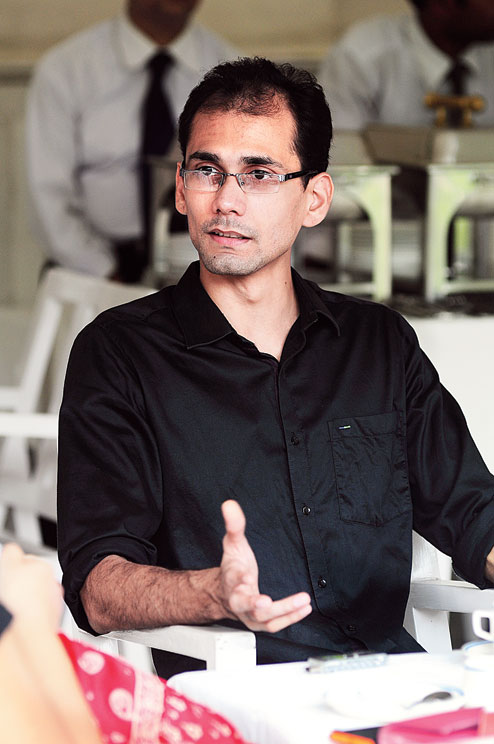

While I was reading the brutally beautiful The Devourers, I pictured its author as Alok Mukherjee, the professor of history the novel opens with. But now as I sit talking to him in the fading light of a summer evening, I change my mind. May be author Indra Das is the other protagonist, the stranger who reveals himself as a werewolf (actually a half-werewolf) to Alok at Shaktigarh Math in Jadavpur.
This was not a frivolous interview but I need to ask. “Are you a werewolf?”
“No, not even remotely,” he replies, equally seriously.
“Did you meet a werewolf at Shaktigarh Math?”
“I did not. But it was influenced by an actual experience at Shaktigarh Math. It was the mid-2000s and I was at the Baul mela, quite intoxicated. Their music is very distinctive, very harsh, very hypnotic... and there was a little kitten on the field, amid all the humans and stray dogs. The kitten came up to me and hid behind me while a pack of stray dogs was trying to get at it, throughout the night. Intoxicated as I was and surrounded by this pack of feral dogs, I tried to imagine what it might feel like to be hunted… actually hunted by something at that same spot hundreds of years ago.”
The Devourers (Penguin Books India, Rs 499), Indra’s first novel, has a young Bengali professor who meets a stranger in present-day Calcutta, who tells him stories. They meet once in a while, at Oly Pub or Maddox Square, and their meetings are imbued with a viscous melancholy that you just can’t seem to shake off. Or may be, like Alok, you too are coming under the spell of the stranger’s stories.

The half-werewolf gives Alok some scrolls written on dried human skin and asks him to type them out. The story in the scrolls then takes you to two werewolves who are shape-shifters — Fenrir and Gévaudan — and their encounters with a woman, Cyrah, in Mughal India, at a time when the Taj Mahal is being built.
Born in Calcutta, 30-year-old Indra studied at Calcutta International School and then pursued liberal arts in Pennsylvania, US. He followed it up with an MFA in creative writing at the University of British Columbia in Canada. He is currently living in Calcutta, awaiting a work permit to return to Vancouver.
In 2012, he was accepted for the prestigious Clarion West Writers Workshop in Seattle, where Game of Thrones writer George R.R. Martin and Fight Club writer Chuck Palahniuk were among his six tutors.
While his growing-up reading list — Tolkien, Stephen King, Michael Crichton, Terry Brooks — gives an indication as to why he veered towards genre fiction, I am more curious about his decision to set his very European werewolves in Mughal India.
“When I was in my early teens, my family and I visited the Taj Mahal and Red Fort and those monuments made a huge impression on me. Immediately I was transported to that era, because at that time I was reading epic fantasies like The Lord of the Rings....
“And werewolves were very common cultural symbols while I was growing up. My fantasies were Eurocentric because of the global nature of capitalism. Stories like Stephen King’s Cycle of the Werewolf or the film, An American Werewolf in London, were all set in majority white European-influenced cultures. But imagining these European fantasy creatures in an Indian historical setting supercharged my senses.”
Indra wrote his first novel aged just 17. “I had this huge ambition of becoming the J.R.R. Tolkien of India, you know,” he grins, remembering his younger, naiver self, who got duped into spending his parents’ money to get this novel published by a “vanity press”.
The predominance of the white, male, straight protagonist is something he feels passionately about. “When I started writing, my default was always white and male and straight. Because that is what I was reading. I am a brown writer but I have the advantage of being a man, and being straight. That immediately puts my difficulty a lot lower than a lot of other writers. But it’s very heartening to see the dialogue against this supremacy. But there’s so much we need to change, still.”
But his decision not to make Alok a straight man was not an attempt against that “supremacy”, he says.
“Stories are very romantic. And the stranger is an incarnation of stories, a pompous one, but still.... So, his and Alok’s interaction carried a seductive note. That’s when it occurred to me that Alok might be attracted to the stranger. That’s when he became bisexual to me, or pan-sexual. And to me you can never have enough protagonists who are not straight and not white,” he smiles.
He has left the final chapter open-ended. Did the stranger leave Alok after making love to him? Will they meet again? Or did the stranger eat Alok and take his form? — I rattle off the possibilities, the author only smiles, and says, “Being able to leave it open-ended is one of the greatest things about art. What happens to the ending of a story is in your brain… there’s an entire universe in your brain now and I absolutely f***ing love that!”
 “He was wonderful. From Game of Thrones, it being as dark as it is, you might imagine that he’d be very grumpy but he really isn’t. He is very open and very jocular, giggling all the time and telling stories. We would all be writing... sometimes he’d come, interrupt us, sit down and talk about his days as a young writer, about throwing people in the pool at award ceremonies, he was very, very talkative. Very enthusiastic and a very good workshopper. That’s where his sternness came through. He was extremely merciless when it came to workshopping fiction. He would not mince words. He would tell you exactly what he thought of your story. He would tear people’s work apart, which is a good thing, that’s what you want in a workshop. He was also terribly exhausted, extremely sleep-deprived, because of his new-found fame from the TV show.
— on George R.R. Martin,
one of his tutors at Clarion West Writers Workshop
Samhita Chakraborty
What question would you ask George R.R. Martin if you met him? Tell t2@abp.in