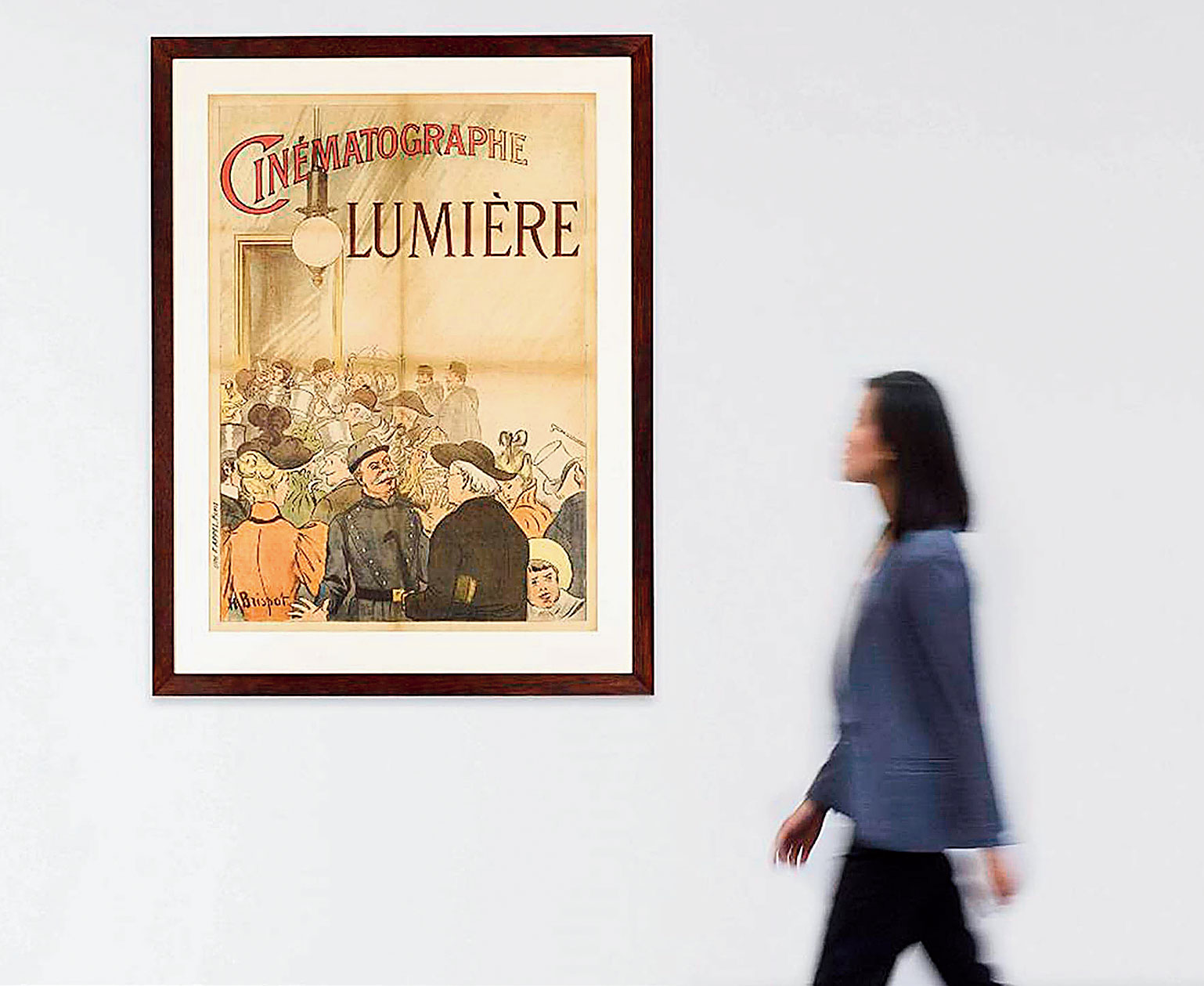

The world’s first film poster, dating back to 1896 and printed to promote 10 short films by the Lumière brothers in Paris, is being auctioned by Sotheby’s in London and is estimated to fetch between £40,000 and £60,000.
“This is the ultimate collector’s poster and a true museum piece,” says Sotheby’s.
In a sense, this poster triggered the birth of cinema.
According to a spokesperson for the auctioneers, “the poster is exceptionally rare, and has been kept in the same private French collection for 40 years. Our consultant is aware of only two other examples in existence — one of which he thinks might be in the French National Archive.”
The short films made by the two French cinematographer brothers, each lasting barely a minute, were screened on December 28, 1895, to an audience of fewer than 30 in a basement room called the Salon Indien (Indian lounge) of the Grand Cafe, on Boulevard des Capucines in Paris. The room was so called because it was decorated in oriental style.
This was the first time moving pictures were shown in public. What was depicted were images of everyday life — for example, 46 seconds of workers leaving the Lumière factory in Lyon; 41 seconds of a baby being fed breakfast; 38 seconds of people bathing in the sea; 46 seconds of horse riders performing tricks; 49 seconds of work in progress in a blacksmith’s; and 49 seconds of a gardener with a sprinkler.


The screen was makeshift. “On the occasion of Lumière’s screening, a white canvas resembling a bed sheet had been hung at one end, with Lumière’s famous cinématographe stationed on a step ladder amidst some 100 chairs borrowed from the Grand Café,” according to Sotheby’s.
The reaction from those watching the 20-minute event was immediate and totally unexpected. According to a contemporary account from an eyewitness, Victor Perrot, “some greeted the screening with suspicion, whereas others seemed utterly shocked by the experience”.
When the lights went down, one woman was so spooked she “uttered a shriek of terror. Later on, there was widespread talk of magic and trickery, as though the moving images were the ruse of a clever conjurer. One man complained that it was unfair to make a mockery of the public in such a way”.
The press were invited but made a bad mistake by not turning up. They caught up quickly with the story splashed across the papers. Perrot, who had got a head start with his exclusive, enthused in various articles and memoirs about a “great historical first”.
After the initial screening, two versions of the poster were rushed out to publicise further screenings. The one that is being auctioned, 105.4cm x 75.5cm and designed by a French artist, Henri Brispot, depicted a throng of people queuing to see the premiere in the Salon Indien. “It is a beautiful tribute to a winter evening which veritably changed the world, uncovering the ‘magic’ of film for the very first time.”

The posters were plastered all over Paris. It is recorded that on January 1 and 2, 1898, 2,000-2,500 people paid a franc each — about $100 in today’s money — to see the “cinématographe”.
Cinema was born.
“It marked the public beginning of one of the most important cultural, artistic and social phenomena of the 20th century. Within a few months, Lumière cinemas had opened in all major international cities, and screenings had been held for most heads of state, kings, queens and even the Tsar and Tsarina of Russia.”
What was also quickly established was the crucial rule of posters in popularising cinema.
On July 7, 1896, the Lumière brothers showcased six films at the Watson Hotel in Bombay and this marked the birth of Indian cinema as we know it today. They arrived in India after having proved their cinematic excellence in Paris. By and by, skilled Indian painters — MF Husain was one of them — became adept at turning out giant Hindi film posters, few of which, sadly, have survived.
Online bidding for the world’s first film poster will take place between August 28 and September 4.
Sotheby’s previously achieved its highest price for a film poster, with King Kong, which smashed its estimate when it sold at £42,000.