The comatose Bengali film industry is looking towards a 73-year-old Bengali businessman from Tripura to get out of life support and back on its feet.
Last Friday evening, amid hostilities, Ratan Saha was declared as president of the Eastern India Motion Pictures Association (EIMPA) via voice vote. Saha replaced Piya Sengupta, who was close to former minister Aroop Biswas and his younger brother, Swarup, the de facto bosses of the Bengali film industry aka Tollywood.
The legality of the move has been questioned by some members owing allegiance to Sengupta.
There are at least four members from the film fraternity in Bengal who won the recent Assembly polls on a BJP ticket, but the Bengali from Tripura has emerged as the one the industry is pinning its hopes on.
The Biswas brothers are no longer calling the shots after the change of guard in Bengal. The question hovering in the mind of most insiders is whether the Biswas brothers have been replaced by the Sahas from Tripura. Ratan Saha and his son, Shatadeep, run the SSR Cinema Chains operating in Tripura and Bengal.
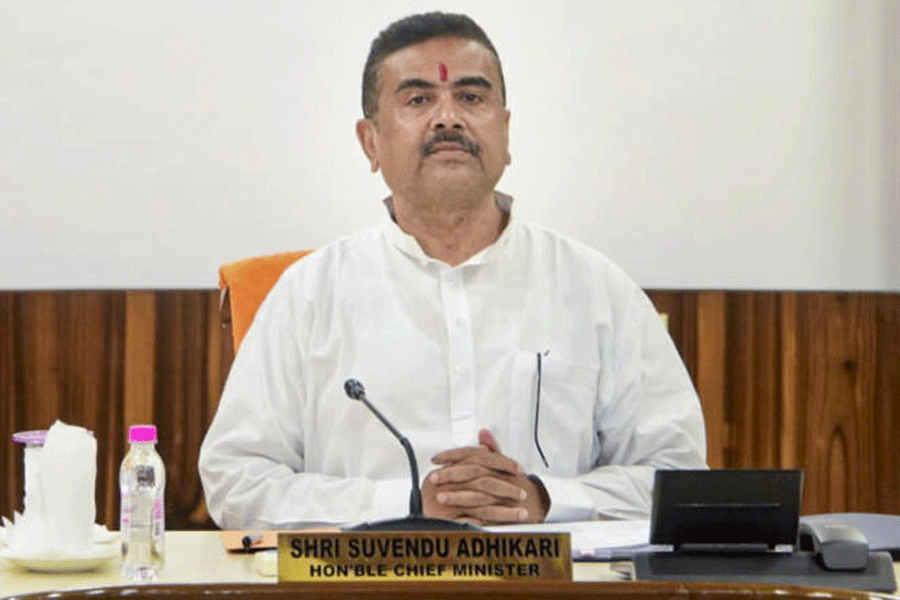
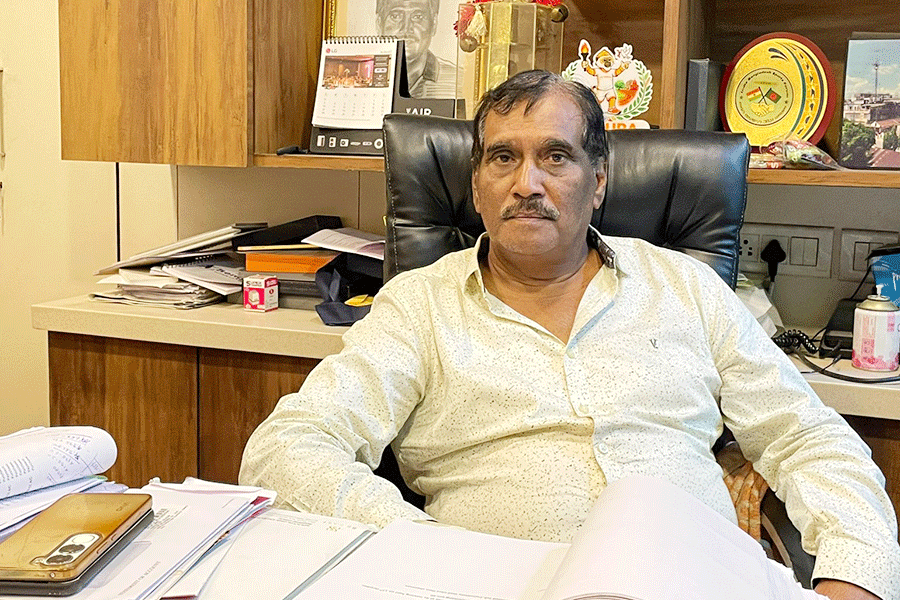
Ratan Saha, who is an elder sibling of Tripura chief minister Manik Saha, has political clout and heft that few can match. A section of the producers and filmmakers have rallied behind Saha to pull the film industry out of the Trinamool’s alleged clutches.
Saha, who has been in Bengal for over 50 years, says his being an elder brother of the Tripura CM has little to do with his elevation. He was the chairman of the exhibitors' section under EIMPA.
“Who came first, the chief minister [of Tripura] or me,” Ratan Saha asked, sitting at his office off Lenin Sarani in central Calcutta. “He has been a chief minister only for a few years. I have been in the industry for more than 50 years.
“I am a businessman. I am not a politician,” he told The Telegraph Online. “I will not join any political party. For obvious reasons I support the BJP. But will I carry the party flag? Will I give political speeches? No.
“I have been given a responsibility and I will utilise it to improve the condition of the industry. I am not hankering after any posts.”
The Saha family traces its roots to Brahmanberia in Comilla, Bangladesh, and made their home in Tripura over eight decades ago.
Ratan and Manik Saha’s father, the late Makhan Lal Saha was a businessman who had multiple ventures that included printing press, cinemas, brick-kilns and making biscuits and lozenges.
In 1972, the family started Rupasi, a single-screen theatre in Agartala’s Post Office Choumohuni, which opened with Satyajit Ray’s Seemabaddha. A year later, Ratan Saha moved to Calcutta to study law and play badminton. His father also gave him the responsibility of running the family-owned Ajanta Cinema in Behala.
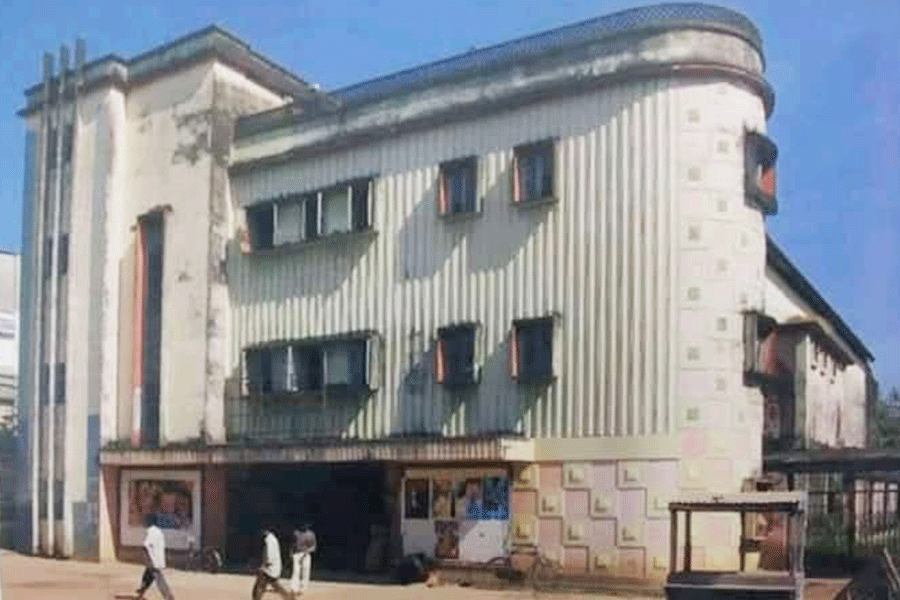
Rupasi cinema in Agartala, owned by the Sahas, has now been converted into a mall Sourced by correspondent
A divided house
On the day the Bengal Assembly election results were announced and the BJP came to power winning 207 of the 294 seats, Saha and his backers went to the EIMPA office to stake their claim on the film body of producers, distributors and exhibitors that has 22 elected and six nominated members in the committee.
How many among the few hundred EIMPA members are qualified to be members has been disputed for years.
“In the last decade and half, the Bengali films market has been completely finished,” said Krishna Narayan Daga, former EIMPA top boss, whose family has been in the trade for four generations.
“Existing rules were bent, new rules framed,” said filmmaker Milan Bhowmik, who calls himself a BJP supporter. “Producers had no say in how the industry would be run. EIMPA should have looked into the problems faced by the producers, distributors and exhibitors. Instead, the EIMPA officials were busy toeing the line of the ruling party for the last 15 years.
“The film industry has slipped into a coma,” Bhowmik added.
Daga and Bhowmik, who are among those backing Saha, cited a screening committee that was announced last September to decide on a film’s release date.
“As a producer, I could not decide when to release my film. I would have to appeal before the screening committee which included Swarup Biswas. Why?” Daga asked. “Films with less than Rs 2 crore budget would not get a multiplex release. Where will the small producers go?”
Daga said that superstar and Trinamool MP Dev had opposed the move. “Even Prosenjit had to submit his film to the screening committee,” he said.
Since the Trinamool came to power in Bengal, the two brothers from New Alipore – Aroop and Swarup – allegedly controlled every aspect of filmmaking, often pushing film directors and producers out of Bengal.
The Biswas Brothers allegedly decided on the size of a unit required for a shoot, the technicians to be hired, their fees and ban directors and actors at will among other actions.
The Telegraph Online had reported on their grip over the industry.
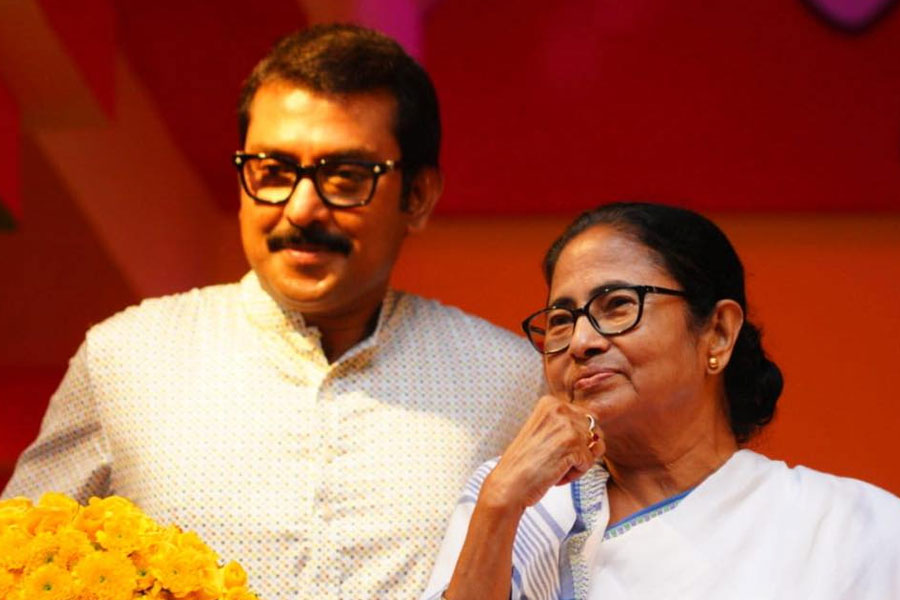
The events that rolled out on Friday when Saha and those supporting him went for a meeting with Sengupta have made into social media feeds.
At least twice Sengupta walked out of the meeting, which was held in the presence of an additional officer-in-charge of the local police station. One of the videos shows Sengupta trying to walk out of the room with a stack of yellow folders containing documents. The nature of the documents is unknown.
A scuffle reportedly broke out during which Sengupta alleged she was injured. Members from both sides went to Calcutta Medical College and Hospital and later the Bowbazar police station to lodge complaints separately.
Saha’s son, Shatadeep, a member of the distributors’ section, pleaded several times with her to join the meeting.
“They wanted to remove Piya di as the president on a voice vote. How is this even possible? Her term ends in 2027,” said a film-producer close to Sengupta.
At the crux of the matter is a dispute over the number of members in the association, which is pending before Calcutta High Court.
Justice Arindam Mukherjee of the high court in his order on September 22, 2025 referred to a previous order and wrote: “The dispute as to the electoral list of EIMPA has become the source of a litigation or litigations just prior to the elections which is scheduled after every two years as per the rules and regulations of EIMPA. On each occasion the same facts surface. A group of members have objections regarding the inclusion or elimination of the members to the electors list.”
For the next election scheduled for 2027, the court had appointed three officers of the law to scrutinise the documents of members under a shadow of doubt.
Incidentally, the members who “unanimously” agreed on Ratan Saha as the new chief are from the same pool of members whose inclusion is disputed.
“An SIR [special intensive revision] of the EIMPA members is the need of the hour,” said Saha.
The committee headed by Sengupta is preparing for a fight.
“We are taking legal steps,” Sengupta told The Telegraph Online. ”Legal experts are being consulted.”
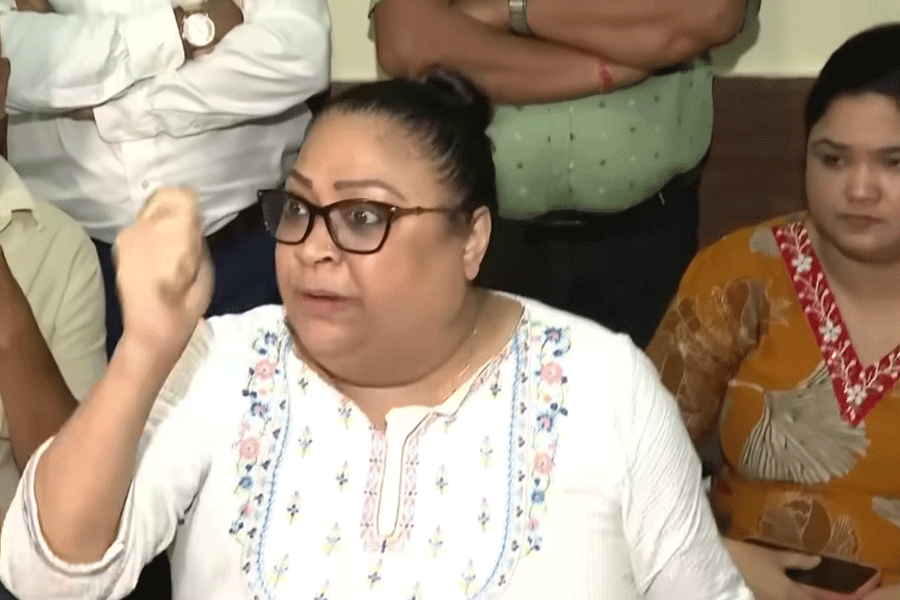
Piya Sengupta Videograb
Battles forward and 100 multiplexes
Ratan Saha is used to prolonged battles and mostly fighting alone.
“What legal challenge? We have been fighting in the courts for seven years. We want the system to be cleansed,” he said.
When a major production house refused to part with a service tax to exhibitors (cinema owners), Saha refused to screen films till the service charge was paid.
The digital projection of films in the theatres has for long been a duopoly in Bengal, which Saha wanted to break.
What was hurting the industry, many felt, were the rates imposed by the companies on films in Bengal. In adjoining states like Bihar and Odisha, the cost was Rs 125 per show for regional language films and Rs 300 for Hindi films.
In Bengal, the exhibitors have to pay Rs 20,000 plus taxes per movie every week.
“I signed a contract with another company. Here in my office I had 50 machines lying. No other exhibitor wanted to get into a conflict with the other companies and did not support me. They did not realise the revenue that belonged to them, belonged to the industry, was being drained,” he Saha said.
The road forward to save the local film industry, he believes, is to increase the number of screens in Bengal.
“If the industry has to be saved we need to build more cinemas,” says Saha.
Saha has been treading on that route since the mid-2000s first when Ajanta was transformed from a single-screen theatre to a multiple one. Next came the turn of Rupasi in Agartala that which was converted into a mall and multiplex.
“People had laughed when I said Agartala must get a mall and multiplex. Though it was family owned, I took over the ownership and developed it,” Saha said.
Saha then went on an expansion drive acquiring and renovating single screen theatres or building new ones in Tripura and Bengal.
“Forty-four such theatres are either ready or in various stages of completion. My target is 100. I am going a little slow these days. Had the previous government cooperated I could have finished my work,” he said. “I Hope the new government in Bengal will look after the industry’s needs.”
The road to recovery is arduous and the heavily fragmented and politicised industry will have to limp for a lengthy period.
So, will the Sahas control the Bengali film industry now? “I can only give suggestions. There is nothing to control here,” Saha replied.