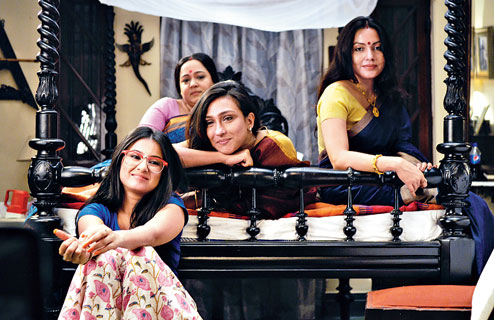

Mingling with people outside the film industry, reading, travelling, and watching films and theatre in the suburbs help director duo Shiboprosad Mukhopadhyay-Nandita Roy have their finger on the public pulse. Their summer release Bela Sheshe has made Rs 2.5 crore just from hall collections, and is running to houseful shows in the sixth week. Can it get any better?
Shiboprosad tells t2...
Congratulations! Bela Sheshe has not just broken even, it has also made a profit. What do you think is the reason behind the success?
It’s a clean family entertainer. People in the age group of eight to 80 can relate to it. I have had people who came to watch a Bengali film in the theatres after 25 years! There’s a huge repeat audience. If the wife has seen Bela Sheshe with friends, she’s come back with her husband; the son is bringing his parents. All these define success. In its sixth week, Bela Sheshe is running to a full house in 39 theatres across Bengal.
Bela Sheshe has been quite a game changer for Bengali films going through a rough patch...
Between 2011 and 2015, we made five films, all of which did good business. Ichche was stuck for three years, when it released nobody watched it till the third week. Week four was stupendous! Muktodhara (2013), Alik Sukh (2014), Ramdhanu (2014) and now Bela Sheshe, the key factor in all these films is the story and honesty in choosing the cast. Sohini Sengupta made a comeback with Alik Sukh decades after Paromitar Ekdin. Whether it’s Samadarshi in Ichche or Nigel Akkara in Muktodhara, Gargee (Roy Chowdhury) in Ramdhanu or Swatilekha Sengupta-Soumitra Chatterjee in Bela Sheshe, we’ve only chosen actors who suit the characters. We don’t believe in unnecessary hype by casting a big name. We believe that Bengalis love to read, watch and listen to good stories. The story is most important. It hardly matters whether we are backed by top producers or not. It’s a myth that films should be backed by big production houses, big stars. We’ve proved it wrong. In five years, consistent good story has put us on top!
And there’s a social message in all your films...
A good story always has a message. With every film we rediscover ourselves. We interact with common people. We watch plays, go to Santiniketan. It’s very important to interact with people outside the industry. But what happens is often directors shut themselves up and interact with only a handful from the industry. That is when they start making unrealistic films. I had gone to a friend’s daughter’s birthday party and that is where I got the idea to make Ramdhanu. I met a couple who wanted to leave early because the next morning they had to appear for an interview in a school for their son’s admission.
In one of the scenes in Bela Sheshe, Swatilekha Sengupta says she would watch the mega serial Jal Nupur, like in many middle-class homes. Do you feel incorporating such details are a must to make the connect?
See, our USP is to make films about everyday things. We love to observe the everyday, mundane things. When you make a film removed from reality, films that show everything perfect and nice have no connect. That doesn’t mean directors cannot have larger-than-life stories. Muktodhara was larger than life but it had a very strong social message. But when you highlight normal incidents, people immediately relate to them. Besides, the characters in our films live, walk and talk in a manner that is relatable. After writing a script, we pick out portions and discuss with friends. Like Monami (Ghosh) and Anindya (Chatterjee), the young couple in Bela Sheshe, are what couples are like today. They interact more on WhatsApp than face to face. When I told this to my friend, his wife stole a glance at him and I knew there would be a connect.
Your films are made within a crores. What’s your budget formula? And how do you recover costs from ticket sales alone?
The budget isn’t an issue. Bela Sheshe is a Rs 1 crore movie. I can’t spend more than this, where is the market? I have a limited market. Bela Sheshe released with 51 prints. In its third week, I released it in Maslandapur, Uluberia and other places in the interiors. Had I released it in the first week in these chains, my film wouldn’t have done well. Now word of mouth is strong and there’s a demand, so releasing it in the third chain after a few weeks always makes sense. We made
Rs 60,000 from Jyoti Cinema Maslandapur in a day. Had I released it in the first week, the collection would have been Rs 3,000. In its sixth week, I’m getting calls from hall owners who are keen to run Bela Sheshe in their theatres.
I would suggest that directors should forget about satellite rights. The main revenue comes from hall collection.
And your target audience has definitely expanded...
Yes, from the family audience to teenagers. When the young crowd watches your films, then there’s a greater word of mouth because they are very active on social media. They immediately tweet or post updates on Facebook and that really helps.
How have you stuck to a core team and beaten the odds in today’s Tollywood?
When I did Alik Sukh, a very big production house came forward to produce it. But I stuck to Atanu Roy Chowdhury. Why? Because he was the one who was there with me in my bad times. And Rituparna (Sengupta) is someone who introduced me to one producer after another five years ago. She may not be there in all our films but she believes in us and we are a team. I can’t imagine a good film without her. We know that a section of the audience waits for our films. Similarly, they wait for Srijit’s (Mukherji) films, or Mainak’s (Bhaumik) films. Our joint agenda is to bring people back to the theatres. Most of us have been fairly successful. Open Tee Bioscope was a huge success.... A story must have a good beginning and a better ending.
From Ichche to Bela Sheshe, what have you learnt and unlearnt as a filmmaker?
Ichche taught us to be persistent and honest. Muktodhara taught us how to manage a fairly big-budget film and an ensemble cast. Alik Sukh taught us to experiment as far as the casting goes. Having Sohini Sengupta and Debshankar Halder in a film and yet get the money back was a challenge. Ramdhanu made me confident as an actor (Shibu played Gargee’s husband) and Bela Sheshe taught us to believe that a good story will pull the audience to the theatre. Bela Sheshe has made us confident and proud.
Friend, guide and cast member Rituparna Sengupta on Bela Sheshe and her association with Shiboprosad-Nandita...

I have always believed in Shibu and Nanditadi’s talent. We started off together with Ritur Mela Jhoom Tara Ra, a dance-based TV reality show, which was very popular. They had dreams to make films and when they narrated the script of Ichche to me, I was immediately interested. I tried my best to get a producer for them even though I couldn’t be a part of the cast. I did Muktodhara and Alik Sukh with them.
What I really admire about them is that they have an urge to present a character in a different way. They have moulded me, challenged me as an actress and made me do things I never imagined I would be able to do on screen. They are directors with a vision. Another thing which is commendable is that they do their homework so well. Their energy and hard work for just the pre-production is enough motivation for any actor. Nowadays I actively take part from the scripting stage. I often give suggestions to tweak a line or two, sometimes we argue but most of the time we agree.
Shibu-Nanditadi are brimming with ideas. But Nanditadi is someone who won’t write a script in a hurry. She takes off, shuts herself from everyone, goes away to a quiet place and writes. I am happy that today they are a name to reckon with in Tollywood. Nanditadi is an excellent screenplay writer, while Shibu understands the market very well. Together they are a strong combination. When a film does good business not only do the people associated with it benefit but it gives a push to the industry too. I am confident that together we will make many more films on very interesting subjects. Till then, let us soak in the success of Bela Sheshe....
Bela Sheshe is a game changer because.... Tell t2@abp.in