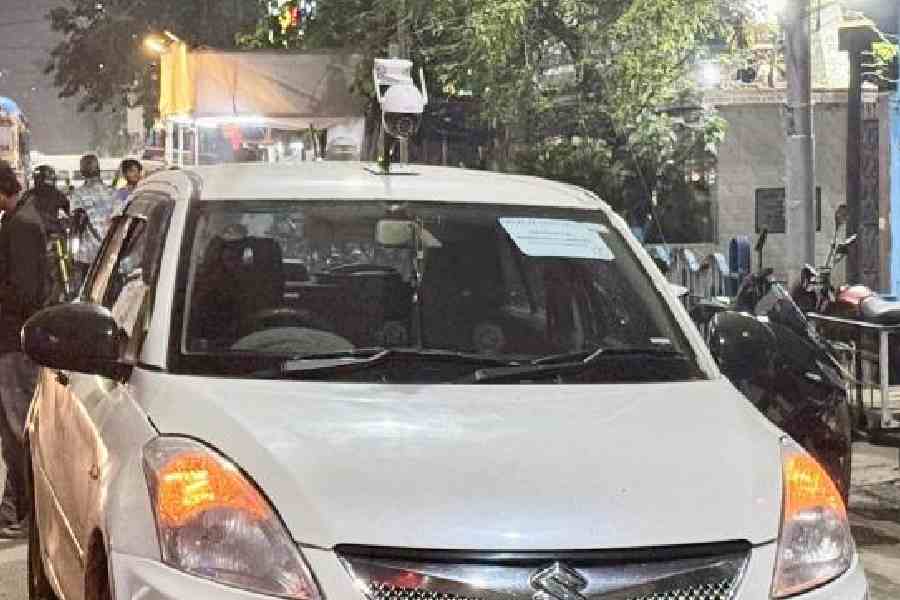
Security cameras guard homes, offices and shops. Mounted on cars, they turn into mobile surveillance tools — and they are now a visible presence on city streets.
Vehicles fitted with roof-mounted cameras have begun moving across Calcutta and the state. These are not linked to improving mapping platforms like Google Maps or Apple Maps. They are part of a surveillance push by the Election Commission ahead of polling, scheduled in two phases on April 23 and 29.
The poll panel has deployed car-mounted live IP (Internet Protocol) cameras to support static surveillance teams (SSTs) and flying surveillance teams (FSTs). Sources said these are PTZ (pan-tilt-zoom) cameras meant to record the surroundings as teams move through areas.
In previous election years, PTZ cameras were limited to vehicles carrying quick response teams (QRTs). This year, however, they have also been installed on vehicles used by SSTs and FSTs, making them more visible, poll panel sources said.
While SSTs and FSTs are activated as soon as elections are notified, QRTs are deployed on polling days. “Static and flying surveillance teams focus on seizing illegal arms, liquor and cash, while quick response teams track intimidation, threats and violence,” a poll official said.
These cameras enable real-time monitoring. Each PTZ camera operates over a local network or Internet connection, transmitting digital video signals. Every device has a unique IP address, allowing remote access — meaning officials can monitor feeds from anywhere.
Footage from the cameras will be relayed to district control rooms as well as the office of Bengal’s chief electoral officer.
The video is stored either on network video recorders (NVRs), cloud platforms or onboard storage such as SD cards. Some systems also support wireless transmission via cellular data networks.
More than 2,600 flying and static surveillance teams will be active across the state, all travelling in vehicles equipped with these cameras. The number of QRT vehicles with similar set-ups will be finalised closer to polling, depending on the law-and-order situation.
Privacy concerns
The cameras vary in capability. Basic models offer fixed views, similar to those used in homes or offices. PTZ variants, however, allow more flexible coverage.
The use of IP cameras has raised concerns around privacy, security and ethics. In 2023, Anker faced scrutiny over its Eufy security cameras for inadequate encryption safeguards.
From April 1, several Chinese video surveillance brands have been banned from selling Internet-connected CCTV cameras in India under new Standardisation Testing and Quality Certification rules, which cover firmware safety, encryption standards, tamper resistance and hardware origin. Even locally assembled devices must undergo the same certification process.
Experts said the technology can strengthen election monitoring if used responsibly. “IP cameras are among the most widely used items for safety and surveillance globally. When put to real and ethical use, they can help monitor situations and save lives,” said Neil Shah, research vice-president at Counterpoint Research, a technology market research firm.
“Powered by AI, these IP cameras can boost the EC’s standard operating procedure. They enable real-time monitoring of behaviour and activity, making them effective.”
However, Shah cautioned that safeguards are critical. “Procurement must follow a thorough process to ensure non-foreign, secure equipment; deployment must eliminate vulnerabilities; and certification must guarantee enterprise-grade protection across hardware, software and cloud systems,” he said.
Calling surveillance a “constant tug of war between security and privacy”, Shah stressed the need for transparency. “Its use should remain limited to elections,” he said.