All is not well in the Bengali film industry. The tragic death of Rahul Arunoday Banerjee, during an outdoor shoot, has exposed the faultlines in an industry that is already fractured. Moreover, the audience seems to be less inclined to watch Bengali films in theatres — the box-office collections of 2026 releases indicates as much.
More importantly, the state is currently in the grip of the Assembly election campaign.
Arjunn Dutta’s Bibi Payra arrives in theatres in such challenging times, and despite the odds, it manages to give viewers a solid reason to show up at the theatres.
What immediately stands out is Dutta’s willingness to step away from his earlier comfort zone. After earning a National Award for his previous work Deep Fridge, which was intense and cerebral, he could have easily played it safe. Instead, with Bibi Payra he goes for a shift in tone and storytelling. It’s a dark comedy at heart, but not the kind that relies on gimmicks. The humour here comes from situations that are deeply uncomfortable, sometimes even disturbing. You laugh, but not without a slight knot in your stomach.
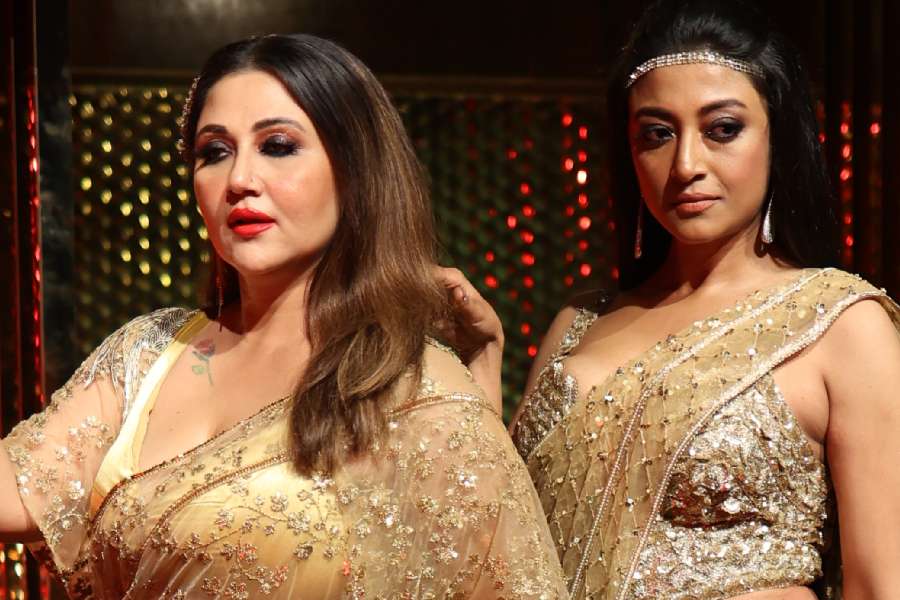
The film revolves around two women: Jhuma and Shiuli, played by Paoli Dam and Swastika Mukherjee, respectively. Both come from lower middle-class households, both are stuck in unhappy marriages, and both are dealing with different forms of domestic abuse behind closed doors. Shiuli is softer, more straightforward, someone who has quietly accepted her reality for far too long. Jhuma, on the other hand, refuses to completely give in.
What makes the film interesting is that it doesn’t treat them as helpless victims. Yes, they’re trapped — financially dependent on their husbands, with limited education, no paternal home to go back to, but they’re not without agency. As their paths cross, they begin to imagine a way out of their misery. And when they finally act, the choices they make aren’t neat or morally clean. That’s where the film finds its bite.
The first half is a laugh riot. The writing by Dutta and Aashirbad Maitra is extremely entertaining. There’s plenty of situational comedy, and it lands well. It’s refreshing to see a women-led film that doesn’t lean entirely on melodrama. Instead, it allows space for humour without undermining the seriousness of what these characters are going through.
The supporting cast plays a big role in making this world feel real. Anirban Chakrabarti, as Shiuli’s husband Jagannath, is the best of the lot. You will hate him, but at the back of your mind you feel that characters like Jagannath are far too many in the society.
Anindya Sengupta brings a different kind of energy as the insurance agent, adding a slightly flamboyant touch that works well within the film’s tone. Subrat Dutta is quietly impressive as Jhuma’s husband. The twist involving him will make you empathise with the character. Lokenath Dey also impresses as Jagannath’s toxic boss.
Among the women, Ankita Majhi does a solid job as the manipulative sister-in-law, and Bhabani Basu Majumdar adds comedic charm as Jhuma’s aunt. All these performances contribute to the larger picture.
Paoli Dam is easily one of the film’s biggest strengths. Her performance is nuanced, layered, and never too loud. Even in moments of intense pain, she holds back just enough, which makes it all the more powerful.
Swastika Mukherjee, in contrast, plays things at a slightly higher pitch, but it works in favour of Shiuli’s character. She captures the vulnerability, the frustration, and the bursts of defiance towards the end, with conviction. Together, they share a dynamic that keeps the film engaging enough.
The depiction of domestic violence is also relatable. Supratim Bhol’s cinematography captures the suffocating nature of these domestic spaces effectively. That said, the film does lose some of its grip in the second half. The narrative begins to feel a bit rushed as it heads towards the climax.
In the end, what stays with you is the film’s tone. Bibi Payra doesn’t shy away from its darkness, but it doesn’t drown in it either. It finds a way to balance humour and discomfort, making you laugh and wince in the same breath.