 |
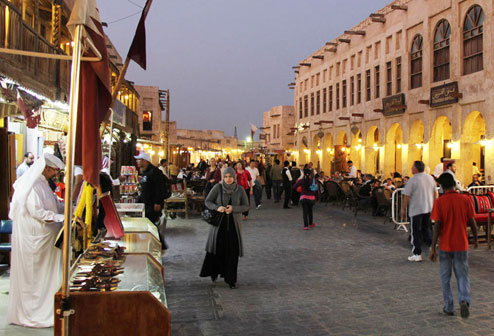
| Souq Wafiq in Doha |
Suspended 36km over the Arabian Sea, I suddenly realised that I no longer wanted to make this trip. A last-ditched attempt to wriggle off the seat belt expired under the hostess’s withering gaze. And I settled back for a four-hour flight to Doha. The capital of Qatar is located on the tip of a peninsula where the Arabian desert ends and the Arabian Sea begins, and four hours was a lot of time to wonder how I could have been convinced to take our hospitality brand to such an inhospitable land.
 |
| Umm Ali or Mother of Ali — a creamy pudding with nuts and raisins |
Finally the flight began its descent. And tall monolithic towers loomed through the desert haze. From the air, Doha’s skyscrapers looked like a ring of stark, gleaming pillars guarding the coast. I felt I was landing on not another country but another planet.
But instead of aliens, I was pleasantly surprised to meet people who would be very much at home back in Calcutta. Magnanimous, chatty foodies greeted me everywhere. Food, tea and gatherings are the three passions Qataris share with Calcuttans, I could tell. But that’s not all. Much of Qatari cuisine has its roots in Indian food.
The ties between Qatar and India reach back many centuries, when Qatar was a hub of dangerous pearl diving. It brought pearl divers from Africa, rich merchants from Venice, slave traders from Morocco, pearl auctioneers from China and Bedouins from Saudi Arabia. But Indian trading caravans seem to have left the most indelible mark, gently blending in with Qatar’s history and culture like the dunes of the desert blending with the waves of the sea.
Qatari cuisine is no predictable Arabian fare like lamb on rice or hummus but breaks away in fascinating ways with seafood delights like lobsters, shrimps, hammour, red snappers, crabs and more, which can be handpicked from the traditional fishing boats called dhows. And it has many influences in its food from as far away as India and Morocco.
Perhaps that gives Doha and its citizens such an easy air of acceptance even around foreign faces, cultures and languages. Their hospitality is nothing like today’s professional skill of making the globe feel small and uniform with minimal fuss. Here, strangers are warmly embraced as friends, through a rich, intricate tradition of gestures and courtesies, which should be received and returned with equal fervour. It’s a throwback to the Bedouins who learnt to depend on each other in the lifeless desert and welcomed in any fellow nomad from the ruthless desert.
Sweeter the tea, sweeter the friendship
My first brush with Qatari hospitality was, needless to say, very sweet. I was introduced to a sheikh who, I was told, makes billions from drilling oil. But when I met him, and we had several meetings in Doha, he was always making tea or coffee. Heaping the sugar and cream for good measure. A sheikh making tea for his guests? This was a sight stranger than aliens. But it is Qatari hospitality, I was told, and sweeter the tea, sweeter turns the friendship.
 |
| Moutabbal — a tasty dip made from aubergine, tahini and lemon |
It can be an overwhelming experience at first but as I sipped the kehwa or spiced hot beverage for the umpteenth time after as many meetings, I began to relish this warm outpouring of goodwill. I thought we were addicted to tea and friendship only in Calcutta but Qataris too can drink tea or coffee any time of the day, given the right company. They keep vacuum flasks filled with the hot beverage in their offices and drawing rooms for anyone who might drop in. It is one sign of proffered friendship one does not refuse, be it in Doha or in Calcutta.
One mouthful at a time
Passion for food is also something the Qataris seem to share with Calcuttans and both people can show the hurried world how to enjoy life one mouthful at a time. Walk down the maze of restaurants in Souq Waqif, and you will meet Qataris lazily smoking from tall silver shisha pipes and sipping coffee. I took a deep breath and recognised the aroma of kebabs and Arabian coffee, not as foreign sensations but something I lovingly remembered from long ago.
Qatari food is all about sharing and like any beautiful relationship, it takes time to prepare the best harees or matchbous. The harees, cooked patiently with broken wheat, tender lamb and spices, achieves its smoky perfection over the slow embers, turning rich and aromatic in the night. Matchbous is also a meat dish, cooked till the meat is melt-in-the-mouth and served with spices and rice. Perhaps that is why authentic Qatari food is so hard to find in a restaurant. You can pick almost any world cuisine and find its authentic taste in Doha, from food carts vending Indonesian satay by the waterfront, Lebanese coffee houses to French cuisine at The Sheraton. The ubiquitous American fast food giants and Macs are hard to miss. But for the best Qatari food, head to a Qatari friend’s home, just the way I did.
Our adda, their majlis
Going inside a Qatari home is like walking into a fortress. Most of their mansions are behind high walls and look forbidding, if at all visible, from the street. But once you are in, there is no getting away from their hospitality. Their majlis is a Qatari version of our very own adda. The Calcuttan in me quickly warmed to the idea of sitting in a circle, on cushions and rugs, to enjoy several rounds of tea and coffee in tiny thimble-shaped cups without handles. It reminded me of the earthen khuri or bhar we are used to having tea in, by the street-side in Calcutta. In the centre of the circle there was hummus, moutabbal (a tasty dip made from aubergine, tahini and lemon) and sambousa (triangular pastries filled with meat or cheese), which is a close cousin of our samosa.
 |
| Kabsa — grilled red snapper with a mountain of spiced rice |
A host takes his responsibility hands-on at Qatari feasts. He showers his guests with the best choice of food, often in a manner both very original, lively and effective. To my delight, Qataris eat a lot of seafood and I dived head first into the dish of grilled red snapper with a mountain of spiced rice called Kabsa. But I need not have taken the trouble for soon, a chunky piece of fish came flying at me, which I deftly stopped with my plate even though I was a bit shaken. My Qatari host had picked the juiciest cut and aimed it perfectly at me like Shane Warne bowling at Sachin Tendulkar. I too batted well, going by the smile on my host’s face. Several more missiles landed left and right, making the feast pretty action-packed. Eating is no sedentary business for Qataris. If only we Calcuttans practise aiming rosogollas at each other’s mouth with such thoroughness, we might throw up a few more Sourav Gangulys!
A nutty affair
Calcutta and Doha share a ‘sweet’ relationship which goes beyond the chief occupation of eating and talking. Qataris ply their guests with sweets all the time. They even dust their plates with sugar before piling it with food as a sign of sweetening the relationship. What brought the two cities in my life even closer is Umm Ali, or Mother of Ali. A creamy pudding with nuts and raisins, it takes a lot of love and warmth to make this kind of rich and delicious dessert. In return for such outpouring of sweetness that greeted me wherever I went in Doha, I could only promise to seal this bond with sandesh. So were my gracious hosts invited to visit Calcutta.
Which city do you think has a strong similarity with Calcutta? Tell t2@abp.in