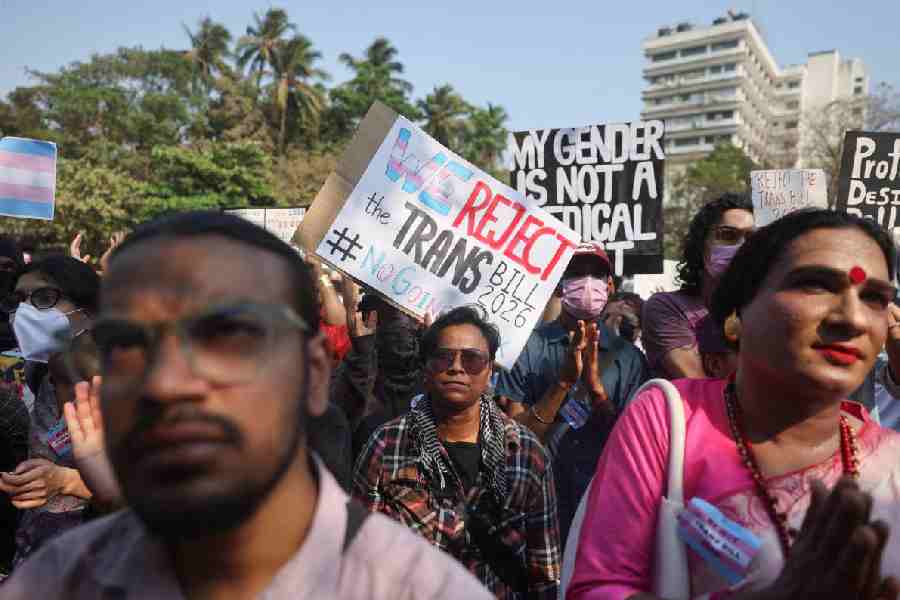
On March 25, the Rajya Sabha passed the Transgender Persons (Protection of Rights) Amendment Bill 2026, just a day after the Lok Sabha cleared the legislation. The bill, now an Act, has come as a shock to the transgender community, who say they were not consulted at any stage in preparing the amendments.
The voices of transpeople, activists and legal experts are united by a single concern: this Act is an assault on the rights of the community. They say it’s a dilution of valuable rights provided under the Transgender Persons (Protection of Rights) Act 2019, and the landmark Supreme Court judgment in 2014 on gender self-identification, which the community says is being deliberately undermined.
So, what exactly has happened?
Right to self-identity is under siege
In 2014, the National Legal Services Authority (Nalsa) filed a case to get legal recognition for people who fall outside the binary of men and women, including those who identify themselves as the third gender.
The Supreme Court’s 2014 Nalsa judgment recognised the fundamental right of every individual to self-identify their gender, enshrining protection under Articles 14, 15, 16, 19(1)(a), and 21 of the Constitution. It expanded the meaning of “sex” in anti-discrimination law to include gender identity, drawing on international human rights standards and the Yogyakarta Principles, a document about human rights in the areas of sexual orientation and gender identity that was published at an international meeting of human rights groups in Yogyakarta, Indonesia, in November 2006.
All of this was included in the 2019 Act and, despite reservations about some provisions in it, the transgender community had welcomed it.
The new Act fundamentally reverses the gains of the 2019 Act, leaving the trans community vulnerable and marginalised. It alters the existing definition of a transgender person.
The previous definition was an inclusive one. It was an umbrella term that was not limited to specific sociocultural communities or people with intersex variations. It allowed self-identification of gender. There were no compulsory medical procedures. It recognised non-binary identities.
The definition that has now been accepted rejects self-perceived gender. Only those who associate with a few sociocultural communities and people with intersex variation are now recognized as transgender persons. A medical test has now been proposed for verification. The Act negates space for transmen, non-binary individuals, gender queer people and gender diverse communities.
It also demotes them from the position of rights-bearing citizens to objects of suspicion, the community says.
‘No thought process in bringing this bill’
The Act’s discriminatory language and exclusionary definition threaten to segregate and polarise Indian society further. By undermining the right to self-identification and narrowing the legal category of “transgender,” it strips people of dignity, protection, and opportunity. Many groups are demanding its withdrawal, warning of the catastrophic consequences it could have for India’s trans community.
Kaushik Gupta, an advocate opposing the bill when it was in Parliament., warns: “There has been no thought process in bringing this bill. It clearly removes trans men from the definition, stripping an entire population of their rights.”
He points out the hypocrisy: “If privileges are given to women, like in the instance of bank interest, no one asks for proof. Why are transgender people being subjected to invasive scrutiny?”
Gupta also points out that the new definition, by excluding self-identification, fundamentally undermines the spirit of the Nalsa judgement.

Kaushik Gupta, an advocate opposing the bill when it was in Parliament., warns: ‘There has been no thought process in bringing this bill’.
The amendment narrowly defines a transgender person as belonging to certain traditional socio-cultural groups (Hijras, Kinnars, Jogtis), intersex people, or those forcibly subjected to mutilation or castration.
It explicitly excludes individuals with different sexual orientations or self-perceived identities, fracturing the unity of the LGBTQIA+ community and erasing the existence of trans men.
“There are many situations where, if a child is born with ambiguous genitalia, an intersex person, that child is abandoned or usually the parents and doctors come together and do a corrective surgery. There is no question of consent. The child was entitled under law to grow up with ambiguous genitalia. Genitalia doesn’t define who I am. There are a lot many people with ambiguous genitalia who have succeeded in life,” says Gupta.
Voices from the community
Tista Das, a prominent transgender rights activist and transwoman married to transman Dipan Chakraborty, calls the Act “a sweeping violation of human and constitutional rights.” She warns that framing the amendment as a “trans issue” distracts from its broader attack on fundamental rights.
“This bill is ignorant of science,” she says. “Science recognises gender dysphoria as a disconnect between mind and body. The law cannot simply erase this reality.”
Tista underlines the new Act’s narrow focus, drawing on her lived experience: “If I am capable of being a doctor or an advocate, why should the law force me onto the streets to dance for survival?”
Dipan, her husband, highlights the bill’s erasure of trans men and condemns the bill’s lighter penalties for sexual violence against transgender people and what he calls its divisive, derogatory nature.
“This is derogatory. We will not accept this. There is no space for compromise,” he asserts.
“We face so many harassments in our family and social life. We ask for help. Those helping us will be criminalised. Even they can be arrested for 5-10 years,” says Dipan. “An amendment is supposed to be helpful to the community. But here this is horrific.”
Trans community organisations say over 100,000 emails were sent to the members of Lok Sabha and Rajya Sabha against the bill.
An unambiguous horror
While the 2019 Act was welcome in many ways and did indeed recognise non-binary identities and self-identification, it was less progressive than the judgment. It required certification from a district magistrate, which left transpersons open to state harassment.
At that time, there was strong criticism from the community and that led to the 2020 Rules, which improved on the Act even if it did not entirely remove concerns. The 2026 Act, of course, is an unambiguous horror, not even attempting to be progressive.
“For raping a trans person, the punishment is now for six months to two years with a fine. It’s unchanged from the 2019 Act. How derogatory is this!” says Dipan.
In comparison, punishment for raping a cis-gender woman is not less than 10 years according to the Bharatya Nyaya Sanhita (BNS). There is no protection extended to transsexual victims of sexual assault, other than Section 18(D) of the Transgender Persons Act.
Both Tista and Dipan stress that the story everyone needs to know is about the horror that is the bill that has just been passed.
“Anyone who does this despite the Constitution’s guarantees should know that this is a despicable Act. As long as there is life in my body, I will fight for a world free of dirt and muck and equal for all,’ says Tista.