Fifty-five-year-old Rajib Pal, an engineering graduate from Jadavpur University, let go of multiple job offers from outside Calcutta. Pal rode the IT boom in the early 2000s and had a successful career in Calcutta.
When it came to his 25-year-old daughter, he did not suggest a similar course. Arkopriya left Calcutta right after school. She now works in Delhi as an editing professional and is also interested in corporate communications. Calcutta does not offer anything that can hold her back, the father said.
The contrasting choices of the father and daughter find an echo across households in Calcutta. The common complaint is that the city has, over the years, turned into a place “from where all the young are leaving”.
The Opposition BJP, CPM and Congress are harping on the state’s job scene in their campaign.
In private, Trinamool leaders, too, admit that it is a prickly issue for them while seeking votes. But many of them insist the scene is not as grim as it is painted to be.
Show me the jobs
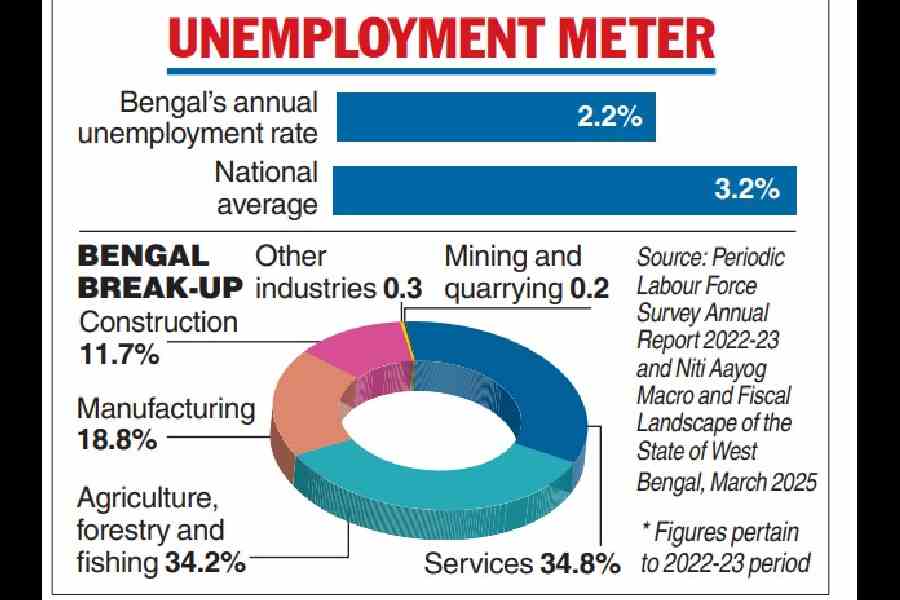
Niti Aayog’s March 2025 report says the “annual unemployment rate for Bengal decelerated to 2.2 per cent and it has remained below the national estimate since 2017-18”.
An economist said jobs that the urban educated youth are looking for are inadequate, and hence the flight away from the city.
“The IT boom started in the late 1990s, and things were looking up in Calcutta. Despite many opportunities, I did not have to leave the city because there was growth. But when my daughter completed school, she chose to study and work outside. She does not wish to come back,” Pal said.
Arkopriya did her graduation from Lady Shri Ram College in Delhi despite clearing the admission tests in some of the better colleges of Calcutta. She completed her master’s from Delhi University.
City off perch
Soumitra Sengupta, a professor of physics, also chose to work in Calcutta after graduating from Presidency College in the early 1980s. A theoretical physicist, Sengupta completed his master’s from Calcutta University and his PhD from the Saha Institute of Nuclear Physics, then a marquee institution where scientists from across India came to work.
“Calcutta was still the hub of higher education in India when we were students. I cannot say that about the city now. New institutes have come up across India, and Calcutta’s position of prominence has dropped. Higher education institutes are no longer concentrated in a single place, but spread out across the country,” said Sengupta, who retired as Amal RayChaudhuri Chair professor at the Indian Association for the Cultivation of Science (IACS) and is now a professor emeritus at the institute.
“Our students, whether they want to pursue a career in academia or outside, are forced to leave the city because there are not enough jobs for them. This does not mean that those who are staying back are any less talented or qualified,” said Sengupta, who also taught at Presidency College and Jadavpur University before joining IACS.
Sengupta said Indian research institutes produce great work, but lose out on the “intense work culture” that is prevalent in the best institutions abroad. He added that students choosing to go abroad was common even during his student days, “and the trend continues”.
Perception
The overall negative perception about Bengal — not always backed by data — may have also contributed to a drop in college enrolment, said a professor of economics. A section of students does not see Calcutta as their first choice for their careers.
A former senior official of Calcutta University told The Telegraph that the number of students enrolled in the 170 affiliated undergraduate colleges fell from 1,32,000 in 2021-22 to 76,000 in 2025-26.
Another economist agreed that the number of “well-paying” salaried jobs was fewer
in Calcutta.
Glimmer of hope
Most economists this newspaper spoke to also said that reliable published data did not show that Bengal is doing singularly badly in generating employment than the rest of the country.
“Although various universities in the state have introduced job-oriented skill enhancement courses, they are not enough. Many students feel the conventional courses offered by the varsities here are not suitable for the contemporary job market. Also, the overall negative perception about Calcutta and the absence of jobs force students to go outside the city,” said Sujatra Bhattacharyya, a visiting economics teacher at Calcutta University and the principal of Netaji Nagar College.
“High-skilled jobs, the ones that urban people look for, are not available in good numbers. This has led to a perception that Calcutta, or Bengal, do not generate employment. However, there are semi-skilled or low-skilled jobs in Bengal and many people from outside the state work in Bengal’s MSME sector,” he said.
The Macro and Fiscal Landscape of the State of West Bengal, a report prepared by the Niti Aayog in March 2025, says that the “annual Unemployment Rate for the State at 2.2 per cent in 2022-23 is below the national average of 3.2 per cent”.
The report says that the working population in the state is predominantly concentrated in services (34.8 per cent); agriculture, forestry and fishing (34.2 per cent); manufacturing (18.8 per cent), and construction (11.7 per cent) as of 2022-23.
Dire?
“The narrative of extreme joblessness in Bengal is somewhat a middle-class perception. The periodic labour force survey data does not reflect this perception. The scene in Bengal is not very different from the rest of India,” said economist Achin Chakraborty.
“Across India, the number of salaried jobs is not increasing at a pace that is required to meet the demand for jobs. The number of jobs in the unorganised sector and the number of those self-employed is going up. Many of those self-employed are not so out of choice, but because they did not get jobs,” said Chakraborty, a visiting faculty member of economics at IIT Kharagpur and a former director of the Institute of Development Studies, Kolkata (IDSK).
He said the promise by some political parties that they would provide one job to each family is impossible to meet.