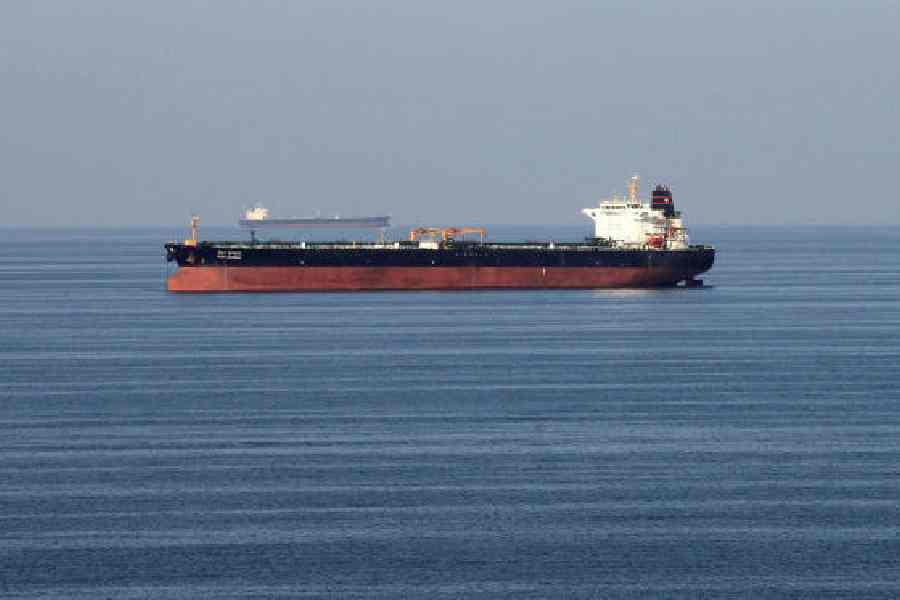
The strategic Strait of Hormuz has snapped sharply into focus after US President Donald Trump followed through on his threat to strike Iran when talks failed to produce an agreement to curb Tehran’s nuclear programme, raising fears of disruption to global oil flows and renewed risks for energy-importing countries such as India.
The risk is already beginning to affect shipping patterns. A number of oil tankers are avoiding the Strait of Hormuz — the narrow shipping lane linking the oil-rich Persian Gulf to the open seas — with some shipowners adopting a caution-first approach after the US and Israel bombed Iran.
While the waterway remains open and some vessels continue to transit the route, tankers are piling up both inside and outside the entrance, according to vessel-tracking data compiled by Bloomberg. Tankers hauled about 16.7 million barrels a day of crude and condensate through the strait in 2025.
An official from the European Union’s naval mission Aspides told Reuters on Saturday that vessels have been receiving VHF transmission from Iran’s Revolutionary Guards saying “no ship is allowed to pass the Strait of Hormuz”. Iran, however, has not formally confirmed any such order.
Tehran has for years threatened to block the narrow waterway in retaliation for any attack on the Islamic Republic.For Tehran, one possible response to the strikes could be an attempt to block or effectively shut the Strait that carries about a quarter of the world’s seaborne oil trade. Any disruption to the passage used by tankers transporting crude and liquefied natural gas from West Asia to China, Europe, the US and other major consumers could trigger a sharp spike in oil prices and destabilise the global economy.
A prolonged closure of the waterway would represent a worst-case scenario for energy markets. Muyu Xu, senior crude analyst at Kpler Ltd., had earlier estimated that even a one-day disruption could push oil prices to between $120 and $150 a barrel. Brent crude, the global benchmark, was trading at around $73 a barrel on Saturday.
However, any move to close the Strait would also hurt Iran’s own economy by restricting its petroleum exports. A disruption to oil flows from the region could also strain Tehran’s ties with China, one of the largest buyers of Iranian crude.
Risk for India
India’s oil supply chain faces renewed uncertainty following the developments in West Asia with analysts estimating that a blockade of the Strait could affect as much as 50 per cent of India’s monthly crude imports.
“A disruption at the Strait of Hormuz would have immediate and significant implications for both India and global oil markets, as roughly 2.6 million barrels per day of India’s crude imports transit the Strait, primarily from Iraq, Saudi Arabia, the UAE and Kuwait,” said Sumit Ritolia, lead research analyst for refining and modelling at Kpler, told Moneycontrol.
Kpler data show that about 50 per cent of India’s monthly crude imports passed through the Strait during January–February, up from about 40 per cent in November–December 2025.
Industry sources said that in the event of a Hormuz blockade, India could seek supplies routed through bypass infrastructure such as Saudi Arabia’s East-West pipeline to the Red Sea and the UAE’s Abu Dhabi Crude Oil Pipeline to Fujairah. However, Ritolia cautioned that limited capacity and producer priorities would only partially offset
disruptions.