Monday, 01 June 2026
Monday, 01 June 2026
Monday, 01 June 2026
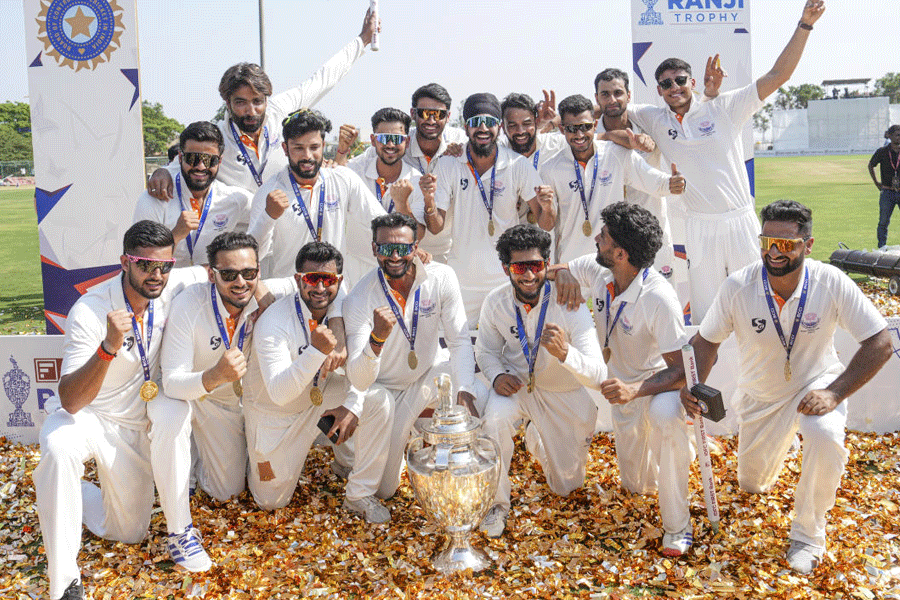
It took Jammu and Kashmir 67 years to make it to their first ever Ranji Trophy finals. They didn’t just make it to the finals, they entered Karnataka’s home and dominated on every single day and in every single session of the 2026 Ranji Trophy finals played at the KSCA Stadium in Hubballi.
With eight Ranji titles to boast, Karnataka’s team featured proven India players like K.L. Rahul, Mayank Agarwal, Karun Nair, captain Devdut Padikkal and Prashid Krishna, along with IPL stars Shreyas Gopal and Vijaykumar Vyshak
Yet, it was J&K’s mammoth 291 run first innings lead after a score of 584 in the first innings that saw the side from strife-torn Union Territory walk away as the winners as the finals ended in a draw with J&K batting on 342/4.
It is perhaps the greatest underdog story in the 88-year history of the Ranji Trophy.
The value of a veteran leader
Without a captain like Paras Dogra, it may not have been J&K’s season. Dogra, a veteran of the domestic circuit, debuted for Himachal Pradesh in 2001 before he shifted to Puducherry in 2018/19. But still there was never a title in sight.
Twenty-five years and 10,000 Ranji runs later, Dogra got his time in the spotlight with a team that didn’t just recognise his value but harnessed it. Dogra ended the season as J&K’s second highest run-scorer with 637 runs that included two tons and a knock of 144 in the only loss against Mumbai.
He may have headbutted Karnataka’s substitute fielder K.V. Aneesh in a moment of heat as the Karnataka side looked to get under the skipper’s skin in the first innings as he stood and scored 70 runs, eating away at game time.
But he won’t mind being fined 50 per cent of his match fee given his hand are now peacefully on the trophy.
Giant-killer enroute the finals
They started with a loss against Mumbai by 35 runs way back at the start of the season but J&K only went from strength to strength.
They beat Rajasthan by 41 runs in Srinagar before a draw against Chhattisgarh in Raipur. Then they faced Delhi away and won by seven wickets, a big win. That was followed up by a massive 281-run win against Hyderabad in Jammu.
Two back to back draws against Puducherry and Himachal meant that Jammu and Kashmir would play Madhya Pradesh in the quarterfinals, they beat MP by 56 runs before they met Bengal in Kalyani.
Playing at home in a semi-finals, Bengal was a firm favourite to win that game with Sudip Gharamai coming off a 299 knock against Andhra Pradesh. But Auqib Nabi had other plans, he picked up nine wickets and the team won by six wickets to reach the finals.
Batters stepped up when it mattered
It wasn’t just Paras Dogra who scored big runs for J&K, Abdul Samad finished as their highest run scorer with 748 runs in 15 innings with five 50s and a key 125 vs Hyderabad. Samad, well known for his range-hitting style batting in the IPL, showed great composure and maturity for Jammu in the finals. In the first innings he scored 61 off 104 in the first inning and 32 off 70 in J&K’s second inning.
But the man who really needs a shoutout is Qamran Iqbal. A night before the finals he was called in to replace injured opener Shubham Khajuria. He practically ran from the tarmac at Hubballi airport – which is just about a big six away from the venue of the finals – to pad up in time to open the innings.
Despite being dismissed for just 6, he steered Jammu & Kashmir home with an unbeaten 160*, given Karnataka no chance of making a comeback. Iqbal finished the season with 471 runs in 10 innings.
Shubham Pundir, whose 121 saw him win the player of the match in the finals scored 330 runs in seven innings proving to be a vital cog in the J&K engine that barged through all opposition.
Auqib Nabi: Baramulla to record books
The bowling hero of this fairytale campaign was undoubtedly Auqib Nabi. Hailing from Baramulla, Nabi’s father originally wanted him to pursue a stable career as a doctor, even once locking him in a room to study. But Nabi’s relentless passion for fast bowling broke through those walls.
In the final, he broke Karnataka's back with a searing spell of 5 for 54. He finished the season as the highest wicket-taker with 60 scalps, cementing his name in the history books as only the third pacer—joining the elite company of Dodda Ganesh and Jaydev Unadkat—to pick up 60 wickets in a single Ranji season.
A new horizon for the Valley
As the Ranji Trophy finally makes its way to Srinagar, Baramulla, and beyond, its impact will echo far beyond the boundary ropes. For decades, the youth of Kashmir have grown up in an environment overshadowed by traditional expectations.
This victory changes the narrative. It proves that Jammu & Kashmir can produce champions who dominate India's mainstream sporting structures.
When youngsters see Auqib Nabi rattling stumps or Abdul Samad playing with seasoned maturity, they see a viable pathway. Sport is no longer just a pastime in Kashmir; it is a beacon of light and a legitimate opportunity. Perhaps, after 67 years of waiting, it was simply meant to be.