
As the holy month of Ramazan draws to an end, the usual rush of politicians hosting iftar parties is in full swing and even the RSS joined the race by organising a grand event in New Delhi on July 2, but the Muslim clergy and Islamic scholars are divided over such events organised by politicians.
One section strongly opposes political iftars, while another supports such events with riders.
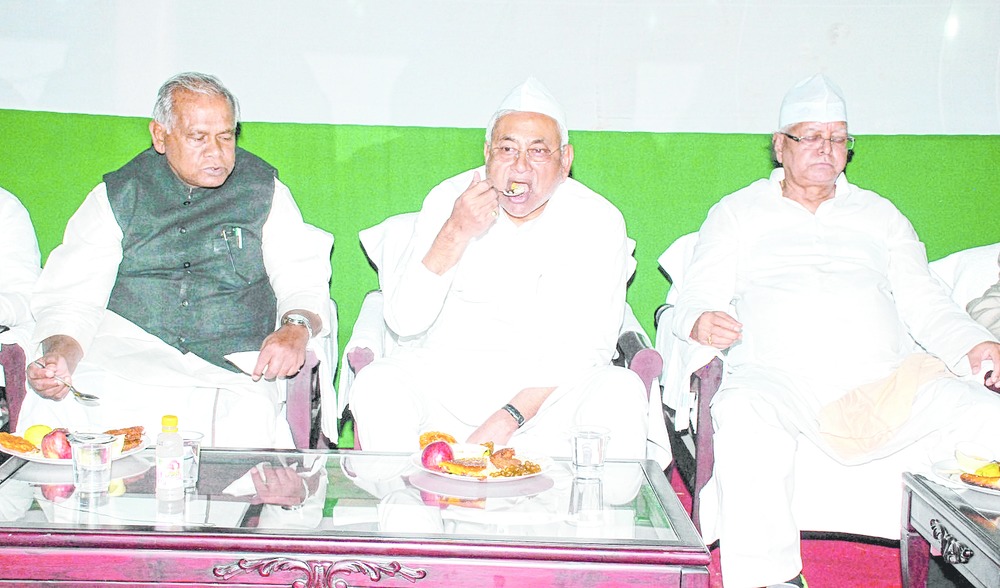
In Bihar, all senior leaders including chief minister Nitish Kumar, RJD chief Lalu Prasad, BJP leader Sushil Kumar Modi and LJP chief Ram Vilas Paswan have hosted crowded iftar parties where dignitaries were offered embroidered topis and chequered scarves and, of course, mouth-watering iftar delicacies.
"Hosting of iftar parties should not be seen only from the religious angle but also from the socio-cultural angle," said Islamic political scholar Syed Shah Shamim Ahmed Muna'mi, a professor as well as head of the Khanquah Muna'mia in the walled city in Patna. "It is not bad if they (Hindus) are attracted towards Muslims and their religious events. Such events may be helpful in bridging the differences and minimising enmity by sitting together. There should be more interaction for the growth of composite culture."
Maulana Anisur Rahman Quasmi, the in-charge of the Phulwarisharif-based and most respected religious body Imarat Shariah, said: " Iftar should not be used as a political tool, but there is no mechanism to stop it. Even the Hadith mentions that the Prophet favoured organising iftar parties."
Another Islamic scholar, Maulana Abu Nasr Farooque, is against iftar parties organised by politicians and said he never attended one.
"What is more unfortunate is that noted clerics routinely attend to show their faces to the leaders," he said.
"The purpose is only political both by the hosts and the guests. The RSS too is doing same politics in a bid to appease Muslims."
Maulana Anisur said that if an iftar party hosted by a Muslim is only for show, publicity and political gain, it was haram (forbidden).
"I urge politicians not to politicise this holy event but if they are hosting it with socio-cultural sentiments and brotherhood, it is fine. Never has any seminary issued fatwa (decree) against holding of iftar parties by non-Muslims and politicians," he said.
Maulana Mohammad Alam Quasmi, imam of the Daryapur mosque, felt the coming together of the two communities is good even if the purpose is political or social gain.
"Such togetherness reduces hatred and misunderstanding and today there is a need to hold such events," he said. He, however, added that he had never attended any such iftar.