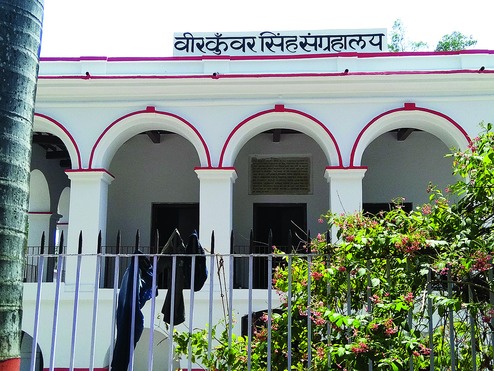

Ara: A square-shaped small building on the campus of Maharaja Bahadur Ram Ran Vijay Pratap Singh College called the Arrah House, now renamed Veer Kuer Singh Sangrahalay, witnessed the beginning of the First War of Independence in 1857 and until the mid-1950s attracted quite a number of tourists both from within and outside the country.
The barren Arrah House had become a den of criminals but the state government's decision to celebrate Veer Kuer Singh Victory Day with full state honours from April 23 to April 25 this year drew the attention of the college administration towards its plight.
"It has now been renovated. The college administration also changed the original structure of the building from outside," said Prof. Gandhiji Rai, former principal of Maharaja College, Ara.
The building has not only been beautified but also given a new touch. The entire campus is encircled with walls, fountains and gardens.
"Erstwhile collector W.C. Wake took shelter to protect himself and his supporters under the command of Subedar Sardar Hukum Singh of 45th Sikh regiment against the fury and jingoism of thousands of people under the command of Veer Babu Kuer Singh," said Prof Vikramaditya Singh, retired professor of history of HD Jain College, Ara.
History peeps through dwindling walls and falling roofs of the deserted looking but inspiring national monument but it has been now renovated this year. "When the Emperor of England, George V, came to take part in Delhi Durbar in 1911-1912, he paid a visit to this place as a mark of respect to the loyalty of the collector and the Sikh regiment, who protected the Arrah House as well as made comprehensive efforts to halt the speed of the First of War of Independence," said Singh.
"The Arrah House, used as a dance hall of a railway engineer, Mr Boyce who was busy in the construction of Delhi-Howrah Railway Line, is a two-storeyed building," added Singh.
There are three halls on the ground floor - one meant for storing grains, the second for keeping important railway materials and the third and the smallest one for the three guards, who used to keep watch on the house and the materials stored. From the southern side, the bigger hall still has an indication of a well, which was being dug for water as there was water shortage inside during weeks of confinement. But it could not be completed, however.
"The sign of a tunnel is still there. If one moves into the hall right beneath the stairs leading to the first floor, there appears to be a hole going down below turning to the north, which has been protected with window-like iron grille. It was nearly abandoned when it was handed over to Maharaja College by the Government of India. Having been left abandoned for years, filth, garbage and an obnoxious smell made it impossible for anyone to reside in the ground floor room but after proper repair, it was once converted into a control room for examination purposes in the 1970s, when Bhagrathi Singh was the principal of the college," said Rai.
It was so cool and comfortable that even during blistering heat, teachers took rest there.
The government used to give Rs 6,000 per annum for repair and maintenance of the house but it was suddenly stopped. It has thus once again been abandoned, resulting in breeding of venomous reptiles and bats.
During the confinement in the Arrah House, there was drinking water shortage. The Britishers planned to dig a tunnel to blow off residential house of Boyce (now administrative block of the Maharaja College).
The similar strategy was adopted by Babu Kuer Singh. But the tunnels could meet at no point due to the timely arrival of Major Eyer. But there's hearsay that the tunnel goes up to Jagdishpur through which Babu Kuer Singh escaped from the Britishers.
"In 1987, the erstwhile Shahabad district magistrate of 1942, on his journey back from China, came to visit the Arrah House. Seeing the building, he observed that either the history baffled him or he baffled the history," said Rai.
"This monument could not be protected when it has a long story of our cultural heritage and our endeavour to win out freedom and if not cared it might disappear from the scene totally," worried Singh.