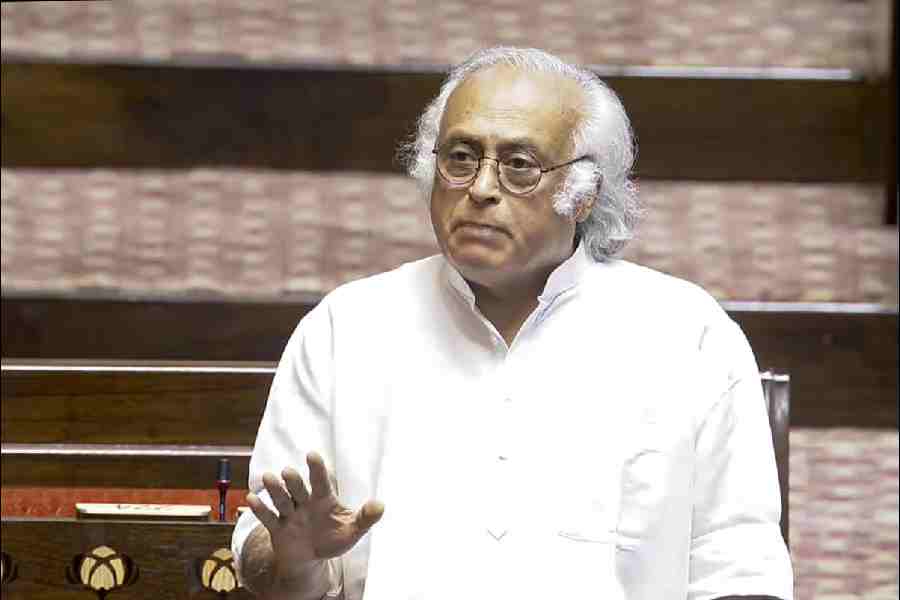

Jitan Ram Manjhi speaks at Jawaharlal Nehru University
in New Delhi on Friday. Picture by Ramakant Kushwaha
New Delhi, March 13: Much before Jitan Ram Manjhi's popularity quotient is tested in the Assembly elections this winter, he has become a 'messiah' for students at the prestigious Jawaharlal Nehru University in the national capital.
Invited to deliver a talk titled 'Politics, Caste & Discrimination: Experience of a Dalit CM', Manjhi was accorded a hero's welcome and was received warmly by hundreds of students cheering on him. They laughed at his sharp punch lines and listened to him in rapt attention as he spoke for about two hours today.
Calling himself an 'accidental' chief minister, who was thrown out when he started to assert himself, Manjhi said he had maintained a low profile for over three decades, which is why he could sustain himself in politics so long.
'Such is the system in our country, particularly in Bihar that Dalit leaders have either been killed or framed in false cases whenever they have tried to come in way of powerful politicians, which is why I had kept myself low profile and non-controversial. That is precisely the reason why Nitish Kumar chose me to keep his chair warm when he decided to step down.'
'For two or three months, I remained just a loyalist but then the media started calling me a rubber stamp CM and I felt insulted and thought I would not be able to show my face to my successors if I kept heeding others in spite of being the political head of the state,' he said in the lecture organised by Birsa Ambedkar Phule Students' Association at JNU.
He recalled how trouble started brewing for him when he started taking social sector decisions. 'As an MLA, I admit that I had not been able do much. But as CM, I was in a position to work for the weaker sections of the society and the problems started when I first announced that five decimal plots would be given to Dalits at market rates for residential purposes, which was an improvisation upon a scheme launched by the previous Nitish government.'
He also mentioned how he also decided to announce free education for girl students up to postgraduation. 'These and other decisions went very well with the public, but pinched Nitish hard,' Manjhi said. 'He (Nitish) started feeling insecure. He then sent the JDU national president asking me to opt out but I refused. Why should I have resigned when I had made no mistake?' he asked.
Purna Bharti, a research scholar, who had come to listen to Manjhi, said she saw him as an 'inspiration'. 'He is not a regular politician as there is certain amount of innocence and genuineness about him. He admits the mistakes he has made. How many politicians can do that?' she said.