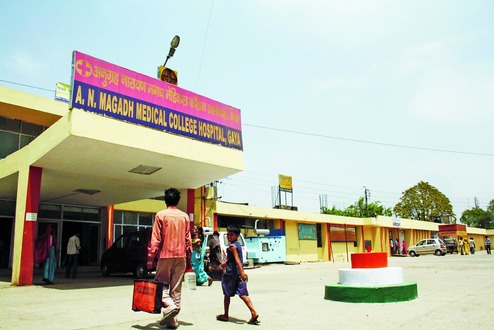

The death of two children from Japanese encephalitis at Anugrah Narayan Magadh Medical College and Hospital (ANMCH) has made health department officials sit up and take notice of the lurking threat.
On Friday, Vikki of Dihuri village under Fatehpur block and Saraswati Kumari of Rasuna village under Manpur block succumbed to the disease at ANMCH.
The pathological test of their blood samples conducted at the microbiology department of ANMCH confirmed that both the children tested positive for the encephalitis virus. Till Sunday, five other children were undergoing treatment for suspected encephalitis at ANMCH but none was a confirmed case.
Gaya civil surgeon Krishna Mohan Purwe told The Telegraph: "As a preventive measure, fogging is being carried out in rural areas, specially from where the case surfaced and deaths occurred. I have alerted all doctors posted at primary health centres across the district to immediately start treatment of any child suffering from suspected encephalitis and, if necessary, refer to ANMCH."
ANMCH superintendent Sudhir Kumar Sinha said: "Because the children who have died belonged to lower socio-economic group, there is a need to verify whether the children who died were immunised or not. A survey of the area from where the children belonged is also needed to verify the status of immunisation drives carried out earlier. I have informed this to senior officials, including the principal health secretary, district magistrate, civil surgeon and the district immunisation officer.
"To tackle cases of Japanese encephalitis, two wards of eight beds each have been set aside. Moreover, the intensive care unit of the hospital is also functional. We have prepared round-the-clock roster for doctors available in the paediatrics department. Medicines for treatment of Japanese encephalitis are also available here."
Teams from the Rajendra Memorial Research Institute of Medical Science, Patna, National Institute of Virology, Pune, All India Institute of Medical last come to Gaya in 2013 and took back blood samples from affected children but could not pinpoint the exact reason behind the infection.
A case of Japanese encephalitis was reported here in 2007 for the first time, and since then, 287 children have died from the fatal disease. More than 500 patients have survived but developed some kind of mental or physical deformity.
However, no death from Japanese encephalitis was reported in 2014. Considering the present situation, immunisation drive was carried out across the district in 2013 and 2014 and Japanese encephalitis vaccination has also been included in the routine immunisation. Even though fresh encephalitis cases this year, have however worried the health department officials.