| CORRUPTION FIGHT BEGINS AT HOME |
 |
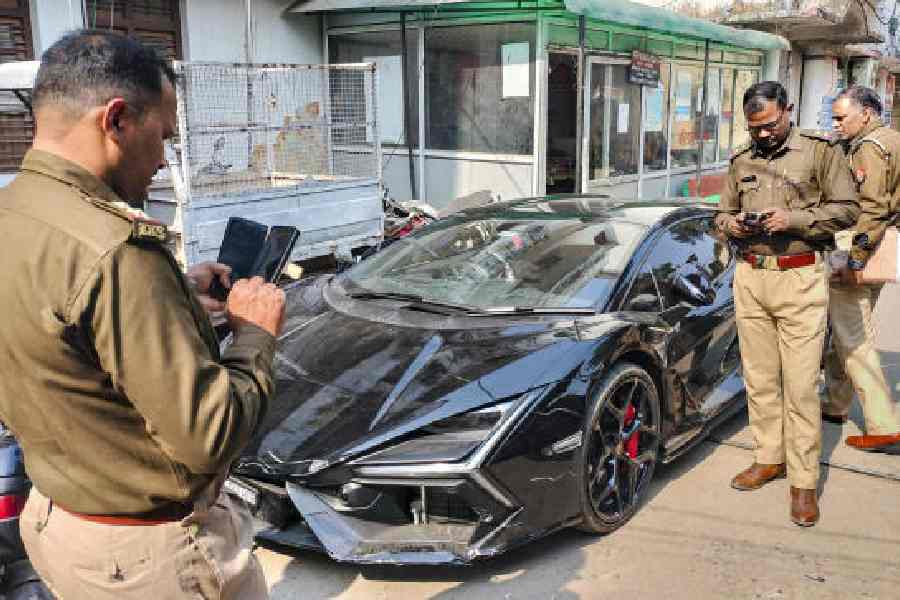
| The residence of motor vehicle inspector Raghuvansh Kunwar at Kanti Factory Road in Patna. Picture by Ranjeet Kumar Dey |
They’ve begun to call it the Pinom-40 effect and it has Bihar’s ruling elite — politician, bureaucrat, babu — in a tizzy.
There’s a joke going around it could be an insidious little trick played by chief minister Nitish Kumar to seduce pharmaceutical majors to invest in Bihar. And how they’d wish it were true. If there is a joke somewhere here, it’s assuredly on them. They are being driven up the wall by their workaholic boss and travelling north with them are their blood pressures; at Rs 11 a shot, Pinom-40 is priced high but it keeps hypertension low.
“You need it with this man,” confesses a senior Bihar officer who is just getting used to standard operating procedures under Nitish Kumar. “You’re dreaming meetings even when you get to sleep for a bit.”
The chief minister isn’t known to flaunt a cellphone but be quite sure he possesses one. And if you happen to be among those who report to him, you are at the other end of a call round the clock.
“You are meant to be ever-alert, ever-aware and ever-ready to report,” says a secretary to the government, “and it is you he seeks answers from directly, not your minions.”
An official note sent out recently instructed all top civil servants to come with presentations to the chief minister’s office alone — no assistants, no file-carriers, no note-takers, not even anyone to help with power point.
To a league too used to languor approaching on the feudal and too unused to accountability, this is like coals shovelled under the seats they’ve been warming. As one corporation head put it: “The CM says he’s in the hot seat, but we are the ones feeling the heat, sometimes you can be forgiven for thinking he is too much of a man in a hurry, you worry if he will trip.”
But he’s probably the one popping Pinom-40s; the chief minister appears to be doing just fine on herbal condiments from his backyard.
“This scurry in the bureaucracy is the function of having forgotten all work culture,” is how another bureaucrat, recently arrived from Delhi, puts it. “We are meant to work, we had come to assume we did not have to. This CM is merely reminding us of the job at hand. And if he seems in a hurry, he is probably doing the right thing because Bihar has a lot of catching up to do.”
It isn’t Nitish Kumar’s hard-task mastering alone that’s become a migraine in the head of his administration. There is that other issue that has, over the years, become so endemic and quotidian it had stopped to attract notice: corruption.
What qualifies more as news in Bihar — as indubitably elsewhere in the country — is the honest public servant, not the dishonest one. Nobody quite — not even Nitish Kumar — believes there exists a broom that can banish corruption. But there is the “danda” of that broom, nevertheless. And the chief minister has begun to wield it.
Its first victim was an Aurangabad-based motor vehicles inspector called Raghuvansh Kunwar who was detected to own premises that cost way beyond the measure of his means. The government has proceeded to seize the property and is currently plodding through the tortuous legalities of converting it into a school.
“It will be tough given our laws,” admitted a concerned official, “but we are hopeful we can actually implement this because the instructions from the top are firm.”
Ministerial colleagues of Nitish Kumar are privately cynical, even uncomfortable, about the anti-corruption drive whose spine is the Special Courts Act aimed at fast-tracking all graft cases.
“Kehne ki baatein hain,” a cabinet colleague says dismissively, “aajkal rajneeti kya, ghar bhi thoda-bahut idhar-udhar ke nahin chalta. Aur phir Bihar ki halat to jag jahir hai, har kadam pe paisa-paisa” (This — the anti-corruption drive — is more hot air than anything else. Leave aside politics, you can’t even run a household these days without a bit of jiggery-pokery. And then, the situation in Bihar is known to all, money at every step).”
But it is perhaps just that —the all-pervasive nature of the malaise — which goaded Nitish Kumar into his current “zero-tolerance” mode. Even he must somewhere reckon with reality and realise that the abolition of corruption is more a thing of symbolism, less of substance. But if he cannot give the idea fundamental right status, he is bent on making it a directive principle of state policy.
Close on the heels of getting his cabinet to publish assets, Nitish has instructed all officials, up and down the ladder, to furnish their possessions for publication. “There will be problems, many problems, corruption is systemic and strongly vested,” he says, “but a message should go out and people should be afraid to be corrupt. This is the one message I got very clearly from people on the campaign trail, this is one issue that concerns everybody and has tremendous connect. I could see it was one issue on which people responded emotively across the state. If we are able to catch just a few and punish them we would have set examples that people will remember and fear,” Nitish says.
So those with their hands in the till should probably prepare to spend some of their loot on acquiring Pinom-40.