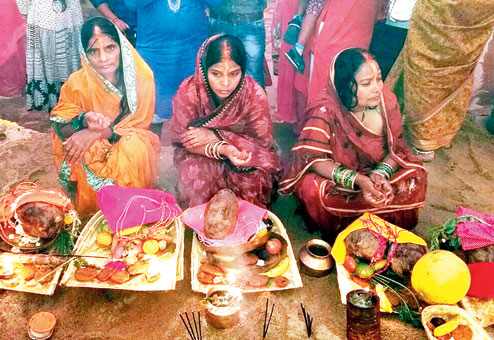

Chhath is forever. That’s how it is meant to be. The norm is to nominate someone from the next generation to observe the rituals and for the chain to continue.
For instance, Kishori Devi of Patliputra Colony in Patna is the seventh generation of her family to be observing Chhath this year. Once a devotee starts observing Chhath, he or she must do so till it passes on to the next generation. The puja can be skipped only if there is a death in the family. But not always.
Kishori, a Saryuparin Brahmin (Brahmin families who live beside the Saryu river) from Darbhanga observed Chhath even after her mother-in-law’s death in 2013. “We hand over the puja to another family with which we have no connection at all, only on rare conditions — like if the next generation cannot observe the puja because of some serious problem,” Kishori said. “However, none of us (Saryuparin Brahmins) want to do that as Chhath puja means a lot to us. We believe whatever we have achieved in life is because of Chhath puja.”
Kishori said she started observing Chhath puja 15 year ago after her mother-in-law Gunjeshwari Devi passed it on to her. Gunjeshwari herself had been passed on the tradition by her mother-in-law. “My mother-in-law told me that our family used to be very poor at one point of time,” Kishori said. “But once the family started observing Chhath, money started rolling in.”
Gunjeshwari observes the most difficult rituals, like sleeping on the floor during the festival period.
Gaya resident Kalyani Sinha (35) has been observing Chhath puja for 10 years. Her mother-in-law, Saroj Devi, had passed the puja on to her in 2006.
“I didn’t want to observe such a strict puja at that time,” Kalyani said. “One has to fast for 36 hours, sleep on the floor during the entire period and pray to the setting as well as rising Sun God standing waist-deep in water. And you cannot afford to miss a single ritual. I told my mother-in-law that I couldn’t afford all that the Puja entails but she would tell me that once I start doing this puja, my husband would get a government job and our hardships would disappear.”
Kalyani says she realised the power of the Sun God soon after. “I started performing the puja in 2006 and in 2009, just three years later, my husband got a government job as a health worker at a primary health centre in Wazirganj. My mother-in-law died in 2007 but her words have come true,” says Kalyani.
That isn’t the only instance. Kalyani’s father-in-law had observed the rituals for four years as thanksgiving for fulfilment of wishes. “My husband had two marriageable sisters who were not finding a suitable match. My father-in-law then prayed to the Sun God, promising to observe Chhath rituals if his daughters’ marriage takes place soon. My sisters-in-law got married soon after,” Kalyani said.
The new generation in both these families is as upbeat about observing the festival. Ratan Priya (27), daughter-in-law of Kishori Devi, said she was mentally prepared to take up Chhath from her mother-in-law.
“I help my mother-in-law with the rituals, such as with the preparation of the prasad, taking the prasad to the Ganga ghat and extending puja material to her during the rituals,” Ratan said. “In fact, a devotee cannot perform this puja on his or her own without support from the family, as there are hundreds of rituals involved. I don’t know whether my mother-in-law would hand over the puja to me or to my brother-in-law’s wife, but I would love to observe the festival. Nothing can match the divine glow I see on my mother-in-law’s face during the entire festival. This is as close as one gets to observing spiritual power.”