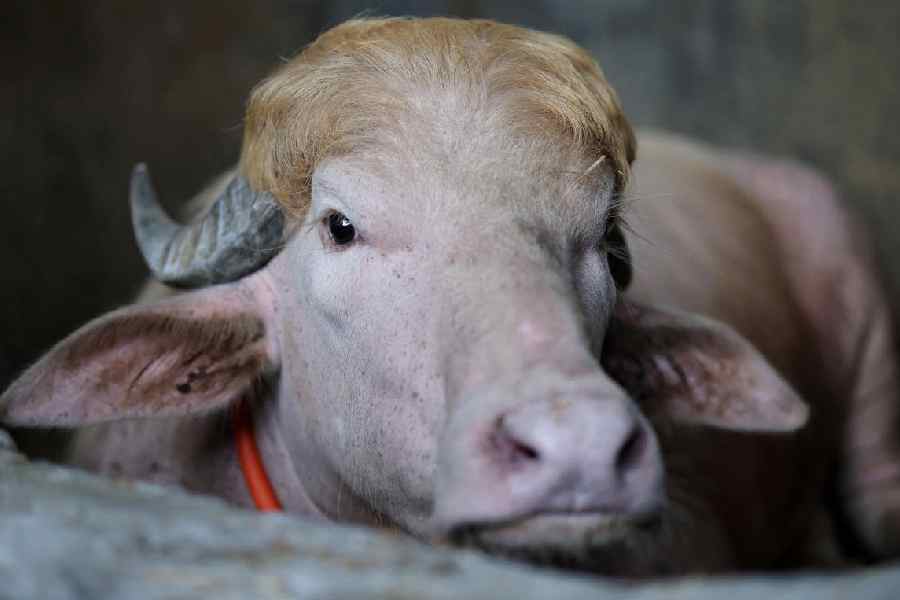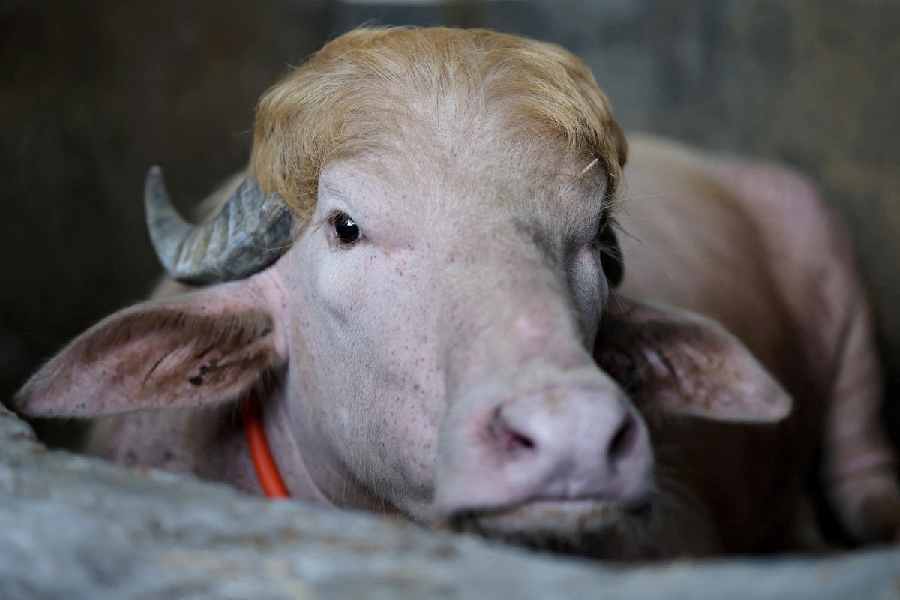
For the last one week, Bangladesh found itself gripped by an improbable national obsession: an albino buffalo with a blond tuft of hair and an uncanny resemblance to US President Donald Trump.
The thing that began as a curiosity in a livestock market outside Dhaka spiralled into a global social media spectacle.
As videos of the nearly 700kg animal — pale-skinned, golden-haired, lumbering with an air of accidental self-importance — raced across Facebook, TikTok and Instagram, it acquired a digital mythology and an unexpected political future.
The buffalo was called Donald Trump.
And unlike millions of other animals destined for sacrifice during Eid-al-Adha, “Donald Trump” would live.
To understand the stakes of this reprieve, one must look to Bangladesh’s qurbani market, which has quietly grown into a colossal $5.7-billion seasonal economy.
Circulating nearly 1.6 per cent of the country’s GDP in a matter of weeks, this massive event moves upwards of 10 million animals through thousands of temporary haats (open-air markets).
In these bustling cash economies, the transaction of livestock is both a religious obligation and an intense spectacle.
These markets double as public arenas where rural prestige and urban consumerism collide, creating a high-energy theatre. Here, livestock are valued as much for their dramatic flair and novelty as their meat.
The decision by Bangladeshi authorities to intervene and spare the animal from slaughter was a pragmatic reading of this modern media ecosystem, where virality can transform livestock into a global character overnight.
By the time the government stepped in, the buffalo had become one of the country’s most discussed exports, covered by almost all the big names in the global media landscape.
Had the sacrifice proceeded, algorithms would have flooded global feeds with graphic videos carrying one irresistible headline: “Donald Trump Slaughtered in Bangladesh.”
Nuance rarely survives digital velocity. Millions who had never heard of Eid-al-Adha would have encountered a shocking image attached to one of the most recognisable names on earth.
Dhaka understood the public relations risk, particularly at a delicate diplomatic juncture.
The episode unfolded just as the recently signed US-Bangladesh Agreement on Reciprocal Trade began to reshape the region’s balance of power. With Dhaka committing to billions in purchases of American Boeing aircraft, energy products, and agricultural goods in exchange for reduced textile tariffs, local officials were acutely aware of how a stray, miscontextualised headline could pollute the bilateral atmosphere.
At a moment when the new Bangladesh Nationalist Party (BNP) administration — which just came to power in the January election — is working tirelessly to cement goodwill in Washington, the prospect of a graphic video dominating the Western political algorithms felt like an unnecessary, self-inflicted headwind.
The government’s intervention was therefore an exercise in narrative management.
Officials cited public interest, arranged compensation for the buyer, and transferred the animal to state care before its relocation to the national zoo. The move instantly flipped the story from a potential liability into a feel-good international narrative about an animal too famous to kill.
The episode also revealed a strict hierarchy of symbolic power as well.
According to local reports, two other sacrificial animals had been named after powerful world leaders. Neither received a pardon, and neither attracted international fascination.
Only the American populist’s likeness carried enough cultural weight to save a life. The real Donald Trump, who has spent decades cultivating his brand, would likely appreciate the irony.
While Bangladesh has previously turned Eid livestock into passing domestic memes — including a viral celebrity goat whose absurdly inflated price tag exposed a massive anti-corruption scandal involving a high-ranking tax official two years ago — the buffalo operated on an entirely different scale.
That previous caprine controversy had triggered a serious bureaucratic purge, highlighting the unique ability of the qurbani market to function as a mirror for the nation’s socio-political anxieties.
Yet, while the goat remained an insular, anti-corruption allegory for a domestic audience, the buffalo transcended borders completely. The visual punchline required no translation. For an international audience exhausted by political polarisation and conflict, a buffalo with an accidental comb-over offered a perfect, low-stakes distraction.
This is because in the attention economy, recognition is value. The Internet did not fall in love with a rare albino specimen; it fell in love with a buffalo playing a celebrity. By the end of the week, the animal had travelled from a farm in Narayanganj to the state zoo, transforming from sacrificial livestock into a diplomatic oddity.
Its fame will inevitably fade as the next meme arrives, but for one strange week, the four-legged Donald Trump achieved the ultimate modern triumph: he became too viral to die.