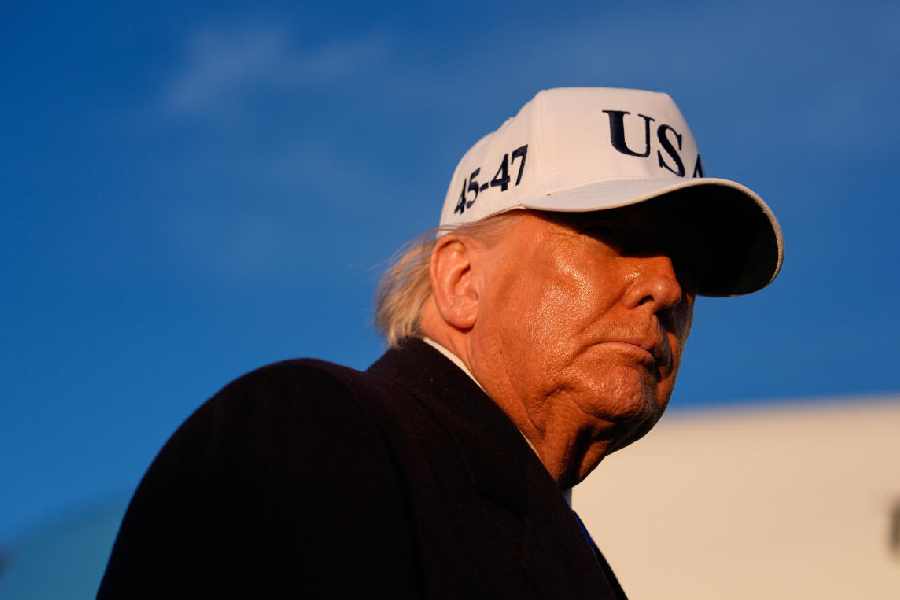
President Donald Trump relied on his gut and largely side-stepped diplomatic coordination as he made the decision to launch strikes on Iran with Israel.
But now with the war's economic and geopolitical consequences unfurling rapidly, he's cajoling allies and other global powers to help mop up the mess.
Trump says he's asked roughly a half-dozen other countries to send warships to reopen the vital Strait of Hormuz, a consequential waterway through which one-fifth of the world's traded oil flows.
So far, none has committed.
Trump even indicated he would use his long-planned trip to China to pressure Beijing to help with a new coalition meant to get oil tanker traffic moving through the strait - a notion that his treasury secretary later downplayed.
"We strongly encourage other nations whose economies depend on the strait far more than ours ... we want them to come and help us with the strait," Trump said at the White House on Monday, listing Japan, China, South Korea and several countries in Europe as examples.
Trump has argued that the shipping channel is not something the United States needs because of its own access to oil.
It's the type of bullying to action that has secured key foreign policy wins for the Republican president in his second term, like prompting nearly all NATO countries to up their defense spending last year after he spent years accusing allies of freeloading off American largess, and using tariffs to extract investments and concessions from trade partners.
But with oil prices soaring and the Middle East rattled by violence, there's little inclination from other countries to heed Trump's call.
China is noncommittal. France is a maybe on escorting ships, when "circumstances permit". Britain is unlikely to dispatch a warship.
In Trump's view, this lack of appetite for helping to secure the strait confirms his suspicions about the benefits of working with other countries, because "if we ever needed help, they won't be there for us".
"I've always felt that was a weakness of NATO," Trump said Monday. "We were going to protect them, but I always said when in need, they won't protect us."
Yet not long after, Trump insisted the US didn't need help from anybody because "we're the strongest nation in the world".
Nonetheless, the pressure campaign from the White House is continuing.
Trump's top spokeswoman, when asked why other nations that were neither consulted nor involved should put their troops in danger to secure the Strait of Hormuz, argued that other countries were benefiting directly from Trump's attempt to disarm the Iranian regime.
"This is something not just the United States but the entire Western world has agreed with for many, many years," White House press secretary Karoline Leavitt told reporters on Monday.
Separately, Trump signaled in a Sunday interview with the Financial Times that "we'd like to know" before he leaves for a late-March summit in Beijing whether China will help secure the strait because of its reliance on Middle Eastern oil, adding: "We may delay."
Yet calling off the face-to-face visit with Chinese President Xi Jinping could have its own major economic consequences as the relations between the world's two biggest economies remain fraught over tariffs and other issues.
In a CNBC interview Monday, Treasury Secretary Scott Bessent said any delay would not be due to disputes over the strait and explicitly urged investors not to react negatively should Trump put off his trip.
"If the meeting for some reason is rescheduled, it would be rescheduled because of logistics," Bessent said from Paris, where he was meeting with Chinese Vice Premier He Lifeng for a new round of trade talks that were meant to pave the way for the trip.
A Foreign Ministry spokesperson in Beijing, Lin Jian, did not respond directly to questions about Trump's call for outside help in the strait. He noted the impact on goods and energy trade and repeated his government's call for an end to the fighting