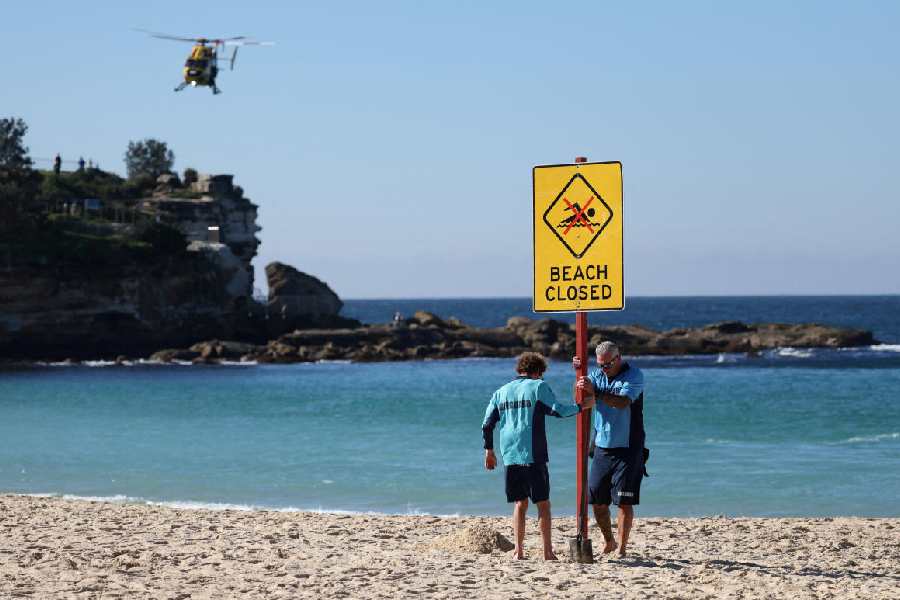
A shark attack at Sydney's Coogee Beach leaving a woman critically injured has reignited calls for shark culls in Australia, but marine experts say the evidence shows such measures would do little to reduce the risk of future attacks while potentially causing major, irreversible damage to marine ecology.
The debate resurfaced after a 35-year-old woman faced life-threatening injuries on Saturday when she was bitten by a great-white shark estimated to be three to four metres long while swimming about 30 metres offshore. The woman remains in hospital under stable conditions; her family reportedly confirmed on Monday that she has had an arm amputated.
The swimmer survived due to a swift rescue by a lifeguard and bystanders. Lifeguard Charlie Verco, who was on a paddleboard nearby, reached the woman moments after the attack and pulled her towards shore after she managed to cling to his board.
"I saw the shark come out of the water, and just the size of it shocked me," lifeguard Charlie Verco told Sydney's The Sunday Telegraph newspaper. He was in the area on his 5.5-metre (18-foot) paddleboard and was the first rescuer to the scene.
After taking her to shore, an off-duty doctor, Ian Ferguson, and others immediately administered first aid, applying tourniquets to severe wounds on her arm and thigh before she was airlifted by helicopter to hospital for emergency treatment, Reuters reported.
Authorities reopened Coogee Beach on Monday under heightened surveillance, with lifeguards, jet ski patrols and shark-spotting drones monitoring the area. The attack has also prompted a review of aerial surveillance rules, with officials granting temporary exemptions to strict airspace restrictions that normally limit drone operations because the beach lies beneath Sydney Airport's flight path.
The latest attack comes amid a slew of shark sightings and encounters around Australia in recent months, including several fatal attacks in Western Australia and Queensland. According to a Reuters analysis of data from the Australian Shark Incident Database, Australia has averaged nearly 29 shark incidents annually over the past decade, up from roughly 16 per year during the 2000s.
The rise in encounters has once again put the spotlight on calls from some politicians to take tougher action against sharks.
Former Prime Minister Tony Abbott argued that authorities should cull sharks following attacks, saying in a social media video: "It's so wrong that we don't cull sharks after attacks.," according to a report by The Guardian.
New South Wales Opposition Leader Kellie Sloane has also argued that public safety must come first, saying there have been too many shark attacks and that "we need to put humans ahead of sharks," in an interview with local media.
But, marine researchers and shark policy experts say such proposals are driven more by emotion than evidence.
According to Reuters and The Guardian, experts argue that shark culls have repeatedly failed to translate into meaningful reduction in attack risk. Sharks traverse vast stretches of the ocean, making it virtually impossible to reduce local populations.
"What’s the point in a cull?" Emeritus professor Rob Harcourt, who leads marine predator research at Macquarie University and the Sydney Institute for Marine Science, told The Guardian.
"A cull won’t change the risk unless you completely remove white sharks from the ocean. It's not feasible and it would be an ecological catastrophe."
Harcourt dismissed calls for culling as a "kneejerk reaction," arguing there is no evidence that killing sharks after attacks makes beaches safer.
Some species most commonly involved in predatory attacks, such as great white sharks, are protected under Australian environmental laws.
Leonardo Guida, a shark scientist with the Australian Marine Conservation Society, said several factors may be contributing to the recent increase in encounters. Population growth means more people are entering the water, while climate change is altering ocean conditions and shark behaviour.
"Climate is changing how our ocean works and sharks are just one aspect of it," Guida told Reuters.
Researchers say seasonal movements also play a role. As ocean temperatures fluctuate, sharks often move closer to coastal waters in parts of Australia and South Africa, increasing the chances of encounters with swimmers, surfers and fishers.
Experts warned that annihilating predators from marine ecosystems could trigger larger ecological ramifications. Sharks sit at the top of the food chain and play a critical role in maintaining balance in marine food webs.
Instead of culls, researchers are advocating for technology-driven approaches such as drone surveillance, smart drum lines, predictive monitoring systems and improved public warning networks.
"Other safety measures, including drones and smart drum lines, have already shown to be of high efficacy," Harcourt told Reuters.
Professor Culum Brown, a fish behaviour expert at Macquarie University, said the focus should be on reducing risk while learning to coexist with wildlife.
"We should be looking at ways we can coexist with nature," Brown told The Guardian. "We should not be having this 18th-century approach to annihilating nature because it threatens us in some way."
Local authorities said they are considering all options, including implementing new technologies and have steadfastly maintained that they will not rule out culling. Researchers like Brown remain adamant that culling as a response to the recent crisis, is “a naive way of scoring political points,” according to The Guardian.