Nepal’s election campaign is heating up ahead of the March 5 general elections, with political parties projecting sharply contrasting prime ministerial candidates that underscore a widening generational divide in the Himalayan nation.
The Communist Party of Nepal (Unified Marxist–Leninist) has named former prime minister K P Sharma Oli, 74, as its candidate, while the Nepali Congress and the Rastriya Swotantra Party have projected leaders under 50.
Gagan Thapa, 49, recently elected president of the Nepali Congress, has been named the party’s prime ministerial face. “The election of a dynamic leader of Nepali Congress, Gagan Thapa, who represents the spirit of the Gen Z youths, has completely changed the present election scenario,” said senior human rights activist Charan Prasai.
However, a rival faction led by former prime minister Sher Bahadur Deuba has challenged the Election Commission’s recognition of Thapa’s leadership.
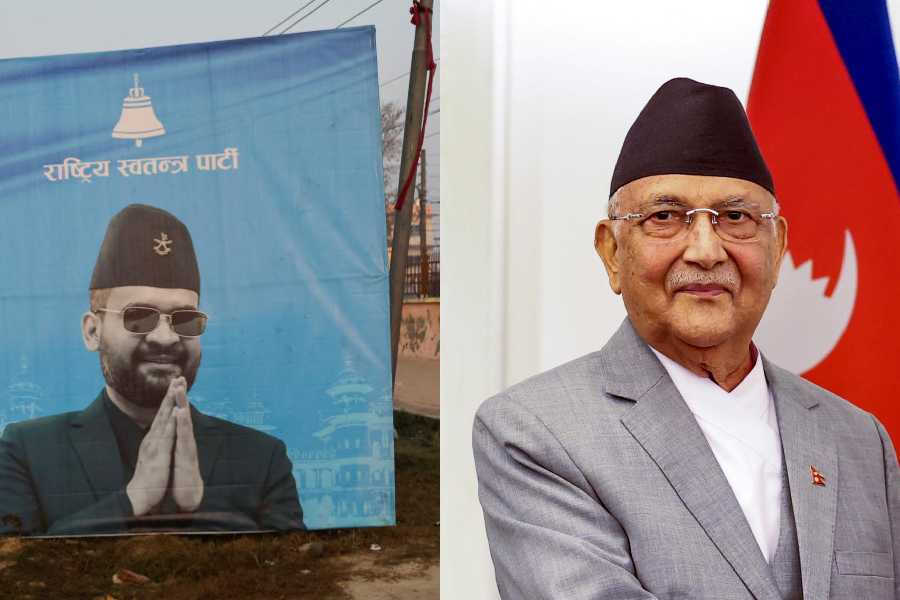
Adding to the generational contrast is Balendra Shah, 35 — popularly known as Balen — a rapper-turned-politician and former Kathmandu mayor, who has joined the Rastriya Swotantra Party.
Shah resigned on Sunday to contest the parliamentary election from Jhapa-5, where he will challenge Oli, who has represented the constituency six times over three decades.
The Gen Z youths have blamed then-prime minister Oli and the then-home minister Ramesh Lekhak from Nepali Congress for the excessive use of force to suppress their movement in September last year, in which 77 people lost their lives.
Oli, who has already taken oath as the prime minister four times, fled on an army helicopter in his last tenure on the second day of the Gen Z protests, as hundreds of angry protesters vandalised the prime minister's quarter at Baluwatar, Kathmandu.
"For Oli, who tactfully sidelined his opponents within the party and emerged as its unchallenged leader, the parliamentary election this time will not only be a tough challenge but can also threaten his over five-decade-long political career, given the growing popularity of his rival ex-Mayor Balen," said Saraswoti Karmacharya, senior journalist at Nepal Samacharpatra.
Other emerging candidates in the scenario are Ujyalo Nepal Party chairman Kulman Ghising, who ended 16 hours of loadshedding in Nepal as the Nepal Electricity Authority chief, and Harka Sampanga, mayor of Dharan Sub-metropolitan City.
Both Ghising and Sampang, representing the ethnic communities of Nepal, have also become popular choices for one or the other Gen Z groups.